







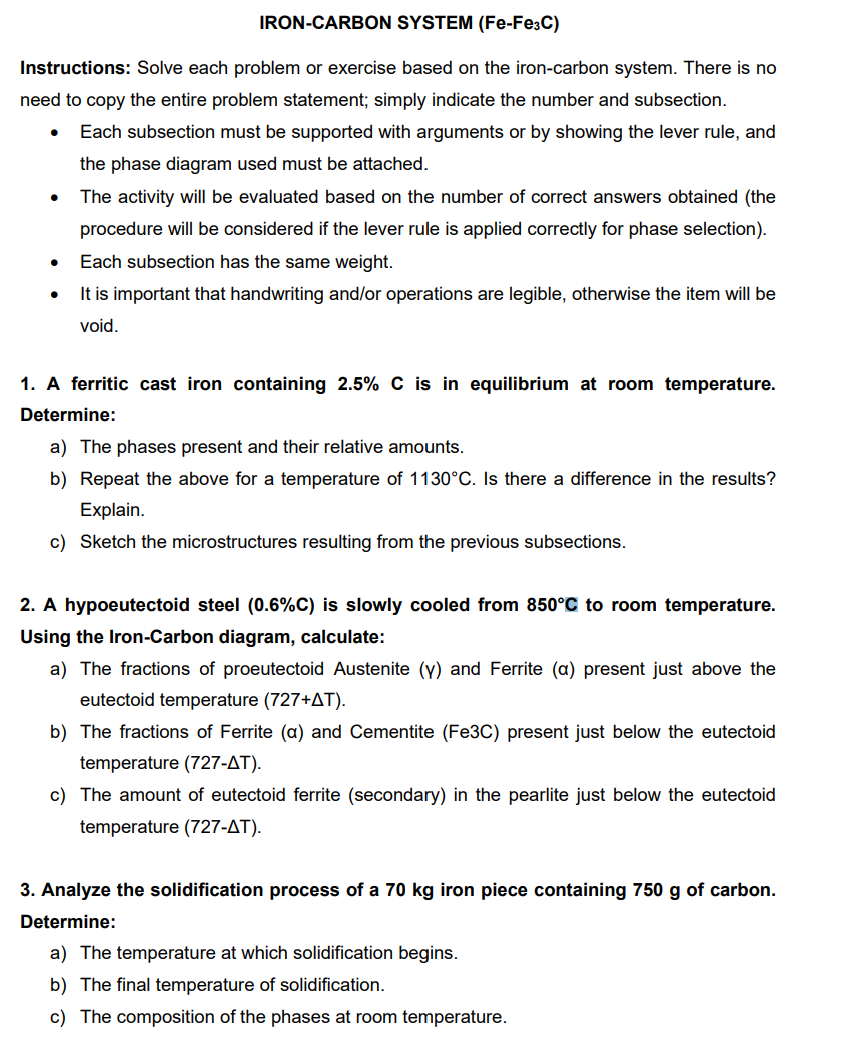
Question: Based on the IRON - CARBON SYSTEM ( Fe - Fe 3 C ) solve the following questions Instructions: Solve each problem or exercise based
Based on the IRONCARBON SYSTEM FeFe C solve the following questions
Instructions: Solve each problem or exercise based on the ironcarbon system. There is no
need to copy the entire problem statement; simply indicate the number and subsection.
Each subsection must be supported with arguments or by showing the lever rule, and
the phase diagram used must be attached.
The activity will be evaluated based on the number of correct answers obtained the
procedure will be considered if the lever rule is applied correctly for phase selection
Each subsection has the same weight.
It is important that handwriting andor operations are legible, otherwise the item will be
void.
A ferritic cast iron containing is in equilibrium at room temperature.
Determine:
a The phases present and their relative amounts.
b Repeat the above for a temperature of Is there a difference in the results?
Explain.
c Sketch the microstructures resulting from the previous subsections.
A hypoeutectoid steel is slowly cooled from to room temperature.
Using the IronCarbon diagram, calculate:
a The fractions of proeutectoid Austenite y and Ferrite present just above the
eutectoid temperature
b The fractions of Ferrite a and Cementite FeC present just below the eutectoid
temperature
c The amount of eutectoid ferrite secondary in the pearlite just below the eutectoid
temperature
Analyze the solidification process of a iron piece containing of carbon.
Determine:
a The temperature at which solidification begins.
b The final temperature of solidification.
c The composition of the phases at room temperature.
Step by Step Solution
There are 3 Steps involved in it
1 Expert Approved Answer
Step: 1 Unlock

Question Has Been Solved by an Expert!
Get step-by-step solutions from verified subject matter experts
Step: 2 Unlock
Step: 3 Unlock
 Study Help