







Question: Based on the pictures below can you please help with this question - Many historians have drawn important parallels between the Roman Empire and modern
Based on the pictures below can you please help with this question - Many historians have drawn important parallels between the Roman Empire and modern day America - in terms of political, social and economic/monetary circumstances. Identify and describe at least three of these parallels - including at least one monetary example.
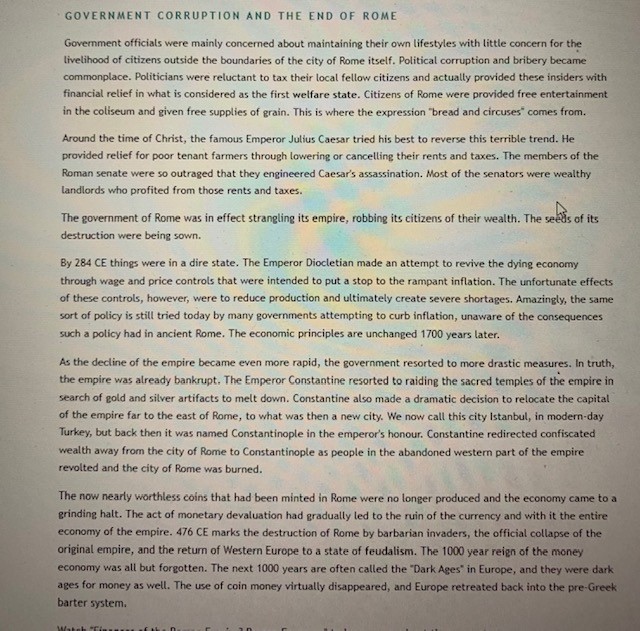
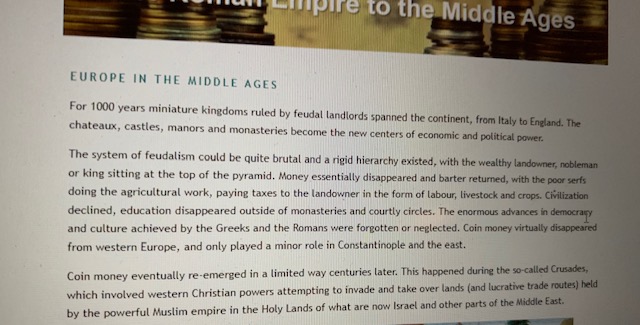
GOVERNMENT CORRUPTION AND THE END OF ROME Government officials were mainly concerned about maintaining their own lifestyles with little concern for the livelihood of citizens outside the boundaries of the city of Rome itself. Political corruption and bribery became commonplace. Politicians were reluctant to tax their local fellow citizens and actually provided these insiders with financial relief in what is considered as the first welfare state. Citizens of Rome were provided free entertainment in the coliseum and given free supplies of grain. This is where the expression "bread and circuses" comes from. Around the time of Christ, the famous Emperor Julius Caesar tried his best to reverse this terrible trend. He provided relief for poor tenant farmers through lowering or cancelling their rents and taxes. The members of the Roman senate were so outraged that they engineered Caesar's assassination. Most of the senators were wealthy landlords who profited from those rents and taxes. The government of Rome was in effect strangling its empire, robbing its citizens of their wealth. The seeds of its destruction were being sown. By 284 CE things were in a dire state. The Emperor Diocletian made an attempt to revive the dying economy through wage and price controls that were intended to put a stop to the rampant inflation. The unfortunate effects of these controls, however, were to reduce production and ultimately create severe shortages. Amazingly, the same sort of policy is still tried today by many governments attempting to curb inflation, unaware of the consequences such a policy had in ancient Rome. The economic principles are unchanged 1700 years later. As the decline of the empire became even more rapid, the government resorted to more drastic measures. In truth, the empire was already bankrupt. The Emperor Constantine resorted to raiding the sacred temples of the empire in search of gold and silver artifacts to melt down. Constantine also made a dramatic decision to relocate the capital of the empire far to the east of Rome, to what was then a new city. We now call this city Istanbul, in modern-day Turkey, but back then it was named Constantinople in the emperor's honour. Constantine redirected confiscated wealth away from the city of Rome to Constantinople as people in the abandoned western part of the empire revolted and the city of Rome was burned. The now nearly worthless coins that had been minted in Rome were no longer produced and the economy came to a grinding halt. The act of monetary devaluation had gradually led to the ruin of the currency and with it the entire economy of the empire. 476 CE marks the destruction of Rome by barbarian invaders, the official collapse of the original empire, and the return of Western Europe to a state of feudalism. The 1000 year reign of the money economy was all but forgotten. The next 1000 years are often called the "Dark Ages" in Europe, and they were dark ages for money as well. The use of coin money virtually disappeared, and Europe retreated back into the pre-Greek barter system.empire to the Middle Ages EUROPE IN THE MIDDLE AGES For 1000 years miniature kingdoms ruled by feudal landlords spanned the continent, from Italy to England. The chateaux, castles, manors and monasteries become the new centers of economic and political power. The system of feudalism could be quite brutal and a rigid hierarchy existed, with the wealthy landowner, nobleman or king sitting at the top of the pyramid. Money essentially disappeared and barter returned, with the poor serfs doing the agricultural work, paying taxes to the landowner in the form of labour, livestock and crops. Civilization declined, education disappeared outside of monasteries and courtly circles. The enormous advances in democracy and culture achieved by the Greeks and the Romans were forgotten or neglected. Coin money virtually disappeared from western Europe, and only played a minor role in Constantinople and the east. Coin money eventually re-emerged in a limited way centuries later. This happened during the so-called Crusades, which involved western Christian powers attempting to invade and take over lands (and lucrative trade routes) held by the powerful Muslim empire in the Holy Lands of what are now Israel and other parts of the Middle East
Step by Step Solution
There are 3 Steps involved in it

Get step-by-step solutions from verified subject matter experts
 Study Help