Question: Based on the text material and the case material, answer the following questions: Who are Publixs competitors and why would they be likely to take
Based on the text material and the case material, answer the following questions:
- Who are Publixs competitors and why would they be likely to take action against Publix?
- How do you think Publix could or should respond to competitor action?
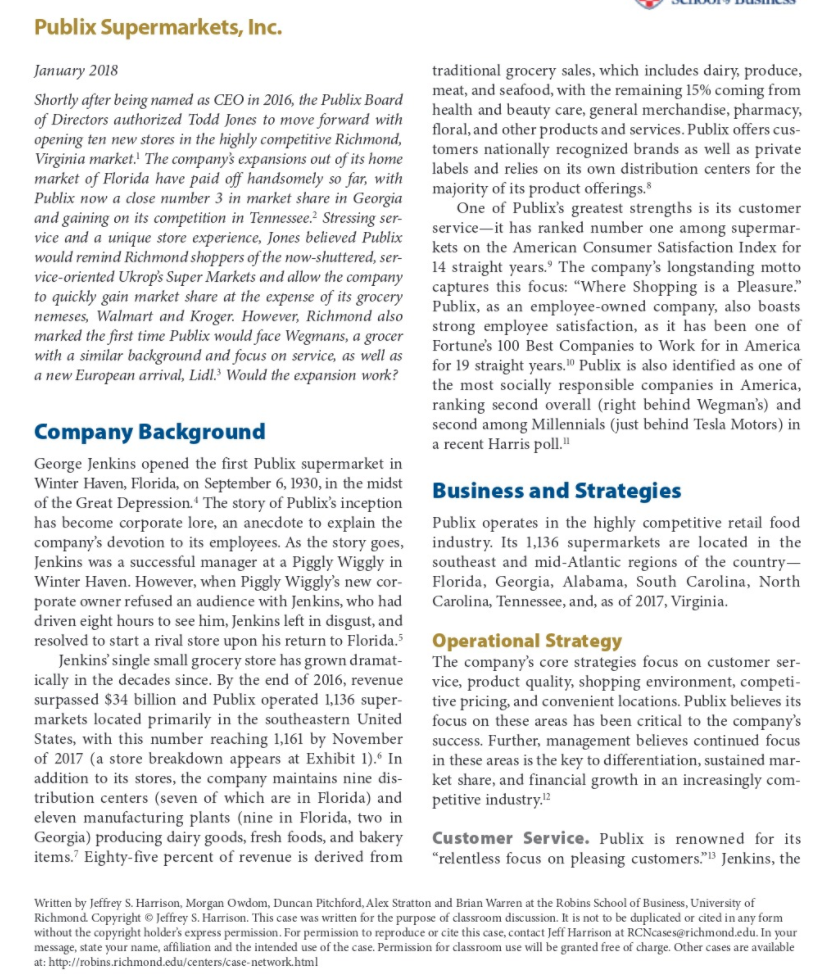
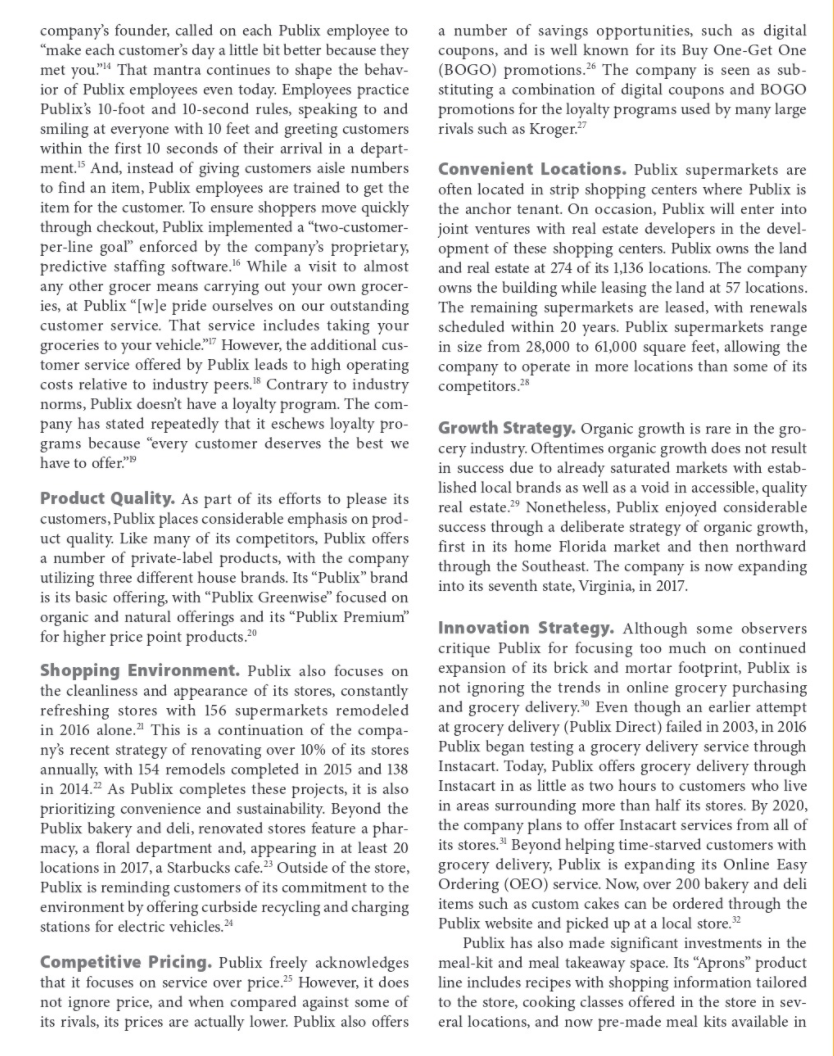
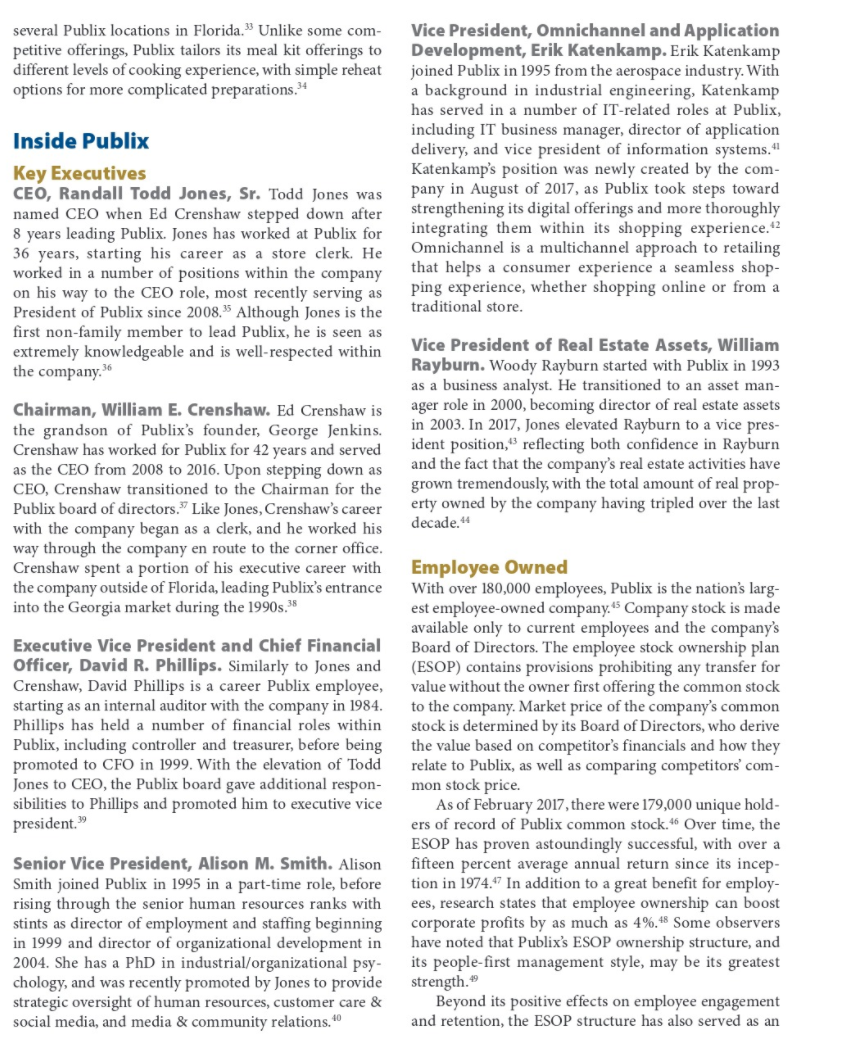
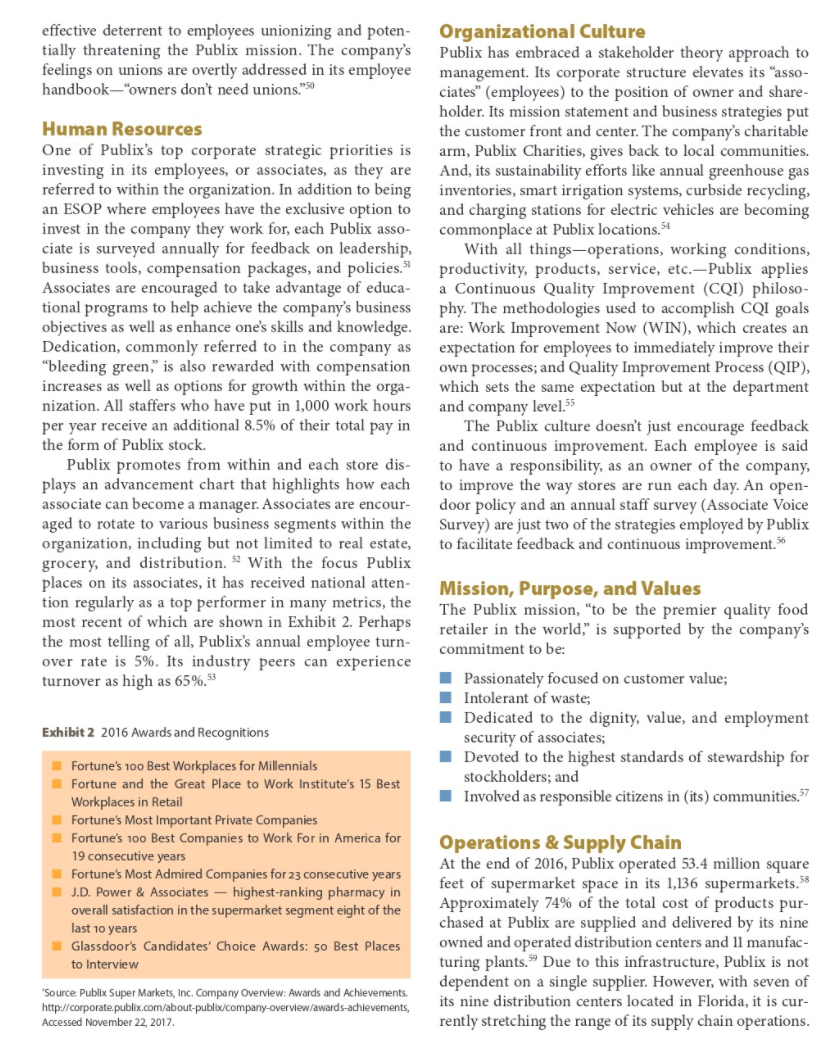
Publix Supermarkets, Inc. January 2018 Shortly after being named as CEO in 2016, the Publix Board of Directors authorized Todd Jones to move forward with opening ten new stores in the highly competitive Richmond, Virginia market. The company's expansions out of its home market of Florida have paid off handsomely so far, with Publix now a close number 3 in market share in Georgia and gaining on its competition in Tennessee. Stressing ser- vice and a unique store experience, Jones believed Publix would remind Richmond shoppers of the now-shuttered, ser- vice-oriented Ukrop's Super Markets and allow the company to quickly gain market share at the expense of its grocery nemeses, Walmart and Kroger. However, Richmond also marked the first time Publix would face Wegmans, a grocer with a similar background and focus on service, as well as a new European arrival, Lidl. Would the expansion work? traditional grocery sales, which includes dairy, produce, meat, and seafood, with the remaining 15% coming from health and beauty care, general merchandise, pharmacy, floral, and other products and services. Publix offers cus- tomers nationally recognized brands as well as private labels and relies on its own distribution centers for the majority of its product offerings. One of Publix's greatest strengths is its customer service-it has ranked number one among supermar- kets on the American Consumer Satisfaction Index for 14 straight years. The company's longstanding motto captures this focus: "Where Shopping is a Pleasure." Publix, as an employee-owned company, also boasts strong employee satisfaction, as it has been one of Fortune's 100 Best Companies to Work for in America for 19 straight years. Publix is also identified as one of the most socially responsible companies in America, ranking second overall (right behind Wegman's) and second among Millennials (just behind Tesla Motors) in a recent Harris poll." Business and Strategies Publix operates in the highly competitive retail food industry. Its 1,136 supermarkets are located in the southeast and mid-Atlantic regions of the country- Florida, Georgia, Alabama, South Carolina, North Carolina, Tennessee, and, as of 2017, Virginia. Company Background George Jenkins opened the first Publix supermarket in Winter Haven, Florida, on September 6, 1930, in the midst of the Great Depression. The story of Publix's inception has become corporate lore, an anecdote to explain the company's devotion to its employees. As the story goes, Jenkins was a successful manager at a Piggly Wiggly in Winter Haven. However, when Piggly Wiggly's new cor- porate owner refused an audience with Jenkins, who had driven eight hours to see him, Jenkins left in disgust, and resolved to start a rival store upon his return to Florida. Jenkins' single small grocery store has grown dramat- ically in the decades since. By the end of 2016, revenue surpassed $34 billion and Publix operated 1,136 super- markets located primarily in the southeastern United States, with this number reaching 1,161 by November of 2017 (a store breakdown appears at Exhibit 1). In addition to its stores, the company maintains nine dis- tribution centers (seven of which are in Florida) and eleven manufacturing plants (nine in Florida, two in Georgia) producing dairy goods, fresh foods, and bakery items.? Eighty-five percent of revenue is derived from Operational Strategy The company's core strategies focus on customer ser- vice, product quality, shopping environment, competi- tive pricing, and convenient locations. Publix believes its focus on these areas has been critical to the company's success. Further, management believes continued focus in these areas is the key to differentiation, sustained mar- ket share, and financial growth in an increasingly com- petitive industry.2 Customer Service. Publix is renowned for its "relentless focus on pleasing customers." 13 Jenkins, the Written by Jeffrey S. Harrison, Morgan Owdom, Duncan Pitchford, Alex Stratton and Brian Warren at the Robins School of Business, University of Richmond Copyright Jeffrey S. Harrison. This case was written for the purpose of classroom discussion. It is not to be duplicated or cited in any form without the copyright holder's express permission. For permission to reproduce or cite this case, contact Jeff Harrison at RCNcases@richmond.edu. In your message, state your name, affiliation and the intended use of the case. Permission for classroom use will be granted free of charge. Other cases are available at: http://robins.richmond.edu/centers/case-network.html a number of savings opportunities, such as digital coupons, and is well known for its Buy One-Get One (BOGO) promotions.26 The company is seen as sub- stituting a combination of digital coupons and BOGO promotions for the loyalty programs used by many large rivals such as Kroger. company's founder, called on each Publix employee to "make each customer's day a little bit better because they met you.That mantra continues to shape the behav- ior of Publix employees even today. Employees practice Publix's 10-foot and 10-second rules, speaking to and smiling at everyone with 10 feet and greeting customers within the first 10 seconds of their arrival in a depart- ment. And, instead of giving customers aisle numbers to find an item, Publix employees are trained to get the item for the customer. To ensure shoppers move quickly through checkout, Publix implemented a "two-customer- per-line goal enforced by the company's proprietary, predictive staffing software. While a visit to almost any other grocer means carrying out your own grocer- ies, at Publix "[w]e pride ourselves on our outstanding customer service. That service includes taking your groceries to your vehicle." However, the additional cus- tomer service offered by Publix leads to high operating costs relative to industry peers. Contrary to industry norms, Publix doesn't have a loyalty program. The com- pany has stated repeatedly that it eschews loyalty pro- grams because "every customer deserves the best we have to offer."19 Convenient Locations. Publix supermarkets are often located in strip shopping centers where Publix is the anchor tenant. On occasion, Publix will enter into joint ventures with real estate developers in the devel- opment of these shopping centers. Publix owns the land and real estate at 274 of its 1,136 locations. The company owns the building while leasing the land at 57 locations. The remaining supermarkets are leased, with renewals scheduled within 20 years. Publix supermarkets range in size from 28,000 to 61,000 square feet, allowing the company to operate in more locations than some of its competitors 28 Growth Strategy. Organic growth is rare in the gro- cery industry. Oftentimes organic growth does not result in success due to already saturated markets with estab- lished local brands as well as a void in accessible, quality real estate.29 Nonetheless, Publix enjoyed considerable success through a deliberate strategy of organic growth, first in its home Florida market and then northward through the Southeast. The company is now expanding into its seventh state, Virginia, in 2017. Product Quality. As part of its efforts to please its customers, Publix places considerable emphasis on prod- uct quality. Like many of its competitors, Publix offers a number of private label products, with the company utilizing three different house brands. Its "Publix brand is its basic offering, with "Publix Greenwise" focused on organic and natural offerings and its Publix Premium" for higher price point products.20 Shopping Environment. Publix also focuses on the cleanliness and appearance of its stores, constantly refreshing stores with 156 supermarkets remodeled in 2016 alone. This is a continuation of the compa- ny's recent strategy of renovating over 10% of its stores annually, with 154 remodels completed in 2015 and 138 in 2014.2 As Publix completes these projects, it is also prioritizing convenience and sustainability. Beyond the Publix bakery and deli, renovated stores feature a phar- macy, a floral department and, appearing in at least 20 locations in 2017, a Starbucks cafe.23 Outside of the store, Publix is reminding customers of its commitment to the environment by offering curbside recycling and charging stations for electric vehicles.24 Innovation Strategy. Although some observers critique Publix for focusing too much on continued expansion of its brick and mortar footprint, Publix is not ignoring the trends in online grocery purchasing and grocery delivery. Even though an earlier attempt at grocery delivery (Publix Direct) failed in 2003, in 2016 Publix began testing a grocery delivery service through Instacart. Today, Publix offers grocery delivery through Instacart in as little as two hours to customers who live in areas surrounding more than half its stores. By 2020, the company plans to offer Instacart services from all of its stores. Beyond helping time-starved customers with grocery delivery, Publix is expanding its Online Easy Ordering (OEO) service. Now, over 200 bakery and deli items such as custom cakes can be ordered through the Publix website and picked up at a local store.92 Publix has also made significant investments in the meal-kit and meal takeaway space. Its "Aprons product line includes recipes with shopping information tailored to the store, cooking classes offered in the store in sev- eral locations, and now pre-made meal kits available in Competitive Pricing. Publix freely acknowledges that it focuses on service over price.25 However, it does not ignore price, and when compared against some of its rivals, its prices are actually lower. Publix also offers several Publix locations in Florida. Unlike some com- petitive offerings, Publix tailors its meal kit offerings to different levels of cooking experience, with simple reheat options for more complicated preparations.94 Inside Publix Key Executives CEO, Randall Todd Jones, Sr. Todd Jones was named CEO when Ed Crenshaw stepped down after 8 years leading Publix. Jones has worked at Publix for 36 years, starting his career as a store clerk. He worked in a number of positions within the company on his way to the CEO role, most recently serving as President of Publix since 2008.95 Although Jones is the first non-family member to lead Publix, he is seen as extremely knowledgeable and is well-respected within the company. 36 Vice President, Omnichannel and Application Development, Erik Katenkamp. Erik Katenkamp joined Publix in 1995 from the aerospace industry. With a background in industrial engineering, Katenkamp has served in a number of IT-related roles at Publix, including IT business manager, director of application delivery, and vice president of information systems.41 Katenkamp's position was newly created by the com- pany in August of 2017, as Publix took steps toward strengthening its digital offerings and more thoroughly integrating them within its shopping experience.42 Omnichannel is a multichannel approach to retailing that helps a consumer experience a seamless shop- ping experience, whether shopping online or from a traditional store. Chairman, William E. Crenshaw. Ed Crenshaw is the grandson of Publix's founder, George Jenkins. Crenshaw has worked for Publix for 42 years and served as the CEO from 2008 to 2016. Upon stepping down as CEO, Crenshaw transitioned to the Chairman for the Publix board of directors." Like Jones, Crenshaw's career with the company began as a clerk, and he worked his way through the company en route to the corner office. Crenshaw spent a portion of his executive career with the company outside of Florida, leading Publix's entrance into the Georgia market during the 1990s.38 Vice President of Real Estate Assets, William Rayburn. Woody Rayburn started with Publix in 1993 as a business analyst. He transitioned to an asset man- ager role in 2000, becoming director of real estate assets in 2003. In 2017, Jones elevated Rayburn to a vice pres- ident position, reflecting both confidence in Rayburn and the fact that the company's real estate activities have grown tremendously, with the total amount of real prop- erty owned by the company having tripled over the last decade. 44 Executive Vice President and Chief Financial Officer, David R. Phillips. Similarly to Jones and Crenshaw, David Phillips is a career Publix employee, starting as an internal auditor with the company in 1984. Phillips has held a number of financial roles within Publix, including controller and treasurer, before being promoted to CFO in 1999. With the elevation of Todd Jones to CEO, the Publix board gave additional respon- sibilities to Phillips and promoted him to executive vice president. Employee Owned With over 180,000 employees, Publix is the nation's larg- est employee-owned company. Company stock is made available only to current employees and the company's Board of Directors. The employee stock ownership plan (ESOP) contains provisions prohibiting any transfer for value without the owner first offering the common stock to the company. Market price of the company's common stock is determined by its Board of Directors, who derive the value based on competitor's financials and how they relate to Publix, as well as comparing competitors' com- mon stock price. As of February 2017, there were 179,000 unique hold- ers of record of Publix common stock. 46 Over time, the ESOP has proven astoundingly successful, with over a fifteen percent average annual return since its incep- tion in 1974.7 In addition to a great benefit for employ- ees, research states that employee ownership can boost corporate profits by as much as 4%.48 Some observers have noted that Publix's ESOP ownership structure, and its people-first management style, may be its greatest strength." Beyond its positive effects on employee engagement and retention, the ESOP structure has also served as an Senior Vice President, Alison M. Smith. Alison Smith joined Publix in 1995 in a part-time role, before rising through the senior human resources ranks with stints as director of employment and staffing beginning in 1999 and director of organizational development in 2004. She has a PhD in industrial/organizational psy- chology, and was recently promoted by Jones to provide strategic oversight of human resources, customer care & social media, and media & community relations.0 effective deterrent to employees unionizing and poten- tially threatening the Publix mission. The company's feelings on unions are overtly addressed in its employee handbook-owners don't need unions."50 Human Resources One of Publix's top corporate strategic priorities is investing in its employees, or associates, as they are referred to within the organization. In addition to being an ESOP where employees have the exclusive option to invest in the company they work for, each Publix asso- ciate is surveyed annually for feedback on leadership, business tools, compensation packages, and policies." Associates are encouraged to take advantage of educa- tional programs to help achieve the company's business objectives as well as enhance one's skills and knowledge. Dedication, commonly referred to in the company as "bleeding green," is also rewarded with compensation increases as well as options for growth within the orga- nization. All staffers who have put in 1,000 work hours per year receive an additional 8.5% of their total pay in the form of Publix stock. Publix promotes from within and each store dis- plays an advancement chart that highlights how each associate can become a manager. Associates are encour- aged to rotate to various business segments within the organization, including but not limited to real estate, grocery, and distribution. 52 With the focus Publix places on its associates, it has received national atten- tion regularly as a top performer in many metrics, the most recent of which are shown in Exhibit 2. Perhaps the most telling of all, Publix's annual employee turn- over rate is 5%. Its industry peers can experience turnover as high as 65%.53 Organizational Culture Publix has embraced a stakeholder theory approach to management. Its corporate structure elevates its "asso- ciates" (employees) to the position of owner and share- holder. Its mission statement and business strategies put the customer front and center. The company's charitable arm, Publix Charities, gives back to local communities. And, its sustainability efforts like annual greenhouse gas inventories, smart irrigation systems, curbside recycling, and charging stations for electric vehicles are becoming commonplace at Publix locations. 54 With all things-operations, working conditions, productivity, products, service, etc.-Publix applies a Continuous Quality Improvement (CRI) philoso- phy. The methodologies used to accomplish CQI goals are: Work Improvement Now (WIN), which creates an expectation for employees to immediately improve their own processes; and Quality Improvement Process (QIP), which sets the same expectation but at the department and company level.55 The Publix culture doesn't just encourage feedback and continuous improvement. Each employee is said to have a responsibility, as an owner of the company, to improve the way stores are run each day. An open- door policy and an annual staff survey (Associate Voice Survey) are just two of the strategies employed by Publix to facilitate feedback and continuous improvement. Mission, Purpose, and Values The Publix mission, "to be the premier quality food retailer in the world," is supported by the company's commitment to be: Passionately focused on customer value; Intolerant of waste; Dedicated to the dignity, value, and employment security of associates; Devoted to the highest standards of stewardship for stockholders; and Involved as responsible citizens in (its) communities. 57 Exhibit 2 2016 Awards and Recognitions Fortune's 100 Best Workplaces for Millennials Fortune and the Great Place to Work Institute's 15 Best Workplaces in Retail Fortune's Most Important Private Companies Fortune's 100 Best Companies to Work For in America for 19 consecutive years Fortune's Most Admired Companies for 23 consecutive years J.D. Power & Associates highest-ranking pharmacy in overall satisfaction in the supermarket segment eight of the last 10 years Glassdoor's Candidates' Choice Awards: 50 Best Places to Interview Operations & Supply Chain At the end of 2016, Publix operated 53.4 million square feet of supermarket space in its 1,136 supermarkets.58 Approximately 74% of the total cost of products pur- chased at Publix are supplied and delivered by its nine owned and operated distribution centers and Il manufac- turing plants. Due to this infrastructure, Publix is not dependent on a single supplier. However, with seven of its nine distribution centers located in Florida, it is cur- rently stretching the range of its supply chain operations. "Source: Publix Super Markets, Inc. Company Overview: Awards and Achievements. http://corporate.publix.com/about-publix/company-overview/awards-achievements, Accessed November 22, 2017. Any further geographic expansion would require addi As of November 2017, Publix's Facebook site had tional distribution centers or a revisit of the company's nearly 2.8 million followers. 63 operations and supply chain strategy.co Financial Condition Marketing Over the past five years, Publix's revenue has grown Publix employs its own marketing team of around from $27.7 billion in 2012 to $34.3 billion in 2016, repre- 100 associates representing 50 different positions. senting a compound annual growth rate of 4.35%. Over When Publix enters a new state, its message does the same time period, net income has increase from not represent anything groundbreaking, but simply $1.55 billion to $2.03 billion, representing a compound attempts to relay its culture to its new market. In 2015, annual growth rate of 5.48%. Thus, not only are sales when Publix expanded into North Carolina, a spokes increasing, due to in-store year-over-year growth as well person stated, [o]ur message remains consistent in as store count increases, but net income is increasing at a connecting on an emotional level with our customer faster rate. COGS, gross margin, and SG&A as a percent and our potential customers, but sharing our cul of sales have remained fairly constant in the last three ture becomes more important. In newer markets, we years. Publix issued 4 quarterly dividend payments in highlight our Publix Guarantee more and promote 2016 totaling $0.8675 per share. Publix has always car- that we don't have a loyalty program-that every cus ried extremely low amounts of debt with its debt-to- tomer deserves the best we have to offer.62 The Publix equity ratio as low as 30% in 2016.64 Liquidity is not a Guarantee states We will never knowingly disappoint concern to Publix with an improving year-over-year you." The marketing team at Publix focuses on geo current ratio landing at 1.56 in 2016. Publix's income graphical areas of operation where Publix is expand statement and balance sheet for the past five years can ing its television, radio, and social media advertising. be found in Exhibits 3 and 4. Publix financial performance compares favor- ably with its peers. Publix prices its products slightly higher than Kroger, but lower than Whole Foods, indicated by the COGS and Gross Margin percent of sales metrics. Impressively, Publix's net income is approximately equal to that of Kroger even though its revenue is only 31% of its larger rival. The company's operating margin is the envy of its peer group, with it exceeding that of Kroger by almost 2.5 times, and nearly doubling that of Walmart. Key comparison data appears in Exhibit 5. The Industry Publix operates as a traditional grocery store, garnering the third-largest market share of any grocer (exclud- ing Walmart) in the United States.65 Historically, the industry contained a number of smaller companies, but recent years have seen consolidation and bankruptcies in the face of increasing competitive pressure. Since the economy rebounded consumers with higher dis- posable income moved back to purchasing premium, organic and all natural food brands, which helped to drive up overall industry revenue. As one observer noted, the grocery business isn't what it used to be" as a convergence of market forces bear down on tradi- tional grocers like Publix.68 An increasing number of competitors now chase the grocery dollar, and changes in how consumers shop and consume food loom large over the company. Major Competitors in the Richmond Market Kroger. Founded in 1883, Kroger is the largest grocery store chain in the United States 69 and the third-largest retailer in the world.70 Kroger operates behind its namesake brand as well as over 20 regional brands in 35 states. Kroger generated over $115 billion in revenue in 2016, as it came off of its first full year of owning Harris Teeter, a regional brand operating in the Carolinas.?! Historically a strong financial performer, Kroger has disappointed recently, with its stock down over 40% for 2017.72 While it has curtailed its expenditures on new stores," Kroger is investing aggressively in technologi- cal improvements, with the company operating its own data analytics unit and spending heavily on tools such as an infrared system allowing it to monitor checkout wait times and deploy additional clerks automatically in response. Kroger also recently launched its ClickList" service in a number of markets, where a customer can order groceries online and pick them up, curbside, at the stores Kroger is also the market leader in leveraging loyalty card data-over 97% of purchases are made by shoppers holding a loyalty card. Kroger uses this data to con- struct target offers, often by mailing coupons to specific customers. The company reports achieving redemption rates of up to 65% with some of these offers, compared to an industry average of roughly 5%." In addition to customer loyalty, Kroger also packs its newer stores with additional services, such as banking, a florist, or a Starbucks counter, which research data indicates helps the company fend off new market entrants and may decrease overall sales losses by up to 8%.78 Food Lion. Based in Salisbury, North Carolina, Food Lion operates over 1,000 grocery stores in 10 Southeastern and Mid-Atlantic states. They have over 63,000 employ- ees and serve about 10 million customers per week. in urban areas, Walmart also continues to invest in its Neighborhood Market stores, which are much smaller than its traditional Supercenter format, with the com- pany having now opened over 735 locations around the country.92 To date, however, Publix has successfully survived "the Goliath-like Walmart assault on its home market in Florida." The company has been operating since 1957, and its name was originally Food Town. In 1974 Food Lion was acquired by the Belgium-based Delhaize Group, which subsequently merged with Koninklijke Ahold, based in the Netherlands. Food Lion now operates as a part of Ahold Delhaize, which operates in 11 countries through 6,556 stores. Food Lion's slogan is Count on me and they offer a double money back guarantee if their food is not fresh. Like Kroger, they have a loyalty card program. They have about 28,000 products in each store, including approx- imately 7,000 store brands. Food Lion bases its mar- keting messages on low price and high quality, but in reality their prices are not particularly low nor is their quality higher than other stores. Their service quality is not higher than average either, and many of their stores are outdated. Basically, there is very little that differen- tiates Food Lion from other supermarkets in the areas where it operates, although there is a certain segment of customers that are loyal to the company based on family traditionthat is, they grew up with their families shop- ping at Food Lion. Walmart. No retailer can ignore Walmart. In 2016, Walmart generated over $486 billion in revenue, mak- ing it the largest retailer in the world. "I Walmart oper- ates over 4,600 stores across the United States, and its low-price model is in stark contrast to Publix. Although historically Publix has made a 40% higher profit on groceries than Walmart, in all but its home market of Florida, Walmart continues to command a higher market share of grocery shoppers.85 Walmart leverages its enor- mous scale to exert pricing power over its suppliers, passing the resulting savings onto consumers.86 While Walmart may have been the original dis- rupter to the grocery marketplace, Walmart executives acknowledge that "[t]here's never been a more disruptive time in the history of retail."7 Like Kroger, Walmart is not standing still; it has pursued a number of acquisi- tions in the online space (including acquiring the online marketplace jet.com) to bolster its digital presence.88 Walmart also recently entered into a partnership with Google, where visitors to Google's online shopping por- tal can make purchases from Walmart. As with Kroger's ClickList, Walmart shoppers can now make grocery purchases online and pick them up at hundreds of its locations. Leveraging its large store footprint, and infa- mous logistics prowess, Walmart now offers pickup dis- counts to online shoppers who are willing to pick up items at a nearby Walmart store." To further its growth Aldi/Lidl. Aldi began shortly after World War II in Germany, near the city of Essen. Offering just 250 basic grocery items, the company swiftly established itself as a leader in the German grocery market." Today, where Walmart may carry 120,000 different items in one of its Supercenters, Aldi stocks between 1,300 and 1,600.9 This dramatically reduces complexity, and costs, allowing Aldi to undercut Walmart by 17% on a basket of 30 typ- ical household items. Aldi has operated in the United States since the 1970s, quietly building up a network of 1,600 stores in 35 states, but recently announced it would build another 900 stores over the next five years. This follows its decision to invest over $1.6 billion in renovat- ing its existing stores. 98 Lidl, founded several decades later in 1973, also pursues a similarly ruthlessly efficient approach to the grocery business as its German compatriot. When it entered the U.K. market in 1994, Lidl upended its gro- cery sector. Today, Lidl commands 5.2% of the British market and growing). Lidl opened its first U.S. stores in Virginia, North Carolina, and South Carolina, and promises its prices in the United States will be up to 50% lower than its competitors (excluding Aldi).102 Although cutthroat competitors in their home mar- ket of Germany and in the U.K., Aldi and Lidl have at least one thing in common-they ignore the Internet "almost entirely."103 Both see online sales as self-canni- balizing, moving from a proven, high-profit channel (physical stores) to an unproven, less-profitable chan- nel (online). U.K. observers estimate that its traditional grocers (such as Tesco and Sainsbury's) make less than a fifth of their already-slim typical margin on online sales.104 Indeed, Morgan Stanley estimates that for a tra- ditional retailer, every percentage-point increase in its e-commerce sales equates to a half a point contraction in the retailer's margins.165 The companies also share a fervor for private-label goods, shunning well-known brands in favor of their own products. The typical Aldi or Lidl store contains up to 90% private-label goods.1 By limiting stocks of name brand items, the German rivals can extract even greater supplier concessions than the notoriously feet nearly doubling that of the largest Publix.22 Only opening 3-4 new stores per year,123 Wegman's average per-store sales of almost $90 million is three times the average per-store sales of Publix. 124 External Environment/Trends Too Many Stores? In addition to a number of strong competitors in the marketplace, broader market trends are buffeting the grocery market. Less than half of gro- cery shoppers now do their food shopping at one pri- mary supermarket. 125 In 2016, convenience stores sold $73 billion of prepared foods, beverages and other food services, up 72% from 2010.126 Two-thirds of sales at dollar stores (Dollar General, Family Dollar, and others) are food, beverages, and other consumables.127 Grocery shoppers are also visiting alternatives like farmer's markets, and buying fewer items per trip. 128 Given this selection of alternative brick and mortar locations for grocery purchases, little surprise that Barclays now says that 38 of the top 50 grocery markets in the United States are too saturated by food retail on a per capita basis.. With numerous large competitors, Richmond may be one of these over-saturated markets. aggressive Walmart.107 Nevertheless, they put signif- icant efforts into quality. Aldi in particular has been successful in positioning itself as offering high-quality, value-priced private-label products.108 Whole Foods. If Aldi and Lidl form one bracket of the brick and mortar grocery market, Whole Foods forms the other. Derisively referred to as "Whole Paycheck for its pricing structure,109 Whole Foods nonetheless grew rapidly from its founding in Texas in 1980.110 It built a strong following as a purveyor of natural and organic foods, developing a cachet among affluent urbanites willing to pay for these offerings and a unique shopping experience. Whole Foods stores contain well-trained staff and offer a number of ser- vices, including prepared meals, wine bars, and other similar amenities. However, like the low-price German chains, Whole Foods developed a robust private label brand (365 Everyday Value) which consumers identi- fied as offering high quality. 12 Nonetheless, recently Whole Foods found itself under pressure from Walmart, Kroger, and others such as Publix. Kroger in particular began aggressively expanding its organic offerings, with the large chain sell- ing more organic and natural products ($16 billion)"13 than Whole Foods total sales in 2016.14 With Whole Foods weakened, in a move seen as upending the U.S. grocery market, Amazon stepped in and acquired the chain in 2017.115 Amazon immediately moved to lower prices on a number of Whole Foods items, and made available through its powerful website Whole Foods' 365 Everyday Value products. 16 Whole Foods locations provide Amazon an existing supply chain and over 450 brick and mortar locations where it can sell Amazon products as well as provide for pickup of online grocery orders." Amazon gives Whole Foods the strength of a $140 billion/year retailer with a CEO in pursuit of fully integrating Amazon into the lives of its customers. 118 Wegman's. Any discussion of Publix almost inevitably involves a comparison to Wegman's, the Northeastern powerhouse based near Rochester, New York. Like Publix, Wegman's is a member of Fortune's Great Places to Work Legends, having been named to the list for 20 years in a row. It is privately held, focused on service and pays its employees far above the industry standard for grocers. And the two are alike in another key aspect--they are both on the march, expanding their geographic reach and colliding in the Virginia market.121 Unlike Publix, however, Wegman's relies upon a much smaller num- ber of stores, with its typical store size of 120,000 square To Cook or Not to Cook? Unfortunately for tradi- tional grocers, many consumers today do not cook at home. Millennials, the largest consumer demographic group, spend 42% of their monthly food budget on food prepared outside the home.!Grocery spending by Millennials is $1,000 less per year (adjusted for infla- tion) than their parents spent in 1990. Older consum- ers, who no longer have a need to prepare a large family meal, are following Millennials in seeking out prepared foods.132 Online prepared meal kits, available from companies such as Blue Apron and Plated, have been enjoying robust growth, with some 24% of Millennials having subscribed to a meal kit service at some point and growth estimated at over 25% per year over the next five years.33 Albertsons, the large privately held grocery chain based in Idaho, recently announced a deal to purchase Plated, and Amazon has launched its own kit service and plans to make available Whole Foods-branded kits as part of its acquisition of the organic grocer.134 120 Omnichannel/Online. Online grocery sales have grown 10.1% over the last five years and are expected to grow at a rate of 6.7% over the next five, with total sales predicted to reach $13.5 billion in 2017.135 Amazon's move to acquire Whole Foods is not the only digital impact on traditional grocers. While the potential for Amazon to disrupt the market is seen as high (almost anyone that sells groceries saw its stock fall on the date Amazon announced the deal, with Kroger leading the path downward at a 9.2% clip),136 potentially just as disruptive is the integration of online ordering and mobile apps into grocery shop- ping. Kroger's in-house analytics team is building a mobile application that will populate a shopping list, together with locations in the store, from a user's rec- ipe. 137 Both Walmart (through its Sam's Club division) and Kroger are piloting mobile applications that allow shoppers to scan items as they move through the store, paying through the app as they exit.138 And, as noted above, both are growing the number of locations that provide curbside pickup of online orders, a potentially savvy move as market research suggests that 76% of online shoppers have an interest in picking up grocery items bought online. 139 In addition to online sales picked up at traditional stores, a number of online platforms and delivery ser- vices exist. Peapod, owned by the Dutch grocery giant Ahold Delhaize, counts 350,000 customers in 23 major metropolitan markets.140 Instacart, an online grocery delivery service, has recently agreed to partnerships with Kroger, Costco, and several smaller regional chains.141 Shipt, another last-mile online provider, announced plans to be in over 100 markets by the end of the year, concentrating in the south and Midwest, delivering for companies such as Costco and Meijer. 142 Healthiness/Better-For-You. The success of Whole Foods, and the growing importance of organics and natural goods to other grocery chains highlight shift- ing consumer preference toward grocery items seen as more healthful (Kroger reports that 14% of its total sales in 2016 were for its "Simple Truth line of organic and natural products).14 Health-oriented markets like Whole Foods, Trader Joe's, Earth Fare and Sprouts Farmers Market have made inroads into the Florida grocery market, largely at the expense of Publix.147 Survey data suggests customers continue to demand a greater variety of all-natural and organic products, with 82% of house- holds purchasing organic products in 2016.148 Organic products expanded 8.4% in 2016 alone. Perhaps more importantly, with consumers willing to pay a premium for such products, they have at least prior to Amazon's recent price cuts at Whole Foods) delivered consistently higher margins for retailers. 150 U.S. Economy. By December 2017, the economy had rebounded from the Great Recession and the stock markets were hitting all-time highs weekly. Real per capita disposable personal income (measured in con- stant 2009 dollars) had increased from $36,235 in January 2013 to $39,368 in May of 2017.103 The United States was experiencing sustained economic growth it had not seen in years and the country's gross domes- tic product had increased by an average of 2.1% over the past eight years, marking the third-longest eco- nomic expansion in U.S. history.'44 While many econ- omists and financial analysts were optimistic abou the direction of the economy, an increasing num- ber were becoming concerned that such continued growth was unsustainable. More and more analysts were beginning to question economic fundamentals, and with stocks trading at a multiple of earnings only previously seen in 1929 and 2000, some feel a market correction is looming.145 Looking Forward Publix continues to enjoy growth in sales, a healthy gross margin and strong financial The co pany is confident that its steady northward geographic expansion will continue supporting long-term growth for Publix. However, the highly competitive situation the company now faces in Richmond Virginia may be indicative of things to come. Wegmans, Lidl and Aldi very recently entered this market, and Kroger, Walmart, Food Lion and Whole Foods already have a significant presence. The continued expansion of Aldi and Lidl will put considerable price pressure on everyone in the Southeastern grocery market. So the over-saturation Publix is facing in Richmond is, in a sense, a good test case for what the company is likely to experience from now on in many or most of its markets. Faced with these sorts of challenges, can the compa- ny's labor-intensive, service-first, real estate heavy model continue to support growth in the future? Will custom- ers migrate towards costs savings wherever they may be found, whether at a brick-and-mortar competitor or online? Will Publix's partnership strategy with Instacart low it to meet the online challenge? Does the company need to increase investment in its Aprons meal kit and prepared foods or should it focus more on expanding higher margin private label products and organic offer- ings? Should Publix abandon its long-standing aversion to a loyalty program? Basically, how can Publix position itself for continued growth when faced with this chal- lenging business environment? Publix Supermarkets, Inc. January 2018 Shortly after being named as CEO in 2016, the Publix Board of Directors authorized Todd Jones to move forward with opening ten new stores in the highly competitive Richmond, Virginia market. The company's expansions out of its home market of Florida have paid off handsomely so far, with Publix now a close number 3 in market share in Georgia and gaining on its competition in Tennessee. Stressing ser- vice and a unique store experience, Jones believed Publix would remind Richmond shoppers of the now-shuttered, ser- vice-oriented Ukrop's Super Markets and allow the company to quickly gain market share at the expense of its grocery nemeses, Walmart and Kroger. However, Richmond also marked the first time Publix would face Wegmans, a grocer with a similar background and focus on service, as well as a new European arrival, Lidl. Would the expansion work? traditional grocery sales, which includes dairy, produce, meat, and seafood, with the remaining 15% coming from health and beauty care, general merchandise, pharmacy, floral, and other products and services. Publix offers cus- tomers nationally recognized brands as well as private labels and relies on its own distribution centers for the majority of its product offerings. One of Publix's greatest strengths is its customer service-it has ranked number one among supermar- kets on the American Consumer Satisfaction Index for 14 straight years. The company's longstanding motto captures this focus: "Where Shopping is a Pleasure." Publix, as an employee-owned company, also boasts strong employee satisfaction, as it has been one of Fortune's 100 Best Companies to Work for in America for 19 straight years. Publix is also identified as one of the most socially responsible companies in America, ranking second overall (right behind Wegman's) and second among Millennials (just behind Tesla Motors) in a recent Harris poll." Business and Strategies Publix operates in the highly competitive retail food industry. Its 1,136 supermarkets are located in the southeast and mid-Atlantic regions of the country- Florida, Georgia, Alabama, South Carolina, North Carolina, Tennessee, and, as of 2017, Virginia. Company Background George Jenkins opened the first Publix supermarket in Winter Haven, Florida, on September 6, 1930, in the midst of the Great Depression. The story of Publix's inception has become corporate lore, an anecdote to explain the company's devotion to its employees. As the story goes, Jenkins was a successful manager at a Piggly Wiggly in Winter Haven. However, when Piggly Wiggly's new cor- porate owner refused an audience with Jenkins, who had driven eight hours to see him, Jenkins left in disgust, and resolved to start a rival store upon his return to Florida. Jenkins' single small grocery store has grown dramat- ically in the decades since. By the end of 2016, revenue surpassed $34 billion and Publix operated 1,136 super- markets located primarily in the southeastern United States, with this number reaching 1,161 by November of 2017 (a store breakdown appears at Exhibit 1). In addition to its stores, the company maintains nine dis- tribution centers (seven of which are in Florida) and eleven manufacturing plants (nine in Florida, two in Georgia) producing dairy goods, fresh foods, and bakery items.? Eighty-five percent of revenue is derived from Operational Strategy The company's core strategies focus on customer ser- vice, product quality, shopping environment, competi- tive pricing, and convenient locations. Publix believes its focus on these areas has been critical to the company's success. Further, management believes continued focus in these areas is the key to differentiation, sustained mar- ket share, and financial growth in an increasingly com- petitive industry.2 Customer Service. Publix is renowned for its "relentless focus on pleasing customers." 13 Jenkins, the Written by Jeffrey S. Harrison, Morgan Owdom, Duncan Pitchford, Alex Stratton and Brian Warren at the Robins School of Business, University of Richmond Copyright Jeffrey S. Harrison. This case was written for the purpose of classroom discussion. It is not to be duplicated or cited in any form without the copyright holder's express permission. For permission to reproduce or cite this case, contact Jeff Harrison at RCNcases@richmond.edu. In your message, state your name, affiliation and the intended use of the case. Permission for classroom use will be granted free of charge. Other cases are available at: http://robins.richmond.edu/centers/case-network.html a number of savings opportunities, such as digital coupons, and is well known for its Buy One-Get One (BOGO) promotions.26 The company is seen as sub- stituting a combination of digital coupons and BOGO promotions for the loyalty programs used by many large rivals such as Kroger. company's founder, called on each Publix employee to "make each customer's day a little bit better because they met you.That mantra continues to shape the behav- ior of Publix employees even today. Employees practice Publix's 10-foot and 10-second rules, speaking to and smiling at everyone with 10 feet and greeting customers within the first 10 seconds of their arrival in a depart- ment. And, instead of giving customers aisle numbers to find an item, Publix employees are trained to get the item for the customer. To ensure shoppers move quickly through checkout, Publix implemented a "two-customer- per-line goal enforced by the company's proprietary, predictive staffing software. While a visit to almost any other grocer means carrying out your own grocer- ies, at Publix "[w]e pride ourselves on our outstanding customer service. That service includes taking your groceries to your vehicle." However, the additional cus- tomer service offered by Publix leads to high operating costs relative to industry peers. Contrary to industry norms, Publix doesn't have a loyalty program. The com- pany has stated repeatedly that it eschews loyalty pro- grams because "every customer deserves the best we have to offer."19 Convenient Locations. Publix supermarkets are often located in strip shopping centers where Publix is the anchor tenant. On occasion, Publix will enter into joint ventures with real estate developers in the devel- opment of these shopping centers. Publix owns the land and real estate at 274 of its 1,136 locations. The company owns the building while leasing the land at 57 locations. The remaining supermarkets are leased, with renewals scheduled within 20 years. Publix supermarkets range in size from 28,000 to 61,000 square feet, allowing the company to operate in more locations than some of its competitors 28 Growth Strategy. Organic growth is rare in the gro- cery industry. Oftentimes organic growth does not result in success due to already saturated markets with estab- lished local brands as well as a void in accessible, quality real estate.29 Nonetheless, Publix enjoyed considerable success through a deliberate strategy of organic growth, first in its home Florida market and then northward through the Southeast. The company is now expanding into its seventh state, Virginia, in 2017. Product Quality. As part of its efforts to please its customers, Publix places considerable emphasis on prod- uct quality. Like many of its competitors, Publix offers a number of private label products, with the company utilizing three different house brands. Its "Publix brand is its basic offering, with "Publix Greenwise" focused on organic and natural offerings and its Publix Premium" for higher price point products.20 Shopping Environment. Publix also focuses on the cleanliness and appearance of its stores, constantly refreshing stores with 156 supermarkets remodeled in 2016 alone. This is a continuation of the compa- ny's recent strategy of renovating over 10% of its stores annually, with 154 remodels completed in 2015 and 138 in 2014.2 As Publix completes these projects, it is also prioritizing convenience and sustainability. Beyond the Publix bakery and deli, renovated stores feature a phar- macy, a floral department and, appearing in at least 20 locations in 2017, a Starbucks cafe.23 Outside of the store, Publix is reminding customers of its commitment to the environment by offering curbside recycling and charging stations for electric vehicles.24 Innovation Strategy. Although some observers critique Publix for focusing too much on continued expansion of its brick and mortar footprint, Publix is not ignoring the trends in online grocery purchasing and grocery delivery. Even though an earlier attempt at grocery delivery (Publix Direct) failed in 2003, in 2016 Publix began testing a grocery delivery service through Instacart. Today, Publix offers grocery delivery through Instacart in as little as two hours to customers who live in areas surrounding more than half its stores. By 2020, the company plans to offer Instacart services from all of its stores. Beyond helping time-starved customers with grocery delivery, Publix is expanding its Online Easy Ordering (OEO) service. Now, over 200 bakery and deli items such as custom cakes can be ordered through the Publix website and picked up at a local store.92 Publix has also made significant investments in the meal-kit and meal takeaway space. Its "Aprons product line includes recipes with shopping information tailored to the store, cooking classes offered in the store in sev- eral locations, and now pre-made meal kits available in Competitive Pricing. Publix freely acknowledges that it focuses on service over price.25 However, it does not ignore price, and when compared against some of its rivals, its prices are actually lower. Publix also offers several Publix locations in Florida. Unlike some com- petitive offerings, Publix tailors its meal kit offerings to different levels of cooking experience, with simple reheat options for more complicated preparations.94 Inside Publix Key Executives CEO, Randall Todd Jones, Sr. Todd Jones was named CEO when Ed Crenshaw stepped down after 8 years leading Publix. Jones has worked at Publix for 36 years, starting his career as a store clerk. He worked in a number of positions within the company on his way to the CEO role, most recently serving as President of Publix since 2008.95 Although Jones is the first non-family member to lead Publix, he is seen as extremely knowledgeable and is well-respected within the company. 36 Vice President, Omnichannel and Application Development, Erik Katenkamp. Erik Katenkamp joined Publix in 1995 from the aerospace industry. With a background in industrial engineering, Katenkamp has served in a number of IT-related roles at Publix, including IT business manager, director of application delivery, and vice president of information systems.41 Katenkamp's position was newly created by the com- pany in August of 2017, as Publix took steps toward strengthening its digital offerings and more thoroughly integrating them within its shopping experience.42 Omnichannel is a multichannel approach to retailing that helps a consumer experience a seamless shop- ping experience, whether shopping online or from a traditional store. Chairman, William E. Crenshaw. Ed Crenshaw is the grandson of Publix's founder, George Jenkins. Crenshaw has worked for Publix for 42 years and served as the CEO from 2008 to 2016. Upon stepping down as CEO, Crenshaw transitioned to the Chairman for the Publix board of directors." Like Jones, Crenshaw's career with the company began as a clerk, and he worked his way through the company en route to the corner office. Crenshaw spent a portion of his executive career with the company outside of Florida, leading Publix's entrance into the Georgia market during the 1990s.38 Vice President of Real Estate Assets, William Rayburn. Woody Rayburn started with Publix in 1993 as a business analyst. He transitioned to an asset man- ager role in 2000, becoming director of real estate assets in 2003. In 2017, Jones elevated Rayburn to a vice pres- ident position, reflecting both confidence in Rayburn and the fact that the company's real estate activities have grown tremendously, with the total amount of real prop- erty owned by the company having tripled over the last decade. 44 Executive Vice President and Chief Financial Officer, David R. Phillips. Similarly to Jones and Crenshaw, David Phillips is a career Publix employee, starting as an internal auditor with the company in 1984. Phillips has held a number of financial roles within Publix, including controller and treasurer, before being promoted to CFO in 1999. With the elevation of Todd Jones to CEO, the Publix board gave additional respon- sibilities to Phillips and promoted him to executive vice president. Employee Owned With over 180,000 employees, Publix is the nation's larg- est employee-owned company. Company stock is made available only to current employees and the company's Board of Directors. The employee stock ownership plan (ESOP) contains provisions prohibiting any transfer for value without the owner first offering the common stock to the company. Market price of the company's common stock is determined by its Board of Directors, who derive the value based on competitor's financials and how they relate to Publix, as well as comparing competitors' com- mon stock price. As of February 2017, there were 179,000 unique hold- ers of record of Publix common stock. 46 Over time, the ESOP has proven astoundingly successful, with over a fifteen percent average annual return since its incep- tion in 1974.7 In addition to a great benefit for employ- ees, research states that employee ownership can boost corporate profits by as much as 4%.48 Some observers have noted that Publix's ESOP ownership structure, and its people-first management style, may be its greatest strength." Beyond its positive effects on employee engagement and retention, the ESOP structure has also served as an Senior Vice President, Alison M. Smith. Alison Smith joined Publix in 1995 in a part-time role, before rising through the senior human resources ranks with stints as director of employment and staffing beginning in 1999 and director of organizational development in 2004. She has a PhD in industrial/organizational psy- chology, and was recently promoted by Jones to provide strategic oversight of human resources, customer care & social media, and media & community relations.0 effective deterrent to employees unionizing and poten- tially threatening the Publix mission. The company's feelings on unions are overtly addressed in its employee handbook-owners don't need unions."50 Human Resources One of Publix's top corporate strategic priorities is investing in its employees, or associates, as they are referred to within the organization. In addition to being an ESOP where employees have the exclusive option to invest in the company they work for, each Publix asso- ciate is surveyed annually for feedback on leadership, business tools, compensation packages, and policies." Associates are encouraged to take advantage of educa- tional programs to help achieve the company's business objectives as well as enhance one's skills and knowledge. Dedication, commonly referred to in the company as "bleeding green," is also rewarded with compensation increases as well as options for growth within the orga- nization. All staffers who have put in 1,000 work hours per year receive an additional 8.5% of their total pay in the form of Publix stock. Publix promotes from within and each store dis- plays an advancement chart that highlights how each associate can become a manager. Associates are encour- aged to rotate to various business segments within the organization, including but not limited to real estate, grocery, and distribution. 52 With the focus Publix places on its associates, it has received national atten- tion regularly as a top performer in many metrics, the most recent of which are shown in Exhibit 2. Perhaps the most telling of all, Publix's annual employee turn- over rate is 5%. Its industry peers can experience turnover as high as 65%.53 Organizational Culture Publix has embraced a stakeholder theory approach to management. Its corporate structure elevates its "asso- ciates" (employees) to the position of owner and share- holder. Its mission statement and business strategies put the customer front and center. The company's charitable arm, Publix Charities, gives back to local communities. And, its sustainability efforts like annual greenhouse gas inventories, smart irrigation systems, curbside recycling, and charging stations for electric vehicles are becoming commonplace at Publix locations. 54 With all things-operations, working conditions, productivity, products, service, etc.-Publix applies a Continuous Quality Improvement (CRI) philoso- phy. The methodologies used to accomplish CQI goals are: Work Improvement Now (WIN), which creates an expectation for employees to immediately improve their own processes; and Quality Improvement Process (QIP), which sets the same expectation but at the department and company level.55 The Publix culture doesn't just encourage feedback and continuous improvement. Each employee is said to have a responsibility, as an owner of the company, to improve the way stores are run each day. An open- door policy and an annual staff survey (Associate Voice Survey) are just two of the strategies employed by Publix to facilitate feedback and continuous improvement. Mission, Purpose, and Values The Publix mission, "to be the premier quality food retailer in the world," is supported by the company's commitment to be: Passionately focused on customer value; Intolerant of waste; Dedicated to the dignity, value, and employment security of associates; Devoted to the highest standards of stewardship for stockholders; and Involved as responsible citizens in (its) communities. 57 Exhibit 2 2016 Awards and Recognitions Fortune's 100 Best Workplaces for Millennials Fortune and the Great Place to Work Institute's 15 Best Workplaces in Retail Fortune's Most Important Private Companies Fortune's 100 Best Companies to Work For in America for 19 consecutive years Fortune's Most Admired Companies for 23 consecutive years J.D. Power & Associates highest-ranking pharmacy in overall satisfaction in the supermarket segment eight of the last 10 years Glassdoor's Candidates' Choice Awards: 50 Best Places to Interview Operations & Supply Chain At the end of 2016, Publix operated 53.4 million square feet of supermarket space in its 1,136 supermarkets.58 Approximately 74% of the total cost of products pur- chased at Publix are supplied and delivered by its nine owned and operated distribution centers and Il manufac- turing plants. Due to this infrastructure, Publix is not dependent on a single supplier. However, with seven of its nine distribution centers located in Florida, it is cur- rently stretching the range of its supply chain operations. "Source: Publix Super Markets, Inc. Company Overview: Awards and Achievements. http://corporate.publix.com/about-publix/company-overview/awards-achievements, Accessed November 22, 2017. Any further geographic expansion would require addi As of November 2017, Publix's Facebook site had tional distribution centers or a revisit of the company's nearly 2.8 million followers. 63 operations and supply chain strategy.co Financial Condition Marketing Over the past five years, Publix's revenue has grown Publix employs its own marketing team of around from $27.7 billion in 2012 to $34.3 billion in 2016, repre- 100 associates representing 50 different positions. senting a compound annual growth rate of 4.35%. Over When Publix enters a new state, its message does the same time period, net income has increase from not represent anything groundbreaking, but simply $1.55 billion to $2.03 billion, representing a compound attempts to relay its culture to its new market. In 2015, annual growth rate of 5.48%. Thus, not only are sales when Publix expanded into North Carolina, a spokes increasing, due to in-store year-over-year growth as well person stated, [o]ur message remains consistent in as store count increases, but net income is increasing at a connecting on an emotional level with our customer faster rate. COGS, gross margin, and SG&A as a percent and our potential customers, but sharing our cul of sales have remained fairly constant in the last three ture becomes more important. In newer markets, we years. Publix issued 4 quarterly dividend payments in highlight our Publix Guarantee more and promote 2016 totaling $0.8675 per share. Publix has always car- that we don't have a loyalty program-that every cus ried extremely low amounts of debt with its debt-to- tomer deserves the best we have to offer.62 The Publix equity ratio as low as 30% in 2016.64 Liquidity is not a Guarantee states We will never knowingly disappoint concern to Publix with an improving year-over-year you." The marketing team at Publix focuses on geo current ratio landing at 1.56 in 2016. Publix's income graphical areas of operation where Publix is expand statement and balance sheet for the past five years can ing its television, radio, and social media advertising. be found in Exhibits 3 and 4. Publix financial performance compares favor- ably with its peers. Publix prices its products slightly higher than Kroger, but lower than Whole Foods, indicated by the COGS and Gross Margin percent of sales metrics. Impressively, Publix's net income is approximately equal to that of Kroger even though its revenue is only 31% of its larger rival. The company's operating margin is the envy of its peer group, with it exceeding that of Kroger by almost 2.5 times, and nearly doubling that of Walmart. Key comparison data appears in Exhibit 5. The Industry Publix operates as a traditional grocery store, garnering the third-largest market share of any grocer (exclud- ing Walmart) in the United States.65 Historically, the industry contained a number of smaller companies, but recent years have seen consolidation and bankruptcies in the face of increasing competitive pressure. Since the economy rebounded consumers with higher dis- posable income moved back to purchasing premium, organic and all natural food brands, which helped to drive up overall industry revenue. As one observer noted, the grocery business isn't what it used to be" as a convergence of market forces bear down on tradi- tional grocers like Publix.68 An increasing number of competitors now chase the grocery dollar, and changes in how consumers shop and consume food loom large over the company. Major Competitors in the Richmond Market Kroger. Founded in 1883, Kroger is the largest grocery store chain in the United States 69 and the third-largest retailer in the world.70 Kroger operates behind its namesake brand as well as over 20 regional brands in 35 states. Kroger generated over $115 billion in revenue in 2016, as it came off of its first full year of owning Harris Teeter, a regional brand operating in the Carolinas.?! Historically a strong financial performer, Kroger has disappointed recently, with its stock down over 40% for 2017.72 While it has curtailed its expenditures on new stores," Kroger is investing aggressively in technologi- cal improvements, with the company operating its own data analytics unit and spending heavily on tools such as an infrared system allowing it to monitor checkout wait times and deploy additional clerks automatically in response. Kroger also recently launched its ClickList" service in a number of markets, where a custo









 Study Help