







Question: Based on the three Keys to discussed Chapter 21 and other course material fill in the chart with the strategies you would use for
Based on the three "Keys to " discussed Chapter 21 and other course material fill in the chart with the strategies you would use for each phase if you were a new CHRO within his/her first 100 days. Include a timeline for each strategydetailed and specific when discussing strategies and state your reasons for choosing the strategy. 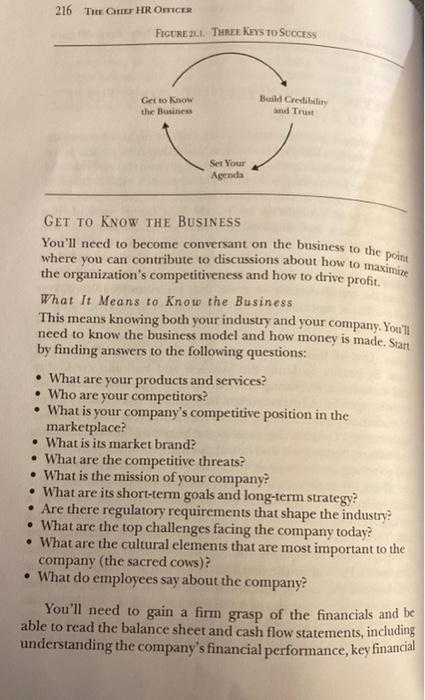
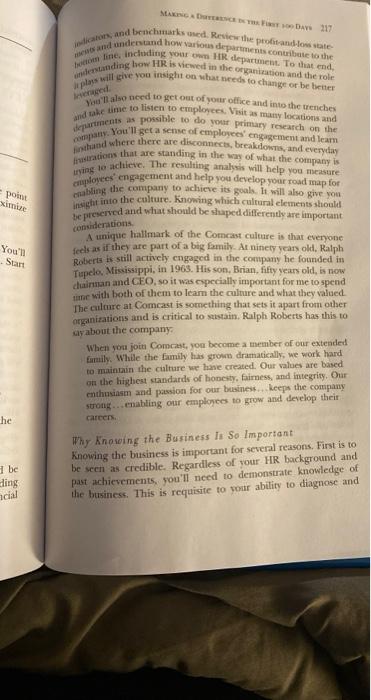
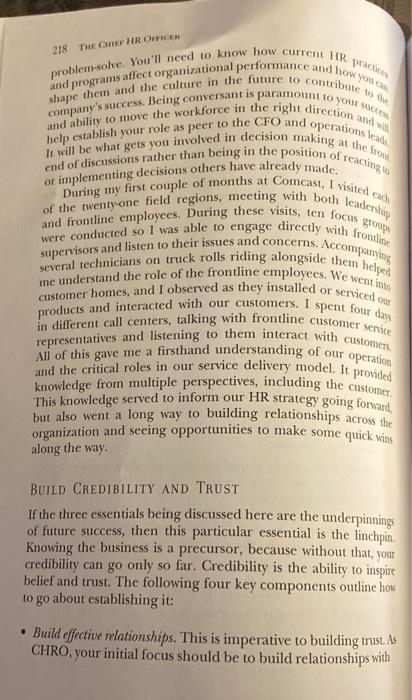
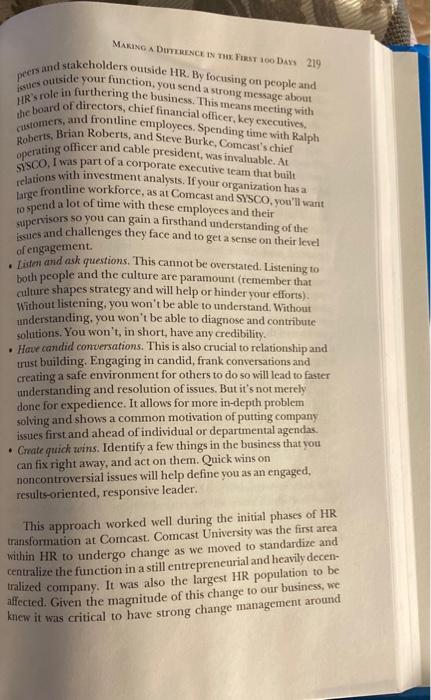
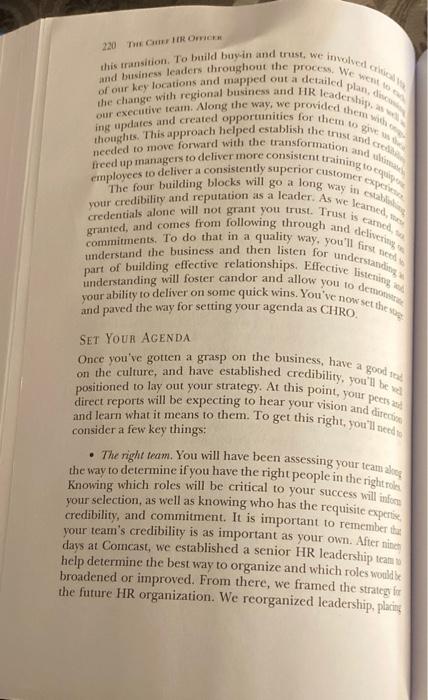
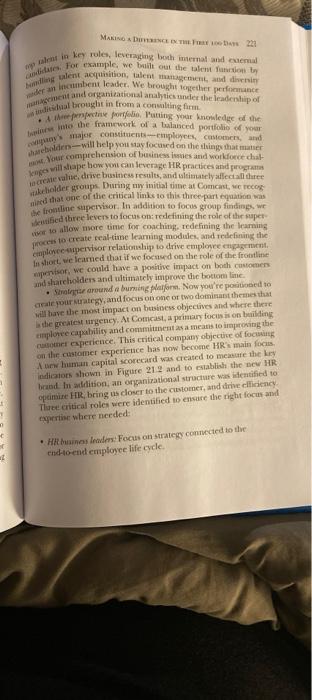
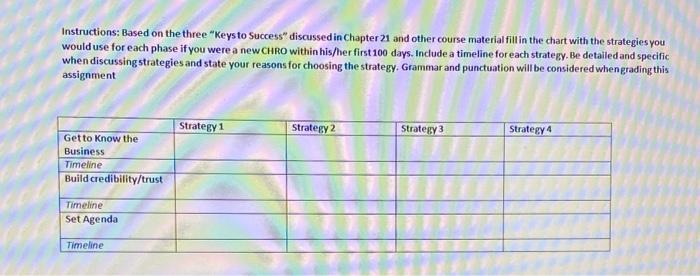
216 THE CHRONICER FIGURE 21.1. THREE KEYS TO SUCCESS Get to know the Business Build Creditlar and Trust Set Your Agenda GET TO KNOW THE BUSINESS You'll need to become conversant on the business to the point where you can contribute to discussions about how to maximize the organization's competitiveness and how to drive profit. What It Means to know the Business This means knowing both your industry and your company. You'll need to know the business model and how money is made. Stan by finding answers to the following questions: What are your products and services? Who are your competitors? What is your company's competitive position in the marketplace? What is its market brand? What are the competitive threats? What is the mission of your company? What are its short-term goals and long-term strategy? Are there regulatory requirements that shape the industry What are the top challenges facing the company today? What are the cultural elements that are most important to the company (the sacred cows)? What do employees say about the company? You'll need to gain a firm grasp of the financials and be able to read the balance sheet and cash flow statements, including understanding the company's financial performance, key financial MAGENES Dave 117 xiniue and benchmarks and Review the profitand low state and understand how various departments contribute to the Boom line, including your HR department. To that end, de standing how HR is viewed in the organization and the role plot will give you insight on what needs to change or better also need to get out of your office and into the trenches and take time to listen to employees, Visit as many locations and rtments as possible to do your primary research on the wany. You'll get a sense of employees' engagement and leam instand where there are disconnects, breakdows, and everyday frustrations that are standing in the way of what the company is cmployees engagement and help you develop your road map for rymg to achieve. The resulting analysis will help you measure calling the company achieve is goals. It will also give you insight into the culture. Knowing which cultural elements should be preserved and what should be shaped differently are important A unique hallmark of the Comcast culture is that everyone feels as if they are part of a big family. At ninety years old. Ralph Robert is still actively engaged in the company he founded in Tupelo, Mississippi, in 1963. His son, Brian, fitty years old, is now cuirman and CEO, so it was especially important for me to spend with both of them to learn the culture and what they valued The culture at Comcast is something that sets it apart from other organizations and is critical to sustain. Ralph Roberts has this to ay about the company When you join Comcast, you become a member of our extended family. While the family has grown dramatically, we work hard to maintain the culture we have created. Our values are based on the highest standards of honesty, faimess, and integrity. Our enthusiasm and passion for our business keeps the company strong...enabling our employees to grow and develop their Career considerations You'n Star he be Hing Why I'nosing the Business Is So Important Knowing the business is important for several reasons. First is to be seen as credible. Regardless of your HR background and past achievements, you'll need to demonstrate knowledge of the business. This is requisite to your ability to diagnose and acial 218 The One HR OFFICER shape them and the culture in the future to contribute to the problem-solve. You'll need to know how current HR and programs affect organizational performance and how you and ability to move the workforce in the right direction and will company's success. Being conversantis paramount to YOU SO help establish your role as peer to the CFO and operations la end of discussions rather than being in the position of reacting to It will be what gets you involved in decision making at the room or implementing decisions others have already made. During my first couple of months at Comcast. I visited cach and frontline employees. During these visits, ten focus groups of the twenty-one field regions, meeting with both leadership were conducted so I was able to engage directly with from several technicians on truck rolls riding alongside them helped supervisors and listen to their issues and concerns. Accompanying me understand the role of the frontline employees. We went into customer homes, and I observed as they installed or serviced our products and interacted with our customers. I spent four dans representatives and listening to them interact with customers in different call centers, talking with frontline customer service and the critical roles in our service delivery model. It provided All of this gave me a firsthand understanding of our operation knowledge from multiple perspectives, including the customer This knowledge served to inform our HR strategy going forward but also went a long way to building relationships across the organization and seeing opportunities to make some quick wins along the way. BUILD CREDIBILITY AND TRUST If the three essentials being discussed here are the underpinnings of future success, then this particular essential is the linchpin. Knowing the business is a precursor, because without that, your credibility can go only so far. Credibility is the ability to inspire belief and trust. The following four key components outline how to go about establishing it: Build effective relationships. This is imperative to building trust. As CHRO, your initial focus should be to build relationships with MAKING A DIERENCE IN THE FIRST 100 DAYS 219 peers and stakeholders outside HR By focusing on people and issues outside your function, you send a strong message about HR's role in furthering the business. This means meeting with customers, and frontline employees. Spending time with Ralph the board of directors, chief financial officer, key executives, Roberts, Brian Roberts, and Steve Burke, Comcast's chief operating officer and cable president, was invaluable. At SSCO, I was part of a corporate executive team that built relations with investment analysts. If your organization has a Lange frontline workforce, as at Comcast and SYSCO, you'll want to spend a lot of time with these employees and their supervisors so you can gain a firsthand understanding of the sties and challenges they face and to get a sense on their level of engagement. Listem and ask questions. This cannot be overstated. Listening to both people and the culture are paramount (remember that culture shapes strategy and will help or hinder your efforts). Without listening, you won't be able to understand. Without understanding, you won't be able to diagnose and contribute solutions. You won't, in short, have any credibility . Have candid conversations. This is also crucial to relationship and trust building. Engaging in candid, frank conversations and creating a safe environment for others to do so will lead to faster understanding and resolution of issues. But it's not merely done for expedience. It allows for more in-depth problem solving and shows a common motivation of putting company issues first and ahead of individual or departmental agendas. . Create quick wins. Identify a few things in the business that you can fix right away, and act on them. Quick wins on noncontroversial issues will help define you as an engaged, results-oriented, responsive leader. This approach worked well during the initial phases of HR transformation at Comcast. Comcast University was the first area within HR to undergo change as we moved to standardize and centralize the function in a still entrepreneurial and heavily decen- tralized company. It was also the largest HR population to be affected. Given the magnitude of this change to our business, we knew it was critical to have strong change management around 220 TOTRONIC our executive team. Along the way, we and business leaders throughout the process. We w this transition. To build buy-in and trust. We involved of our key locations and mapped out a detailed plan.com the change with regional business and HR leadership provided them w thoughts. This approach helped establish the trust and se ing updates and created opportunities for them to needed to move forward with the transformation and freed up managers to deliver more consistent training to come employees to deliver a consistently superior customer your credibility and reputation as a leader. As we learned, The four building blocks will go a long way in esta credentials alone will not grant you trust. Trust is carved commitments. To do that in a quality way, you'll first granted, and comes from following through and deliver understand the business and then listen for understand part of building effective relationships. Effective listening understanding will foster candor and allow you to dem settore and paved the way for setting your agenda as CHRO SET YOUR AGENDA Once you've gotten a grasp on the business, have a good to on the culture, and have established credibility, you'll be positioned to lay out your strategy. At this point, your peers! direct reports will be expecting to hear your vision and direct and learn what it means to them. To get this right, you'll nicht consider a few key things: The right team. You will have been assessing your team the way to determine if you have the right people in the right roles Knowing which roles will be critical to your success will info your selection, as well as knowing who has the requisitcoperis credibility, and commitment. It is important to remember that your team's credibility is as important as your own. After ninen days at Comcast, we established a senior HR leadership teata help determine the best way to organize and which roles would be broadened or improved. From there, we framed the strategy for the future HR organization. We reorganized leadership, placing MAKING A DEBT222 at in roles, lever og both anda dies. For example, we built out the talent on by and went acquisition, talem went and dinin der an incumbent leader. We brought together performance cient and organizational analytics to the leadership of med brought in from a conting firm. A pow. putting your knowledge of the into the framework of a balanced portfolio wholden-will help you stay focused on the thing that w major constituye our comprehension of business and wodocce chat lenges will shape bow you can leverage HR practices and cate, de businesses, and ultimately detallure wholder groups. During the initial time at Comcast, WECOR med at one of the critical links to this three part equation was e frontline supervisor. In addition to focus group findings, we retified three leven to focus on redefining the role of the super to allow more time for coaching, redefining the learning ces to create real-time learning modules and redefining the toployeepervisor relationship to drive employee engagement, In short, we learned that if we focused on the role of the frontline expertsor, we could have a positive impact on both customers and shareholders and ultimately improve the bottom line. . State around a burning platform. Now you're positioned to are your strategy, and focus on one or two dominant themes that will have the most impact on business objectives and where there the greatest urgency. At Concast, a primary focus is on building emplovee capability and commitment as a means to improving the comer experience. This critical company objective of forming 1 on the customer experience has now become HR's main focus uw human capital scorecard was created to measure the key indicators shown in Figure 21.2 and to establish the new HR beundIn addition, an organizational structure was identified to optimize HR, bring us closer to the customer, and drive citiciency The critical roles were identified to ensure the right focus and grise where needed: HR bainos Ideas: Focus on strategy connected to the end to end employee life cycle. 1 Instructions: Based on the three "Keys to Success" discussed in Chapter 21 and other course material fill in the chart with the strategies you would use for each phase if you were a new CHRO within his/her first 100 days. Include a timeline for each strategy. Be detailed and specific when discussing strategies and state your reasons for choosing the strategy. Grammar and punctuation will be considered whengrading this assignment Strategy 1 Strategy 2 Strategy 3 Strategy 4 Get to know the Business Timeline Build credibility/trust Timeline Set Agenda Timeline ** create a chart to organize responses. Example chart pictured below**
Step by Step Solution
There are 3 Steps involved in it
1 Expert Approved Answer
Step: 1 Unlock

Question Has Been Solved by an Expert!
Get step-by-step solutions from verified subject matter experts
Step: 2 Unlock
Step: 3 Unlock
 Study Help