







Question: Based on the training objectives you created in Human Resource Director provide a training agenda, and indicate the time allocated and the order of the
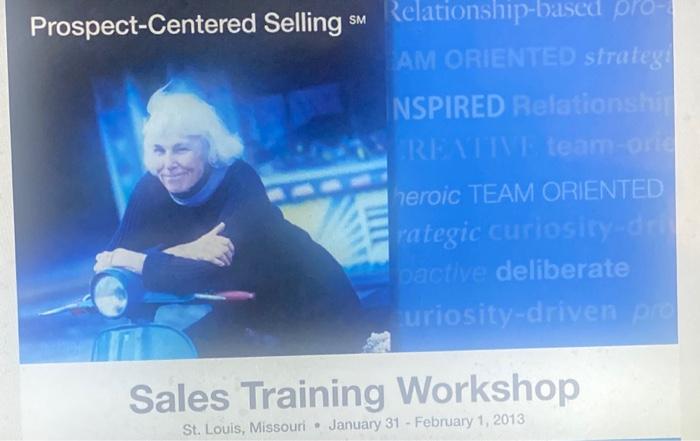
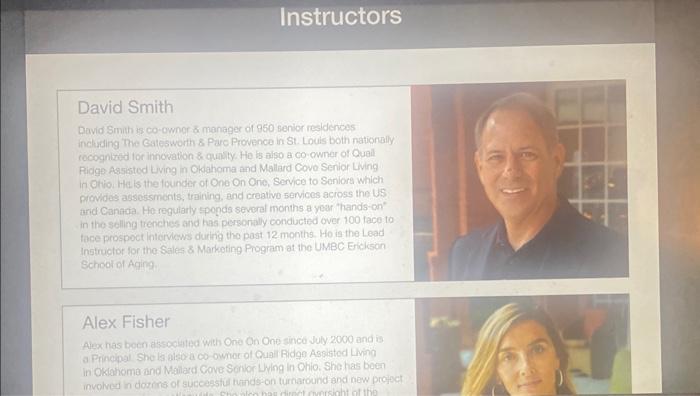
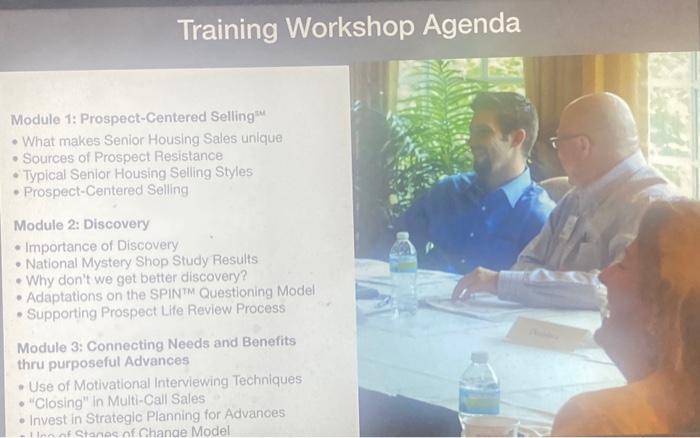
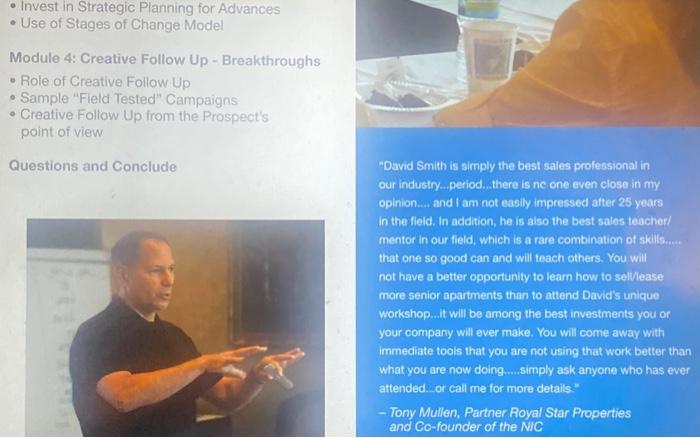
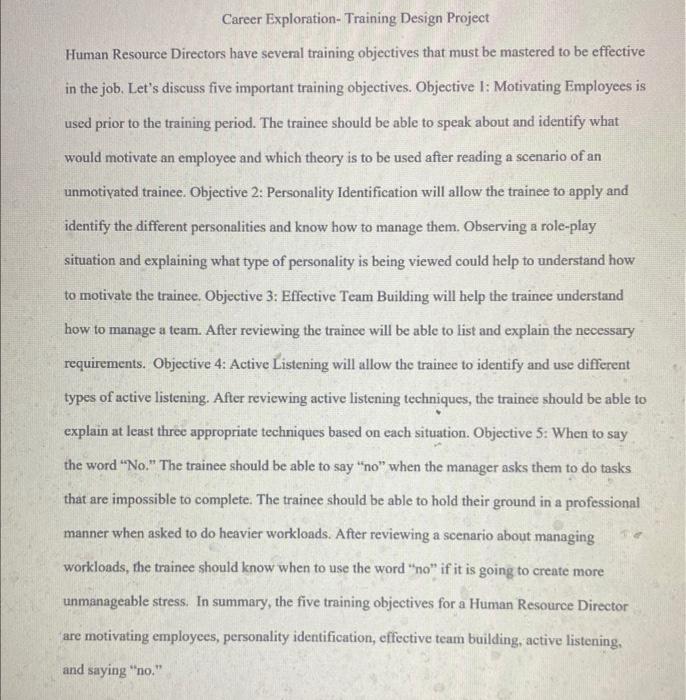
Prospect-Centered Selling sm Rela AM ORIENTED strateg NSPIRED Relationsin leroic TEAM ORIENTED ategic curiosiby a deliberate uriosity-driven pa Sales Training Workshop David Smith David Smith is co-ownor a manager of 950 senior residences including The Gatesworth 8 Paro Provence in St. Louis both nationally, rocognized tor innovation \&. quasity the is also a co-owner of Quall Pidge Assistod Lving in Ordahoma and Mallard Covo Senior Living In Orio He is the founder of Ono On One, Service to Seniors which provides assessmonts, training, and creative servioes across the US. arid Canada. Ho regularly sponds several inonths a year "thands-con" in the solling trenches and has personally conducted over 100 tace to tace prospoct interviews during tha past 12 months. Ho is the Lead Instructor for the Sales Marketing Program at the UMBC Ericiscon Schoof of Aging Alex Fisher Alex has becn alscoluted with One On Ones sinco vuly 2000 and is. a Principal She la also a co-owner of Cual Pidge Asoisted Living. in Okahoma and Mailard Cove Sonbr Lwing in Ohio. She has been. involved in dotense of successtul tunds-on turnaround and new proyect Training Workshop Agenda Module 1: Prospect-Centered Selling su - What makes Senior Housing Sales unique - Sources of Prospect Resistance - Typical Senior Housing Selling Styles - Prospect-Centered Selling Module 2: Discovery - Importance of Discovery - National Mystery Shop Study Results - Why don't we get better discovery? - Adaptations on the SPINM Questioning Model - Supporting Prospect Life Review Process Module 3: Connecting Needs and Benefits thru purposeful Advances - Use of Motivational Interviewing Techniques - "Closing" in Multi-Call Sales - Invest in Strateglo Planning for Advances - 1 len of Stanes if Chance Model Module 4: Creative Follow Up - Breakthroughs - Role of Creative Follow Up - Sample "Field Tested" Campaigns - Creative Follow Up from the Prospect's point of view Questions and Conclude "David Smith is simply the best sales professional in our industry...period...there is ne one even close in my opinion.w and I am not easily impressed after 25 years in the field. In addition, he is also the best sales teacherf mentor in our field, which is a rare combination of skills. that one so good can and will teach others. You will not have a better opportunity to learn how to sell/lease more senior apartments than to attend David's unique workshop... it will be among the best investments you or your company will ever make. You will come away with immediate tools that you are not using that work better than what you are now doing....simply ask anyone who has ever attended...or call me for more details." - Tony Mullen, Partner Royal Star Properties and Co-founder of the NIC Career Exploration- Training Design Project Human Resource Directors have several training objectives that must be mastered to be effective in the job. Let's discuss five important training objectives. Objective I: Motivating Employees is used prior to the training period. The trainee should be able to speak about and identify what would motivate an employee and which theory is to be used after reading a scenario of an unmotiyated trainee. Objective 2: Personality Identification will allow the trainee to apply and identify the different personalities and know how to manage them. Observing a role-play situation and explaining what type of personality is being viewed could help to understand how to motivate the trainee. Objective 3: Effective Team Building will help the trainee understand how to manage a team. After reviewing the trainee will be able to list and explain the necessary requirements. Objective 4: Active Listening will allow the trainee to identify and use different types of active listening. After reviewing active listening techniques, the trainee should be able to explain at least three appropriate techniques based on each situation. Objective 5: When to say the word "No." The trainee should be able to say "no" when the manager asks them to do tasks that are impossible to complete. The trainee should be able to hold their ground in a professional manner when asked to do heavier workloads. After reviewing a scenario about managing workloads, the trainee should know when to use the word "no" if it is going to create more unmanageable stress. In summary, the five training objectives for a Human Resource Director are motivating employees, personality identification, effective team building, active listening, and saying "no
Step by Step Solution
There are 3 Steps involved in it

Get step-by-step solutions from verified subject matter experts
 Study Help