







Question: based on this case - i need to answer build a financial analysis to forciase what a new location should make. i already know it
Bratwurst, Beer and Business: Planning for Growth at Wurstkche
yler Wilson and Joseph Pitruzzelli locked the door to their restaurant and stepped outside into the snow, exhausted from the months of sixteen hour days leading to the grand opening party of their new Denver, Colorado location. Although they were experiencing one of the worst
snow storms of the season, 300 people had attended their event. Customers were excited for something newa modern, authentic German/Belgian sausage restaurant. The duo felt reenergized by the enthusiasm for their concept and the potential they saw in this new location, which was different than their home-base of Los Angeles. As they meandered back to their temporary apartment, they relived some of the highlights from the night. I left the party feeling like Denver could very likely be our most successful location yet, Wilson recalled.
Once they got back to their barren apartment, however, they started to articulate some of their anxieties. They shared some serious doubts about their general manager, who had relevant experience but had never led a team. The local staff had not developed the close team culture that was a hallmark of the pairs other restaurants. The restaurant opened months behind schedule as a result of problems with the building and bad weather. Still, the weather promised to improve, and they felt bolstered by their successful opening.
Appetite for Entrepreneurship First cousins Wilson and Pitruzzelli were born with entrepreneurship in their blood. Generations
of family members before them had started businesses, many supported and funded by other relatives.
Wilson followed suit, and at five years old he decided to start his first business selling oranges from his grandfathers ranch to passersby. By high school, he had purchased two used margarita machines to rent out for events and parties. As an undergraduate at the University of Southern California (USC) in the early 2000s, he knew a traditional job was not in his future and that he would need to create his own career path. I didnt want to learn about the theory of business. I wanted to really learn what its actually like. I didnt see myself ever working for anybody else, recounted Wilson.
T
2
An untraditional learner with dyslexia, he was rejected from admission to USCs Marshall School of Business not once, but three times. Undeterred, Wilson petitioned for special permission to create an Entrepreneurship minor, and therefore gained access to all the Marshall courses.
Pitruzzelli had a similar experience creating his own degree as a student at the University of San Francisco (USF) five years prior. Pitruzzelli was an International Business major, but became fascinated by Industrial Design. Unfortunately, USF did not have a related course of study. However, Pitruzzelli found a USF partnership with California College of the Arts, which allowed him to pursue degrees in both International Business and Industrial Design. Eager to combine these knowledge areas and gain experience, he started his own design firm while still a student. Pitruzzelli found success designing and investing in bars and night clubs in San Francisco when he was barely of legal drinking age himself. But after he graduated, he began to contemplate his next career move. I was ready to move on, and San Francisco was too cold. I was looking for a new challenge but I just didnt know what it was, yet, Pitruzzelli remembered.
Starting from Scratch: Wurstkches Origins Wilson knew that Pitruzzelli had an affection for architecture and up-and-coming artistic
communities. So when Pitruzzelli traveled south for a weekend visit in 2007, the two of them explored the Arts District in Downtown Los Angeles (DTLA). The Arts District sat as a vacant industrial area from World War II until the 1970s, at which point a group of artists known as the Young Turks illegally moved into abandoned warehouses to escape high rents elsewhere, creating an edgy underground arts scene.1
At the time of Pitruzzellis visit, DTLA was mostly known for its business center comprised of large corporate officesand for its large homeless population. The cousins spent the weekend imagining possibilities for DTLA. Pitruzzelli remarked, There was a sense that you could get in on the ground floor and really influence it. There was amazing infrastructure, but it was a ghost town.
Pitruzzelli fell in love with one building in the Arts District in particular. After Wilson saw that building available for lease later that year, Pitruzzelli immediately contacted the broker and began to discuss leasing options.
Wilson and Pitruzzelli were excited to secure financing to use the space to create their next job opportunity and contribute to the revitalization of DTLAs Arts District.
Launching Wurstkche As a student living near USCs campus just a few miles away, Wilson lamented the lack of nightlife
in DTLA and thought the building could address this need. Pitruzzellis experience designing bars seemed a perfect fit. The two envisioned a dance bar modeled on a lounge that Pitruzzelli designed in San Francisco. Unfortunately, they discovered that city regulations made it nearly impossible to obtain a license to serve liquor without also serving food.
In order to meet the zoning requirements, Wilson and Pitruzzelli decided they would open a small area for food just inside the front door. The dance bar area would be down the hallway in the back of the building. To minimize costs and ensure focus on the dance bar, their goal was to create a simple menu with food that did not require an expensive culinary team. They agreed that Pitruzzelli would design the space and help launch the business, and Wilson would ultimately manage it.
Wilson and Pitruzelli shared memories of family get-togethers and parties where friends enjoyed sausages and beer. They remembered how simple and enjoyable the food preparation was, and decided the front of the building would focus on gourmet sausage and beer. They would prioritize customer experience over producing their own products.
Wilson noted, It became a game of how do we brand sausages? They made the early decision to stay with a niche market, serving only sausage, Belgian-style fries, and German/Belgian beer. Unsure of what to name their business, they turned to a German-English dictionary, and settled on the name Wurstkche (pronounced Verst-Koo-Shah), or sausage kitchen.
In 2008, Wilson proposed marriage to his girlfriend and decided to drop out of USC to focus full attention on his nascent business with Pitruzzelli. That same day, Wilson and Pitruzzelli assembled their parents and grandparents. But this meeting was a far cry from a traditional family gathering.
Instead, 21-year-old Wilson and 26-year-old Pitruzzelli pitched their business idea to their extended family, aiming to obtain more than half a million dollars in funding. They gave a presentation complete with financial projections. Pitruzzelli recalled with a laugh, We offered equity cuts. Our family was supportive, but I think my grandfather didnt want the liability. So after some grilling, they offered a loan instead. That way they knew theyd be paid back.
With an initial loan of $665,000, the two secured a ten-year lease on the building and turned their attention to launching Wurstkche. The building already had a Conditional Use Permit allowing beer and wine sales. But it was zoned for heavy manufacturing (M3), so Wilson and Pitruzzelli needed to apply for a variance to acquire a Type 47 liquor license from the state, and then receive special permission from the city to use the state license. While they undertook that arduous process, the pair decided they would open the sausage restaurant at the front of the building in the interim. They planned to launch the adjoining dance hall within the next year after acquiring the proper licensing and permission to serve liquor.
Shortly after obtaining the loan, the country faced the worst economic recession since the Great Depression. The recession was rooted in a real estate crisis in which banks struggled with the aftermath of a housing bubble that left many home owners unable to pay their mortgages. The devastating effects rippled throughout the global economy. In the autumn of 2008, the restaurant industry suffered stagnant sales for the first time in almost twenty years, creating financial problems across the entire industry. Many restaurants closed, and several others faced serious problems.2 Pitruzzelli reminisced:
I felt oblivious to it, or maybe I blocked it out. The world may have been crumbling, but in our Arts District bubble, everything seemed full of possibility. When I did think of it, I reassured myself that people still drink (maybe more) during down times, and dancing could be a way for many to let go of stress. I think about opening during a recession now and have nightmares. Im thankful for how fortunate we were during that period.
Wurstkche opened in November 2008 with a total staff of seven people. Pitruzzelli recalled, My dad was at the restaurant all the time, and Tylers mom was there a lot, too. Our family helped out wherever they could. They were doing everything from painting to helping with office work.
The original goal was to sell 100 sausages per day from the small kitchen near the front of the restaurant. This would be operated by one or two people, utilizing a simple menu with limited cooking required. The menu consisted of twenty different types of gourmet meat and vegetarian sausages, ranging from traditional to exotic fare, such as rattlesnake and rabbit. Patrons could customize their sausage toppings from a list including sauerkraut, caramelized onions, various types of peppers, and gourmet mustard choices. They also offered Belgian fries with a variety of dipping sauces. Their carefully curated beer list included only authentic German and Belgian options.
Wurstkche opened before interior construction was complete, and before it obtained its liquor license. After the lunch rush each day, Wilson and Pitruzzelli resumed construction on the dining area. But construction did not serve as a deterrent to patrons. Wilson said, People were excited to be part of building something new. We were honest with our guests from the beginning about our growing pains. Then they felt like they were part of the journey as we all created something together (see Exhibit 1 for photos of the contruction of Wurstkches DTLA location).
Warming Up: The New Downtown LA Wilson and Pitruzzelli saw the Arts District in DTLA as gritty and full of potential. When we
leased the building that became Wurstkche, Downtown LA was this area that everyone talked about as a place that would eventually become cool, but there was really nothing going on. It was completely empty after 6:00 PM every day, remembered Wilson. The Wurstkche location was half a mile from a part of DTLA known as Skid Row, a 50-block area which contained one of the largest populations of homeless people in the United States.
But Pitruzzelli felt at home in the Arts District:
The Arts District was similar to the Warehouse District I lived in while in San Francisco. I mean, it was kind of deserted. There were literally couches on fire in the middle of the street. But in this particular zone, I saw potential. There was a creative vibe, just very little street activation. People were doing interesting things, but it was behind closed doors. There were no lawns or nice storefronts; it was kind of dodgy and private. As we became part of the neighborhood, we could tell it was residential, though. There was a community, but it wasnt outward facing. We started going on the weekly security walk, where a senior LAPD officer would chaperone neighbors to walk around the area and listen to their security concerns. People would walk, bring their dogs, and share gossip with each other.
By entrenching themselves in the community, Wilson and Pitruzzelli were able to appeal to long- time residents in addition to outsiders. A January 2009 article in Citizen LA described the way in which Wurstkche was able to straddle the line between the past and the future of the Arts District:
From trash laden photo shoots to red carpets events, downtown continues to attract new people with new ideas. After years of complaints from disgruntled locals (wary of the erosion of the downtown spirit and bohemian scene), its nice to have something that everyone can rally behind. This [Wurstkche] is the response locals have been looking for: the right people with the right attitude.3
As Wurstkche gained traction, more restaurants and shops opened in the Arts District, creating the community that the pair had always envisioned for DTLA.
A Sizzling Start: Wurstkches Quick Success One of Wurstkches first customers was Jessica Gelt, a food and entertainment writer at the Los
Angeles Times. Gelt wrote a flattering piece about Wurstkche the month the restaurant opened. The day after it was published, customers were lined up at the door, citing the article. That article really began an onslaught of press, interviews, and more customers. It was an ongoing process of growth from that point, said Wilson.
Wurstkche also opened at a time when smartphones were becoming mainstream. Yelp, the online crowd-source review website, was gaining millions of new users per month. This allowed positive word of mouth to spread as customers used their smartphones to search for new restaurants and write instant reviews. Early reviews were glowing, with most Yelpers offering the highest rating of five stars. Amateur food blogs were also incredibly helpful. People would take great pictures and publish posts to their friends, giving us publicity. This is when people started becoming obsessed with taking selfies with their food, remarked Wilson.
The early days were not without difficulty, however. Wurstkche was growing at a faster rate than Wilson or Pitruzzelli could predict. The original goal of 100 sausages per day was surpassed within days of opening. There were months in which the number of sausages sold would double from one week to the next. Given that they had to place orders for sausages and buns two weeks in advance, it was almost impossible for the duo to accurately plan. To add further complication, their refrigerator, which was supposed to hold a weeks worth of sausage, could only hold enough for 36 hours at the rate they were selling.
Remembering that time period, Pitruzzelli remarked, It was stressful. We were hustling and on our feet, all the time. But it was exhilarating. Wilson commented, It was miserable. I hated it, but I was not going to stop. One day, I got in my car and started crying. I was going to bed at 1:00 A.M. and waking up at 6:00 A.M. every day.
After a year of growing Wurstkche, the Wilson and Pitruzzelli began to think about hiring a CFO. Someone in Wilsons network shared Larry Cousins resume. Literally everything we had a challenge with, he specialized in. He had a sophisticated knowledge of the tax, legal, insurance, and admin issues we were starting to encounter as we grew. He was savvy about metrics and cash flow forecasting, Wilson explained enthusiastically.
Cousins had decades of experience in CFO positions in various industries, including the food service business. He had recently served as the CFO of Habit Burger, a fast-casual burger restaurant, which grew from 12 to 22 locations during his tenure. After Cousins sale of Habit Burger in 2008, he 3 Stiehl, GC. Wurstkche. Seriously Wild Meat. Citizen LA, January 2009.
w6
considered his options. He was not ready to retire, but sought a change. I like working with companies that have strong ideas and operations but are still in the ramp up phase, trying to find something that works and run with it. That discovery phase is more exciting to me than big, established companies with outside ownership, said Cousins.
Wilson called Cousins almost immediately. Cousins was on a vacation in Maui, and answered the phone from the beach. His excitement matched Wilsons. He remarked:
Wurstkche had every attribute I was looking for. Tyler and Joseph were very serious about their work and motivated to succeed. They were open to new ideas and didnt have big egos. They cared about figuring out the best way to do something, not whose idea is used. When I looked at the menu, I thought it was just a genius, lightning in a bottle concept. I came down for a visit in 2009, and when I saw the place I loved it. The Millennial sensibility they had was really cool. Its more than great food. Its a space people want to be in.
Cousins was hired in late 2009. Wilson recalled, We could only afford to bring him on two days per week, and he made more than double what I was paying myself at the time. But he more than paid for himself in the first year. Hiring Larry was one of the best things we did in the first few years. By the end of its second year, Wurstkches sales increased more than tenfold from the end of the prior year. That success combined with Cousins financial savvy enabled Wilson and Pitruzzelli to pay off their debt within three years of opening.
How the Sausage Is Made: Developing a Business Model After a year of continual success in DTLA, Wilson and Pitruzzelli realized that the simplicity of
their sausage restaurant was one of Wurstkches greatest assets. Although their original dream had been to open a dance club, they decided to forgo those plans and focus on the business model that had proven to be so successful. The area reserved for dancing was permanently designated as a dining area and bar.
The menu continued to offer only sausages, Belgian-style fries, limited topping and dip choices, beverages, and a single dessert. The menu that caught my attention hasnt changed. Theyve stayed true to that and theyve stayed true to their original design, Cousins said.
The business model was based on quick turnover of food products and high beer sales. Efficiencies were created with the limited menu and a relatively low labor cost, given the lack of chef and wait staff. Wilson and Pitruzzelli made the decision early not to make any of their sausages in-house. In the early days, they sourced their sausages from many different vendors. Those who accommodated Wurstkches changing demands were rewarded with the restaurants loyalty. Weve had different companies approach us with various discounts or promotions, but we stick by the vendors who have proven their reliability, said Wilson.
Wilson and Pitruzzelli were also intentional about the other food items they stocked. For instance, the restaurant offered only four topping choices and four types of mustard, none of which required perishable produce. We have entertained the idea of adding pretzels, and people often suggest salads or burgers. One time, Tylers dad said we should include pickles as a topping choice. As much as I love pickles, that would have opened the flood gates, recalled Pitruzelli.
The retail price point was similar to fast casual restaurants, with sausages ranging from $6.50 for classic offerings to $8.50 for exotic choices, including two toppings and gourmet mustard. Customers could expect to enjoy a sausage, Belgian fries, and a beer for less than $20. But unlike most fast casual
restaurants, Wurstkche focused equally on creating a specific customer experience, positioning itself as a modern, exotic hangout.
Renowned food critic, Jonathan Gold, remarked in a February 2009 LA Weekly article:
The impeccably designed interior splits the difference between high design and building site, so that the impossible geometries of the folded-metal sausage plates which resemble a detail from an early John Okulick construction rhyme with the folded metal barstools, and the worn wood of the beams matches the less- worn wood of the long communal benchesThe restaurant is arty but clean; gritty but stocked with white truffle oil, aoli for the fries, and Triple Karmelite on tap the kind of bohemianism that accepts American Express.4
Cousins elaborated, Its fast casual, but it doesnt feel that way. A lot of experts look at sales per square foot, but our concept is a little different. Ours is more oriented to the look and feel of the restaurant. So I dont really think about sales per square foot as much as sales per labor hour.
Wilson and Pitruzzelli also cultivated a particular company culture and invested in staff training. Wilson explained:
Our culture starts with caring for our team. If our staff feels supported, theyll take care of our customers. Its hard to create, but thats what we focus on. We have only brought in a few external management hires, everyone else has worked their way up. We have a passion for helping people grow. We focus on education, because people arent coming out of the school system ready to work. Theyre lacking skill sets. So we teach them how to be leaders and team players. We offer multiple leadership courses, a food safety course, a lengthy manager shadowing process. Once an employee reaches the management level, we pay for classes at local colleges and bring in firms to aid in our teams leadership development. The process to bring an employee from entry-level to management costs $10,000 or more per hire. There isnt a lot of protection from copycats in the restaurant business, but this is how we stand out.
A Second Helping Pitruzzelli led the charge to find the perfect place for a second restaurant. He recalled:
I didnt really have a formal rubric. I like to see an undercurrent of culture nearby: are there single speed bikes parked outside? Design studios hiding in warehouses? Artists squatting or bands making noise nearby? I looked for buildings with architectural character; I prefer irregular buildings, like triangles at the corner of streets with unusual intersections. New development construction is always a turnoff. I didnt want a vanilla shell. I like breaking through walls, not knowing what Im going to find, and then letting those surprises inform the design.
He chose Venice, a beach community situated just shy of 20 miles from the original Wurstkche restaurant. Pitruzzelli sensed that the location had a similar bohemian, creative community to the Arts District, but believed it was far enough from DTLA to prevent cannibalization.
4 Gold, Jonathan. In the Wurst Way: Downtowns Wurstkuche Serves Up Bohemia on a Toasted Roll. LA Weekly, February 4, 2009.
Pitruzzelli made it a priority to find a building that was already zoned to allow for food service and a full bar. Eventually, he found a night club, which he described as disgusting and plastered over, but with the right bones [architectural framework].
Wilson and Pitruzzelli initially leased the building, but soon purchased it for $2 million. Cousins remembered the expansion to Wurstkches second site:
Joseph was jumping up and down about Venice because he found a brick building he loved in an area he considered to be up-and-coming. I wouldnt have seen the opportunity in that location, but I wouldnt have seen the opportunity in Downtown LA when they opened a restaurant there, either. So, I trusted him.
The entrepreneurs purchased the club and stripped it down to the bricks to create a simple, inviting space. Recognizing that they could not maintain the level of day-to-day involvement that they had invested in the DTLA location, they hired a general manager for the Venice location. The general manager was brought on staff six months prior to the grand opening in Venice, and in the interim she served as the general manager at the DTLA location. She was very successful in taking over, and she was fully trained on how to run our current operations. The staff loved her. They were very upset when we moved her to Venice, even though thats what she was originally hired for, remembered Wilson.
In 2012, the second Wurstkche location opened to the public. Opening day, it was bonkers, recounts Pitruzzelli. It started out very strong. But opening a new restaurant is very stressful. We didnt have a perfect, mature infrastructure to manage both locations. Eventually little details started to slip. We couldnt be everywhere at the same time. After a few months, the general manager left. In retrospect, maybe she should have stayed at the DTLA location and Tyler could have opened Venice? But whos to say what the perfect answer would have been?
Wilson intermittently managed the Venice location, until the pair eventually hired a Director of Operations to oversee daily operations of both locations. The Venice Wurstkche location consistently showed a profit, but did not match the success of the Downtown Los Angeles location.
Still Hungry: Considering Further Expansion After a year of business in Venice, Wilson and Pitruzzelli decided to expand Wurstkche beyond
California.
Cousins suggested a regional growth plan, in which all new locations would be within driving distance of existing restaurants. However, the co-founders pushed back. Staying in LA seemed too easy, remarked Wilson. Pitruzzelli added, I didnt feel like Wurstkche could saturate LA and be supported in all the different parts of the city. We wanted to replicate the idea of finding undervalued real estate in cool, bohemian areas, and using our business as a catalyst to start a movement in new cities. The team briefly considered a franchise model, but Wilson and Pitruzzelli were concerned about diluting the brand they had carefully created.
Pitruzzelli had always planned to move to another city after launching the original Wurstkche, and he was excited to try something new. Wilson was also anxious to move quickly. The pair created a list of possible locations for expansion. They considered Seattle, Austin, Denver, Portland, New York, and Chicago. I disagreed, but I wasnt going to fight with them, because if theyd come to me in 2006 with the original concept I never would have understood that either, recalled Cousins.
Wilson and Pitruzzelli found a property in Denver that visually looked like a hybrid between the Venice and DTLA Wurstkche restaurants. Even better, it already had the necessary permits for food
and alcohol service. In 2013, they purchased the building for 25% of the Venice buildings sale price. We bought the building instead of leasing for a few reasons. First, it was the price of an apartment in LA, so we didnt want to pass up the deal. But we also saw a larger vision for the building to one day contain several businesses, not just Wurstkche.
Perfecting the Recipe: Refining Operational Systems Around the time Wilson and Pitruzzelli purchased the building in Denver, they re-read Michael E.
Gerbers book The E-Myth. In the book, Gerber contended that founders must possess technical skill, entrepreneurial vision, and managerial attention to detail to grow a business. In addition, small businesses must move beyond their founders in order to be successful. To achieve this, founders must work on their businesses rather than in them, by developing detailed systems for information, physical resources, and employee management.
The book had inspired many of the operational practices in the original Wurstkche location. The two decided that prior to launching a third location, they needed to invest in formalizing their operating systems and procedures. We cant run a shit show. We have a hundred people relying on us for a paycheck. So, to take a step forward, we needed to feel like the company as a whole was running well and the operations were in a solid place, Pitruzzelli recalled. Wilson added, We were really trying to have that head in, hands out approach to our business, described in The E-Myth. Thus, the building in Denver sat vacant while the two explored their options to formalize their systems.
Pitruzzelli dedicated himself to creating an operations manual to govern all locations. He also prioritized revamping the employee handbook. The first employee handbook was very stern. It was trying to instill my capitalist work ethic. I attempted to create a more loving handbook the second time around, while also teaching everyone the same set of information, he said (see Exhibit 2 for a sample from the original Wurstkche employee handbook and Exhibit 3 for a sample from the updated handbook).
The next challenge Wilson and Pitruzzelli tackled was how to formalize and standardize staff training across different locations. Wurstkche invested in staff development since its inception, but the model had required intensive involvement from both Wilson and Pitruzzelli. The whole thing was sort of crazy and way too controlling. We originally had timelines written to the second, detailing what our managers should be doing at every moment. It was so rigid and unforgiving; it didnt allow for any flexibility or chaos that inevitably arises in the hospitality business, remembers Wilson. He elaborated, it took us a long time to realize that you cant totally avoid all unknown factors. So, we started trying to train people to think the way we think rather than controlling the minutia of their behavior.
The pair considered different possibilities for how to build more flexibility into their systems. Pitruzzelli wondered how to codify the right balance of flexibility, consistency, and quality in the operations manual. He worked to find the appropriate tone in the updated employee handbook, and decided to use as many graphics as possible to illustrate his points.
Wilson and Pitruzzelli struggled the most with how to identify and groom potential employees who would embody their own mindset and work ethic. We tried to move to systems to identify whether someone is capable of specific traits to fit our company, rather than starting from a blank slate, said Wilson. Wilson and Pitruzzelli explored Myers Briggs profiles, emotional intelligence screening, and psychometric testing to utilize in hiring processes. Cousins emphasized, We need complete buy-in from employees, and especially from managers. They need a deep understanding of the Wurstkche style rather than trying to create their own brand or bringing conflicting styles from previous places of employment.
The duo also thought about how to better leverage the Director of Operations role. He spent most of his time fighting fires, and he handled day-to-day management of the Venice location for a while. He liked this reactive approach. But we needed him to be more strategic in managing operations across both stores, and eventually across all three. The two brainstormed how to maximize this position and ways to discuss this shifting role with the Director of Operations.
With a new operations manual and a revamped employee handbook and hiring protocol, the Wurstkche team moved forward with the Denver expansion.
High Altitude Cooking: Launching in Denver Construction on the Denver Wurstkche location began in January 2014, with the design modeled
off the other locations. Wilson and Pitruzzelli rented an apartment to stay in during their frequent visits, and furnished it with little more than two mattresses on the floor.
They identified two employees from DTLA and one from Venice who would serve as assistant managers at the new restaurant. They hired a local general manager with restaurant experience in Denver. All four employees were trained in LA before they were sent to Denver. However, construction on the new location was significantly behind schedule as a result of several issues with the contractor. So, the new team of managers, salaried and on payroll, waited in Denver for the building to open. Wilson and Pitruzzelli could not be a daily presence during this period, because they had to manage the California restaurants.
Eventually, Wilson and Pitruzzelli had to find another contractor to finish the Denver building, further delaying completion. We were kind of forced to the bottom of the barrel with the people we hired. We didnt have the strong relationships we do in LA, plus a new restaurant was opening every day in Denver, so there was a lot of competition, Wilson stated, We really underestimated the value of our personal networks in LA to launch a business.
Finding cashiers and kitchen staff also proved difficult: It was tough to compete with the pot industry [marijuana had been legalized for recreational use in the state of Colorado in November 2012], which was pulling away entry-level low-skill jobs. Not many people wanted to work in our kitchen when they could get $20-30 per hour bud tending [serving a customer service function in marijuana retail locations], said Pitruzzelli. Around the same time, the Director of Operations left because he could not fill the more strategic role that Wilson and Pitruzzelli required.
Wurstkche Denver finally opened in February 2015, with construction costs totaling twice the original budget, and concluding months behind schedule. Opening the doors of the restaurant helped the founding duo become optimistic about the potential of their Mile High City operation. Our opening party was awesome. The following two weekends were very strong, and we were looking forward to seeing increased business as the weather improved, remembered Wilson.
As spring approached, sales did not improve. Wurstkches goal was to earn $14,000 of revenue each day in Denver. We thought it was a very realistic goal, and the store was built to handle it, said Wilson. However, typical sales averaged $2,000-3,000 per day, and it cost the company approximately $1,000 per day to keep the store open, after accounting for fixed costs, marketing and promotions, and Wilson and Pitruzzellis travel expenses. The pair was frustrated, but noted that the daily loss rate was slowly decreasing over time (see Exhibit 4 for a financial comparison between Wurstkches three locations).
It was difficult for Wilson and Pitruzzelli to maintain a detailed understanding of operations in Denver given their physical distance. They received conflicting accounts from the general manager and the assistant managers, who placed blame on one another, the weather, the Denver Broncos
football game schedule, and other factors. The personalities of our original management team in Denver never really gelled, and they never quite figured it out. Tyler and I were too far away to do the intensive coaching and course correction we would usually do in our other locations, Pitruzzelli recalled.
They also realized that the Denver market revolved around sports, and patrons preferred eateries near the stadium or bars with televisions. We were just a few blocks too far away to be part of that scene, recalled Cousins. Wurstkche also forbid televisions in its locations, to maintain fidelity to their brand. Pitruzelli added, We just werent prepared for how much larger the sports culture is in Denver as opposed to LA.
A few months after opening, one of the assistant managers left, and the others were underperforming. Wilson and Pitruzzelli made the decision to let the general manager go. Denver was a black hole for our team. Theyd vanish with no accountability, Pitruzzelli lamented. Ultimately, Wilson and Pitruzzelli decided that remote management was too difficult in this scenario, so Pitruzzelli moved to Denver full-time in October 2015 to manage the restaurant. We were trying to be positive, maintain our corporate culture, and deal with high employee turnover, but it was brutal. We were exhausted, remembered Wilson.
I hated walking into an empty restaurant. It was embarrassing and depressing, and it was a challenge to motivate an underperforming team, said Pitruzzelli. Still, Cousins, as CFO, contended, Denver is not a financial disaster. It will eventually reach equilibrium. Tyler and Joseph have a clear concept with favorable margins. Its more about the opportunity cost of their time and energy.
The entrepreneurs also thought about their plan to expand into other markets. They contemplated the idea of timing, and how to identify the right time to build a business in an emerging city. They grappled with the question of how to maintain their brand integrity and strong staff development with an increasing number of remote locations.
Looking Forward Wilson and Pitruzzelli strolled down the street from their Denver restaurant to the familiar pizza
place where they purchased dinner on many of the nights Wilson was in town. They ate it sitting on the floor of their bare apartment.
As the end of the year approached, they were worn down by seven years of nonstop work. They thought about Wurstkches rapid success in DTLA, which quickly propelled them to another strong location in Venice. They mused about how opportune the timing had been in the success of each California location, and the way they had been able to respond to and impact the Arts District and Venice communities. The duo wondered how to improve sales in Denver and considered their options.
They could try to assimilate more with the Denver culture, rather than being so steadfast with the brand they developed in California. Perhaps a secret to their early success had been understanding the surrounding community and building a gathering place that reflected local values, which varied more than they initially realized between Los Angeles and Denver. For instance, perhaps they should consider installing televisions in the Denver location to attract a broader crowd on game days. They thought about adding bar games, such as corn hole, and changing the music to more popular selections. They could also consider expanding their menu to include local food and beer rather than maintaining their strict adherence to Wurstkches German/Belgian theme. But would this undermine the artsy, bohemian atmosphere they had created, and at what cost should this atmosphere be protected?
Alternatively, Wurstkche could retain its brand and culture but invest more in strengthening their operational systems. Wilson and Pitruzzelli reflected on the management turnover in both Venice and Denver and contemplated how they could have prevented those situations. They thought about the complex daily management needed to simultaneously oversee three locations, and the burn out they were feeling from the level of personal daily involvement they had. The two considered whether they should hire a consultant, or even a CEO, to build and oversee the systems they knew the restaurants needed.
They thought about how to increase foot traffic to their restaurant. They considered engaging a street marketing team to distribute flyers and deliver lunch to office buildings with promotions to visit the restaurant. Or they could invest in a local staff member solely focused on community relations. When they bought the building, they excavated its basement with a concept to eventually open an upscale subterranean bar with a separate entrance from the alley. They thought about pursuing the bar to drive more foot traffic to the area and create business for both locations. Or they could explore real estate closer to Denvers football stadium, Sports Authority Field at Mile High, which had more passersby.
Pitruzzelli, who was in Denver to triage the situation, wondered whether he should trim the restaurants operating hours or close the restaurant two days per week, saving significant cost in staff time. He also thought this option would allow him to let go of some under-performing employees and invest in building a team and culture with the more promising staff members. But he contemplated whether this approach would come at the cost of losing potential customers.
Wilson and Pitruzzelli deliberated the merits and drawbacks of closing the Denver restaurant. The success in the other locations enabled the company to absorb financial losses in Denver indefinitely. The financial loss was draining but we could handle it. The bigger risk was the loss of focus we had on our LA locations, remembered Wilson, Joseph and I were run ragged. We started to see problems building in LA, and they became more than one-off situations, but managers and teams losing their sense of excellence. The facility maintenance and customer service started going downhill. Our hard costs and labor costs started increasing little by little.
As the pair gazed out the window at the falling snow, they thought about whether there were any other possibilities for improving Wurstkches success in their expansion strategy.
SCG-526 Bratwurst, Beer and Business: Planning for Growth at Wurtkche
Exhibit: Financial Overview of Wurstkche Locations in 2015
Sales/Labor Hr. Check Avg. Avg. Checks/Day
DTLA 83.26 19.84 695
Venice 59.16 22.67 365
Denver 25.60 17.66 156
Source: Wurstkche internal documents
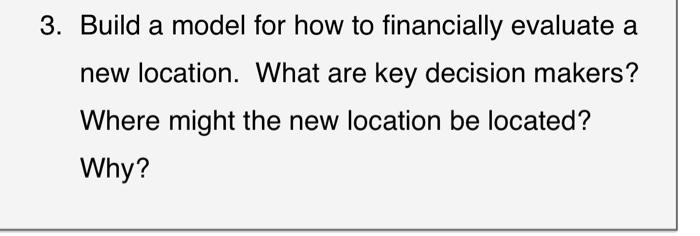
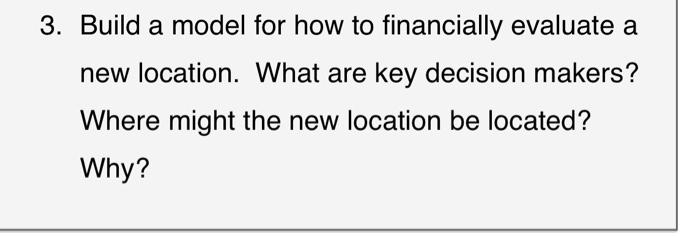
3. Build a model for how to financially evaluate a new location. What are key decision makers? Where might the new location be located? Why? 3. Build a model for how to financially evaluate a new location. What are key decision makers? Where might the new location be located? Why? 3. Build a model for how to financially evaluate a new location. What are key decision makers? Where might the new location be located? Why? 3. Build a model for how to financially evaluate a new location. What are key decision makers? Where might the new location be located? Why
Step by Step Solution
There are 3 Steps involved in it

Get step-by-step solutions from verified subject matter experts
 Study Help