Question: Process Analysis: Develop a Supplier, Input, Process, Output, Customer (SIPOC) map of the whole process to capture the context and scope of the process. Process
- Process Analysis:
- Develop a Supplier, Input, Process, Output, Customer (SIPOC) map of the whole process to capture the context and scope of the process.
- Process Modelling:
- Produce complete as-is process models ONLY for the section Recruitment and selection
- Since all staff members at Talent Seek are very busy, you will not be able to gather further information (e.g., interviews) from the organisation. You will have to make appropriate assumptions. Describe assumptions that you make about the section Recruitment and selection particularly areas where the information provided in the case is not sufficient or not clear.
- Process analysis
- Develop an issues register for this process. Please provide the qualitative and quantitative impact where possible. How do you prioritise these issues? Please only provide 6 issues. (The issues dont have to be related to the Recruitment and Selection process they can relate to any part of the overall recruitment process)
- Please describe the qualitative impact in detail. If appropriate, you need to specify if the issue is a non-value adding activity or waste and what kind of waste.
- For the quantitative impact you need to explain in detail which values you use, why and the calculation steps.
- Please provide a PICK Chart or Pareto chart where you visualize the issues.
- Conduct a root cause analysis for the top priority issue identified. Only one root cause analysis required. You can draw a why-why diagram or a fishbone diagram.
- Process improvements:
- Use the different Process Redesign Heuristics to develop two short term (within 3-6 months) and two long term (within 12-18 months) improvements for this process.
Attached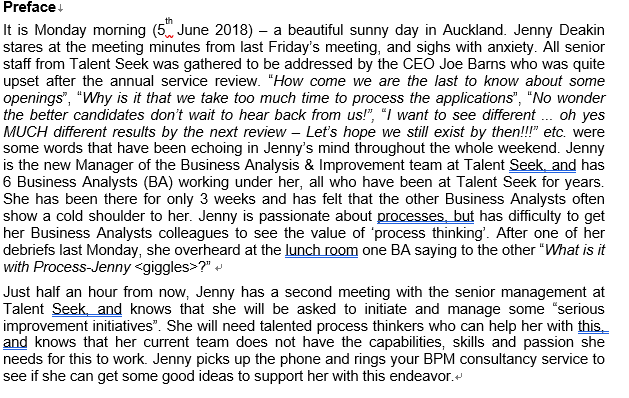
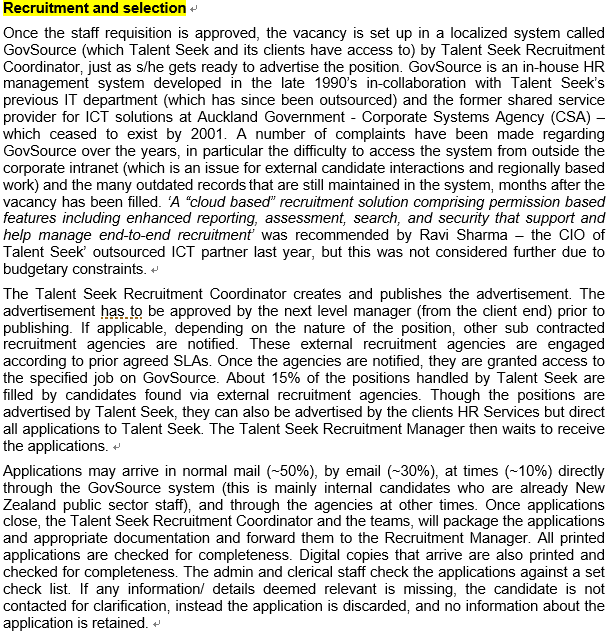
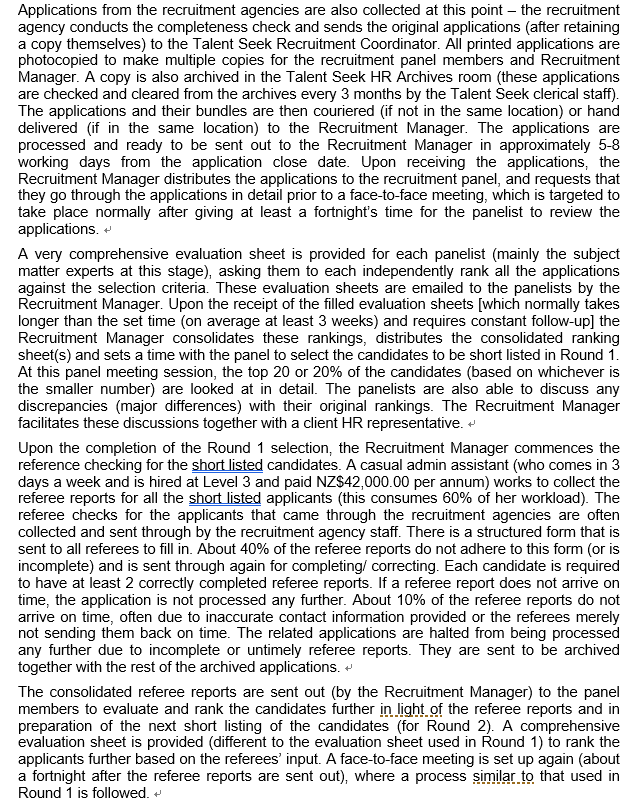
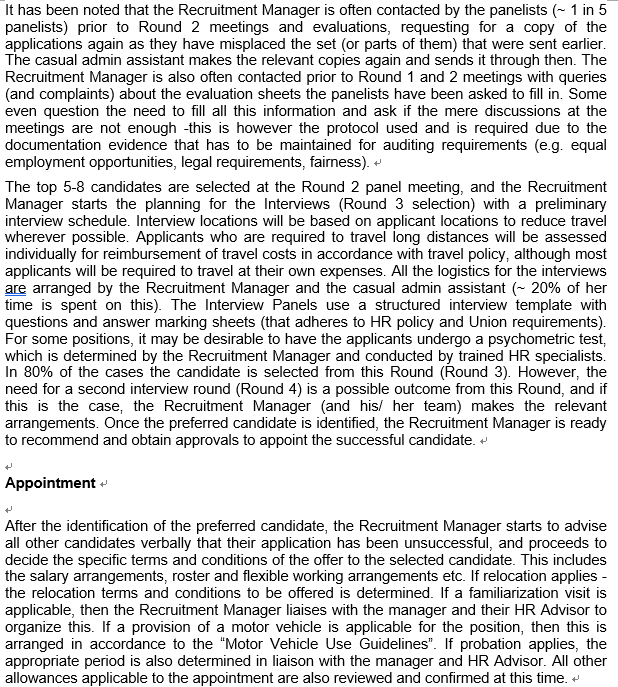
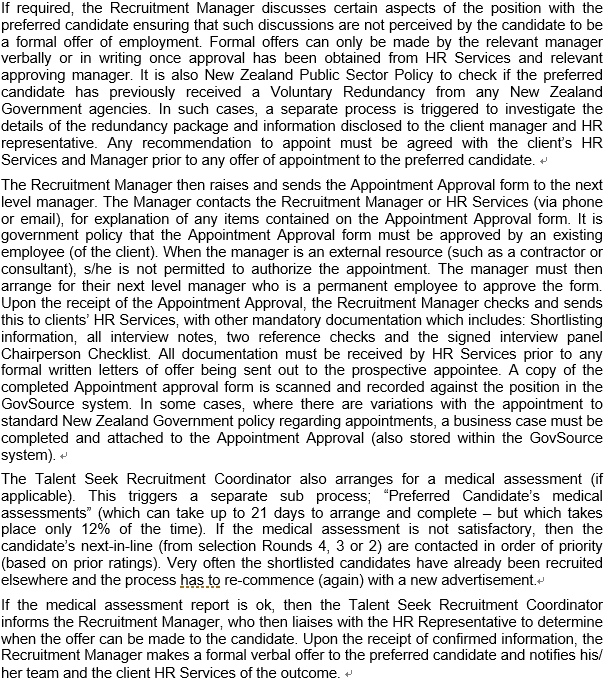
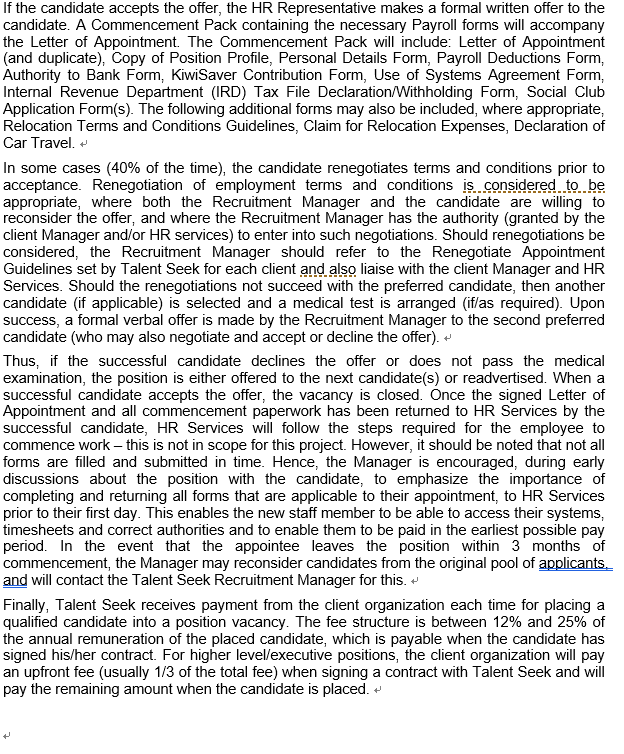 information down below
Preface It is Monday morning (5) June 2018) - a beautiful sunny day in Auckland. Jenny Deakin stares at the meeting minutes from last Friday's meeting, and sighs with anxiety. All senior staff from Talent Seek was gathered to be addressed by the CEO Joe Barns who was quite upset after the annual service review. "How come we are the last to know about some openings, Why is it that we take too much time to process the applications", "No wonder the better candidates don't wait to hear back from us!", "I want to see different ... oh yes MUCH different results by the next review Let's hope we still exist by then!!!" etc. were some words that have been echoing in Jenny's mind throughout the whole weekend. Jenny is the new Manager of the Business Analysis & Improvement team at Talent Seek, and has 6 Business Analysts (BA) working under her, all who have been at Talent Seek for years. She has been there for only 3 weeks and has felt that the other Business Analysts often show a cold shoulder to her. Jenny is passionate about processes, but has difficulty to get her Business Analysts colleagues to see the value of 'process thinking'. After one of her debriefs last Monday, she overheard at the lunch room one BA saying to the other "What is it with Process-Jenny
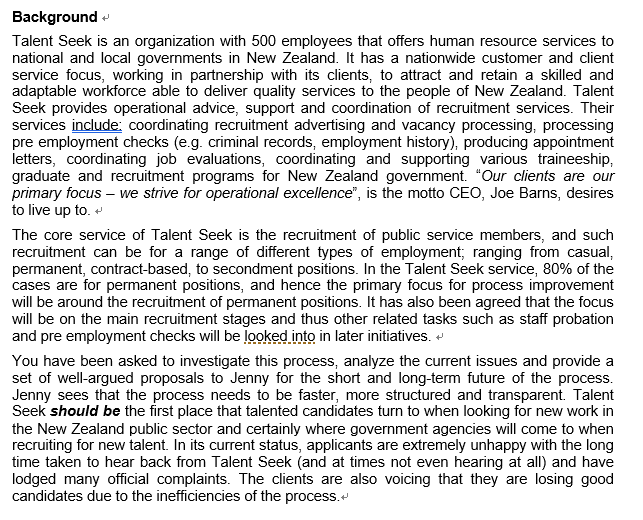
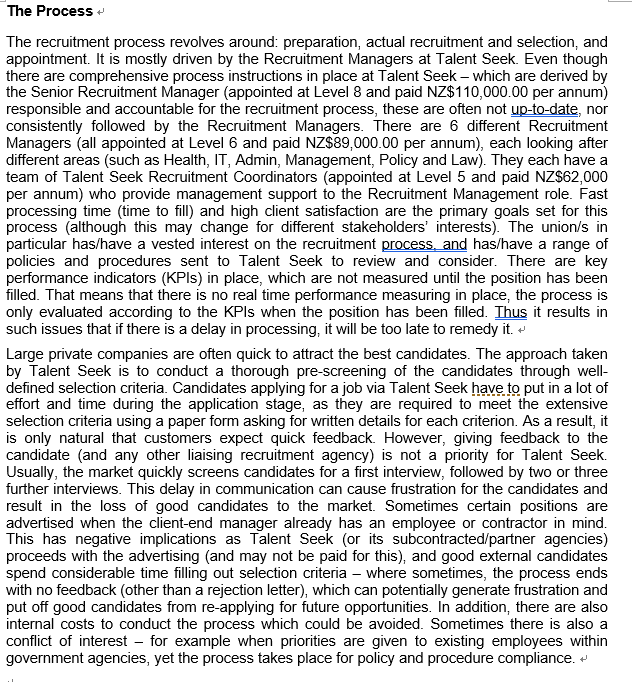
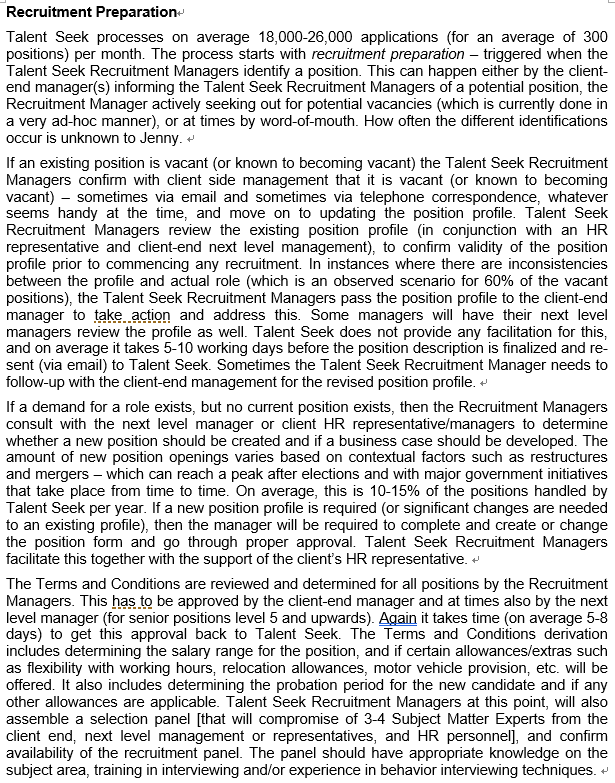
?" + Just half an hour from now, Jenny has a second meeting with the senior management at Talent Seek, and knows that she will be asked to initiate and manage some "serious improvement initiatives". She will need talented process thinkers who can help her with this. and knows that her current team does not have the capabilities, skills and passion she needs for this to work. Jenny picks up the phone and rings your BPM consultancy service to see if she can get some good ideas to support her with this endeavor. t Background Talent Seek is an organization with 500 employees that offers human resource services to national and local governments in New Zealand. It has a nationwide customer and client service focus, working in partnership with its clients, to attract and retain a skilled and adaptable workforce able to deliver quality services to the people of New Zealand. Talent Seek provides operational advice, support and coordination of recruitment services. Their services include coordinating recruitment advertising and vacancy processing, processing pre employment checks (e.g. criminal records, employment history), producing appointment letters, coordinating job evaluations, coordinating and supporting various traineeship, graduate and recruitment programs for New Zealand government. "Our clients are our primary focus - We strive for operational excellence", is the motto CEO, Joe Barns, desires to live up to. + The core service of Talent Seek is the recruitment of public service members, and such recruitment can be for a range of different types of employment; ranging from casual, permanent, contract-based, to secondment positions. In the Talent Seek service, 80% of the cases are for permanent positions, and hence the primary focus for process improvement will be around the recruitment of permanent positions. It has also been agreed that the focus will be on the main recruitment stages and thus other related tasks such as staff probation and pre employment checks will be looked into in later initiatives. + You have been asked to investigate this process, analyze the current issues and provide a set of well-argued proposals to Jenny for the short and long-term future of the process. Jenny sees that the process needs to be faster, more structured and transparent. Talent Seek should be the first place that talented candidates turn to when looking for new work in the New Zealand public sector and certainly where government agencies will come to when recruiting for new talent. In its current status, applicants are extremely unhappy with the long time taken to hear back from Talent Seek (and at times not even hearing at all) and have lodged many official complaints. The clients are also voicing that they are losing good candidates due to the inefficiencies of the process. The Process The recruitment process revolves around: preparation, actual recruitment and selection, and appointment. It is mostly driven by the Recruitment Managers at Talent Seek. Even though there are comprehensive process instructions in place at Talent Seek - which are derived by the Senior Recruitment Manager (appointed at Level 8 and paid NZ$110,000.00 per annum) responsible and accountable for the recruitment process, these are often not up-to-date, nor consistently followed by the Recruitment Managers. There are 6 different Recruitment Managers (all appointed at Level 6 and paid NZ$89,000.00 per annum), each looking after different areas (such as Health, IT, Admin, Management, Policy and Law). They each have a team of Talent Seek Recruitment Coordinators (appointed at Level 5 and paid NZ$62,000 per annum) who provide management support to the Recruitment Management role. Fast processing time (time to fill) and high client satisfaction are the primary goals set for this process (although this may change for different stakeholders' interests). The union/s in particular has/have a vested interest on the recruitment process, and has/have a range of policies and procedures sent to Talent Seek to review and consider. There are key performance indicators (KPIs) in place, which are not measured until the position has been filled. That means that there is no real time performance measuring in place, the process is only evaluated according to the KPIs when the position has been filled. Thus it results in such issues that if there is a delay in processing, it will be too late to remedy it. + Large private companies are often quick to attract the best candidates. The approach taken by Talent Seek is to conduct a thorough pre-screening of the candidates through well- defined selection criteria. Candidates applying for a job via Talent Seek have to put in a lot of effort and time during the application stage, as they are required to meet the extensive selection criteria using a paper form asking for written details for each criterion. As a result, it is only natural that customers expect quick feedback. However, giving feedback to the candidate (and any other liaising recruitment agency) is not a priority for Talent Seek. Usually, the market quickly screens candidates for a first interview, followed by two or three further interviews. This delay in communication can cause frustration for the candidates and result in the loss of good candidates to the market. Sometimes certain positions are advertised when the client-end manager already has an employee or contractor in mind. This has negative implications as Talent Seek (or its subcontracted/partner agencies) proceeds with the advertising (and may not be paid for this), and good external candidates spend considerable time filling out selection criteria - where sometimes, the process ends with no feedback (other than a rejection letter), which can potentially generate frustration and put off good candidates from re-applying for future opportunities. In addition, there are also internal costs to conduct the process which could be avoided. Sometimes there is also a conflict of interest for example when priorities are given to existing employees within government agencies, yet the process takes place for policy and procedure compliance. + Recruitment Preparation- Talent Seek processes on average 18,000-26,000 applications (for an average of 300 positions) per month. The process starts with recruitment preparation triggered when the Talent Seek Recruitment Managers identify a position. This can happen either by the client- end manager(s) informing the Talent Seek Recruitment Managers of a potential position, the Recruitment Manager actively seeking out for potential vacancies (which is currently done in a very ad-hoc manner), or at times by word-of-mouth. How often the different identifications occur is unknown to Jenny. + If an existing position is vacant (or known to becoming vacant) the Talent Seek Recruitment Managers confirm with client side management that it is vacant (or known to becoming vacant) sometimes via email and sometimes via telephone correspondence, whatever seems handy at the time, and move on to updating the position profile. Talent Seek Recruitment Managers review the existing position profile (in conjunction with an HR representative and client-end next level management), to confirm validity of the position profile prior to commencing any recruitment. In instances where there are inconsistencies between the profile and actual role (which is an observed scenario for 60% of the vacant positions), the Talent Seek Recruitment Managers pass the position profile to the client-end manager to take action and address this. Some managers will have their next level managers review the profile as well. Talent Seek does not provide any facilitation for this, and on average it takes 5-10 working days before the position description is finalized and re- sent (via email) to Talent Seek. Sometimes the Talent Seek Recruitment Manager needs to follow-up with the client-end management for the revised position profile. If a demand for a role exists, but no current position exists, then the Recruitment Managers consult with the next level manager or client HR representative/managers to determine whether a new position should be created and if a business case should be developed. The amount of new position openings varies based on contextual factors such as restructures and mergers - which can reach a peak after elections and with major government initiatives that take place from time to time. On average, this is 10-15% of the positions handled by Talent Seek per year. If a new position profile is required (or significant changes are needed to an existing profile), then the manager will be required to complete and create or change the position form and go through proper approval. Talent Seek Recruitment Managers facilitate this together with the support of the client's HR representative. The Terms and Conditions are reviewed and determined for all positions by the Recruitment Managers. This has to be approved by the client-end manager and at times also by the next level manager (for senior positions level 5 and upwards). Again it takes time (on average 5-8 days) to get this approval back to Talent Seek. The Terms and Conditions derivation includes determining the salary range for the position, and if certain allowances/extras such as flexibility with working hours, relocation allowances, motor vehicle provision, etc. will be offered. It also includes determining the probation period for the new candidate and if any other allowances are applicable. Talent Seek Recruitment Managers at this point, will also assemble a selection panel (that will compromise of 3-4 Subject Matter Experts from the client end, next level management or representatives, and HR personnel], and confirm availability of the recruitment panel. The panel should have appropriate knowledge on the subject area, training in interviewing and/or experience in behavior interviewing techniques. + Recruitment and selection Once the staff requisition is approved, the vacancy is set up in a localized system called GovSource (which Talent Seek and its clients have access to) by Talent Seek Recruitment Coordinator, just as s/he gets ready to advertise the position. GovSource is an in-house HR management system developed in the late 1990's in-collaboration with Talent Seek's previous IT department (which has since been outsourced) and the former shared service provider for ICT solutions at Auckland Government - Corporate Systems Agency (CSA) - which ceased to exist by 2001. A number of complaints have been made regarding GovSource over the years, in particular the difficulty to access the system from outside the corporate intranet (which is an issue for external candidate interactions and regionally based work) and the many outdated records that are still maintained in the system, months after the vacancy has been filled. 'A "cloud based" recruitment solution comprising permission based features including enhanced reporting, assessment, search, and security that support and help manage end-to-end recruitment was recommended by Ravi Sharma the CIO of Talent Seek' outsourced ICT partner last year, but this was not considered further due to budgetary constraints. + The Talent Seek Recruitment Coordinator creates and publishes the advertisement. The advertisement has to be approved by the next level manager (from the client end) prior to publishing. If applicable, depending on the nature of the position, other sub contracted recruitment agencies are notified. These external recruitment agencies are engaged according to prior agreed SLAs. Once the agencies are notified, they are granted access to the specified job on GovSource. About 15% of the positions handled by Talent Seek are filled by candidates found via external recruitment agencies. Though the positions are advertised by Talent Seek, they can also be advertised by the clients HR Services but direct all applications to Talent Seek. The Talent Seek Recruitment Manager then waits to receive the applications. Applications may arrive in normal mail (-50%), by email (-30%), at times (-10%) directly through the GovSource system (this is mainly internal candidates who are already New Zealand public sector staff), and through the agencies at other times. Once applications close, the Talent Seek Recruitment Coordinator and the teams, will package the applications and appropriate documentation and forward them to the Recruitment Manager. All printed applications are checked for completeness. Digital copies that arrive are also printed and checked for completeness. The admin and clerical staff check the applications against a set check list. If any information/ details deemed relevant is missing, the candidate is not contacted for clarification, instead the application is discarded, and no information about the application is retained. + Applications from the recruitment agencies are also collected at this point the recruitment agency conducts the completeness check and sends the original applications (after retaining a copy themselves) to the Talent Seek Recruitment Coordinator. All printed applications are photocopied to make multiple copies for the recruitment panel members and Recruitment Manager. A copy is also archived in the Talent Seek HR Archives room (these applications are checked and cleared from the archives every 3 months by the Talent Seek clerical staff). The applications and their bundles are then couriered (if not in the same location) or hand delivered (if in the same location) to the Recruitment Manager. The applications are processed and ready to be sent out to the Recruitment Manager in approximately 5-8 working days from the application close date. Upon receiving the applications, the Recruitment Manager distributes the applications to the recruitment panel, and requests that they go through the applications in detail prior to a face-to-face meeting, which is targeted to take place normally after giving at least a fortnight's time for the panelist to review the applications. + A very comprehensive evaluation sheet is provided for each panelist (mainly the subject matter experts at this stage), asking them to each independently rank all the applications against the selection criteria. These evaluation sheets are emailed to the panelists by the Recruitment Manager. Upon the receipt of the filled evaluation sheets (which normally takes longer than the set time (on average at least 3 weeks) and requires constant follow-up] the Recruitment Manager consolidates these rankings, distributes the consolidated ranking sheet(s) and sets a time with the panel to select the candidates to be short listed in Round 1. At this panel meeting session, the top 20 or 20% of the candidates (based on whichever is the smaller number) are looked at in detail. The panelists are also able to discuss any discrepancies (major differences) with their original rankings. The Recruitment Manager facilitates these discussions together with a client HR representative. + Upon the completion of the Round 1 selection, the Recruitment Manager commences the reference checking for the short listed candidates. A casual admin assistant (who comes in 3 days a week and is hired at Level 3 and paid NZ$42,000.00 per annum) works to collect the referee reports for all the short listed applicants (this consumes 60% of her workload). The referee checks for the applicants that came through the recruitment agencies are often collected and sent through by the recruitment agency staff. There is a structured form that is sent to all referees to fill in. About 40% of the referee reports do not adhere to this form (or is incomplete) and is sent through again for completing/ correcting. Each candidate is required to have at least 2 correctly completed referee reports. If a referee report does not arrive on time, the application is not processed any further. About 10% of the referee reports do not arrive on time, often due to inaccurate contact information provided or the referees merely not sending them back on time. The related applications are halted from being processed any further due to incomplete or untimely referee reports. They are sent to be archived together with the rest of the archived applications. + The consolidated referee reports are sent out (by the Recruitment Manager) to the panel members to evaluate and rank the candidates further in light of the referee reports and in preparation of the next short listing of the candidates (for Round 2). A comprehensive evaluation sheet is provided (different to the evaluation sheet used in Round 1) to rank the applicants further based on the referees' input. A face-to-face meeting is set up again (about a fortnight after the referee reports are sent out), where a process similar to that used in Round 1 is followed. + It has been noted that the Recruitment Manager is often contacted by the panelists (-1 in 5 panelists) prior to Round 2 meetings and evaluations, requesting for a copy of the applications again as they have misplaced the set (or parts of them) that were sent earlier. The casual admin assistant makes the relevant copies again and sends it through then. The Recruitment Manager is also often contacted prior to Round 1 and 2 meetings with queries (and complaints) about the evaluation sheets the panelists have been asked to fill in. Some even question the need to fill all this information and ask if the mere discussions at the meetings are not enough - this is however the protocol used and is required due to the documentation evidence that has to be maintained for auditing requirements (e.g. equal employment opportunities, legal requirements, fairness). The top 5-8 candidates are selected at the Round 2 panel meeting, and the Recruitment Manager starts the planning for the Interviews (Round 3 selection) with a preliminary interview schedule. Interview locations will be based on applicant locations to reduce travel wherever possible. Applicants who are required to travel long distances will be assessed individually for reimbursement of travel costs in accordance with travel policy, although most applicants will be required to travel at their own expenses. All the logistics for the interviews are arranged by the Recruitment Manager and the casual admin assistant (- 20% of her time is spent on this). The Interview Panels use a structured interview template with questions and answer marking sheets (that adheres to HR policy and Union requirements). For some positions, it may be desirable to have the applicants undergo a psychometric test, which is determined by the Recruitment Manager and conducted by trained HR specialists. In 80% of the cases the candidate is selected from this Round (Round 3). However, the need for a second interview round (Round 4) is a possible outcome from this Round, and if this is the case, the Recruitment Manager (and his/her team) makes the relevant arrangements. Once the preferred candidate is identified, the Recruitment Manager is ready to recommend and obtain approvals to appoint the successful candidate. + t Appointment After the identification of the preferred candidate, the Recruitment Manager starts to advise all other candidates verbally that their application has been unsuccessful, and proceeds to decide the specific terms and conditions of the offer to the selected candidate. This includes the salary arrangements, roster and flexible working arrangements etc. If relocation applies - the relocation terms and conditions to be offered is determined. If a familiarization visit is applicable, then the Recruitment Manager liaises with the manager and their HR Advisor to organize this. If a provision of a motor vehicle is applicable for the position, then this is arranged in accordance to the "Motor Vehicle Use Guidelines". If probation applies, the appropriate period is also determined in liaison with the manager and HR Advisor. All other allowances applicable to the appointment are also reviewed and confirmed at this time. + If required, the Recruitment Manager discusses certain aspects of the position with the preferred candidate ensuring that such discussions are not perceived by the candidate to be a formal offer of employment. Formal offers can only be made by the relevant manager verbally or in writing once approval has been obtained from HR Services and relevant approving manager. It is also New Zealand Public Sector Policy to check if the preferred candidate has previously received a Voluntary Redundancy from any New Zealand Government agencies. In such cases, a separate process is triggered to investigate the details of the redundancy package and information disclosed to the client manager and HR representative. Any recommendation to appoint must be agreed with the client's HR Services and Manager prior to any offer of appointment to the preferred candidate. + The Recruitment Manager then raises and sends the Appointment Approval form to the next level manager. The Manager contacts the Recruitment Manager or HR Services (via phone or email), for explanation of any items contained on the Appointment Approval form. It is government policy that the Appointment Approval form must be approved by an existing employee (of the client). When the manager is an external resource (such as a contractor or consultant), s/he is not permitted to authorize the appointment. The manager must then arrange for their next level manager who is a permanent employee to approve the form. Upon the receipt of the Appointment Approval, the Recruitment Manager checks and sends this to clients' HR Services, with other mandatory documentation which includes: Shortlisting information, all interview notes, two reference checks and the signed interview panel Chairperson Checklist. All documentation must be received by HR Services prior to any formal written letters of offer being sent out to the prospective appointee. A copy of the completed Appointment approval form is scanned and recorded against the position in the GovSource system. In some cases, where there are variations with the appointment to standard New Zealand Government policy regarding appointments, a business case must be completed and attached to the Appointment Approval (also stored within the GovSource system). The Talent Seek Recruitment Coordinator also arranges for a medical assessment (if applicable). This triggers a separate sub process; "Preferred Candidate's medical assessments" (which can take up to 21 days to arrange and complete but which takes place only 12% of the time). If the medical assessment is not satisfactory, then the candidate's next-in-line (from selection Rounds 4, 3 or 2) are contacted in order of priority (based on prior ratings). Very often the shortlisted candidates have already been recruited elsewhere and the process has to re-commence (again) with a new advertisement - If the medical assessment report is ok, then the Talent Seek Recruitment Coordinator informs the Recruitment Manager, who then liaises with the HR Representative to determine when the offer can be made to the candidate. Upon the receipt of confirmed information, the Recruitment Manager makes a formal verbal offer to the preferred candidate and notifies his/ her team and the client HR Services of the outcome. + If the candidate accepts the offer, the HR Representative makes a formal written offer to the candidate. A Commencement Pack containing the necessary Payroll forms will accompany the Letter of Appointment. The Commencement Pack will include: Letter of Appointment (and duplicate), Copy of Position Profile, Personal Details Form, Payroll Deductions Form, Authority to Bank Form, KiwiSaver Contribution Form, Use of Systems Agreement Form, Internal Revenue Department (IRD) Tax File Declaration/Withholding Form, Social Club Application Form(s). The following additional forms may also be included, where appropriate, Relocation Terms and Conditions Guidelines, Claim for Relocation Expenses, Declaration of Car Travel. + In some cases (40% of the time), the candidate renegotiates terms and conditions prior to acceptance. Renegotiation of employment terms and conditions is considered to be appropriate, where both the Recruitment Manager and the candidate are willing to reconsider the offer, and where the Recruitment Manager has the authority (granted by the client Manager and/or HR services) to enter into such negotiations. Should renegotiations be considered, the Recruitment Manager should refer to the Renegotiate Appointment Guidelines set by Talent Seek for each client and also liaise with the client Manager and HR Services. Should the renegotiations not succeed with the preferred candidate, then another candidate (if applicable) is selected and a medical test is arranged (if/as required). Upon success, a formal verbal offer is made by the Recruitment Manager to the second preferred candidate (who may also negotiate and accept or decline the offer). + Thus, if the successful candidate declines the offer or does not pass the medical examination, the position is either offered to the next candidate(s) or readvertised. When a successful candidate accepts the offer, the vacancy is closed. Once the signed Letter of Appointment and all commencement paperwork has been returned to HR Services by the successful candidate, HR Services will follow the steps required for the employee to commence work - this is not in scope for this project. However, it should be noted that not all forms are filled and submitted in time. Hence, the Manager is encouraged, during early discussions about the position with the candidate, to emphasize the importance of completing and returning all forms that are applicable to their appointment, to HR Services prior to their first day. This enables the new staff member to be able to access their systems, timesheets and correct authorities and to enable them to be paid in the earliest possible pay period. In the event that the appointee leaves the position within 3 months of commencement the Manager may reconsider candidates from the original pool of applicants. and will contact the Talent Seek Recruitment Manager for this. + Finally, Talent Seek receives payment from the client organization each time for placing a qualified candidate into a position vacancy. The fee structure is between 12% and 25% of the annual remuneration of the placed candidate, which is payable when the candidate has signed his/her contract. For higher level/executive positions, the client organization will pay an upfront fee (usually 1/3 of the total fee) when signing a contract with Talent Seek and will pay the remaining amount when the candidate is placed. Preface It is Monday morning (5) June 2018) - a beautiful sunny day in Auckland. Jenny Deakin stares at the meeting minutes from last Friday's meeting, and sighs with anxiety. All senior staff from Talent Seek was gathered to be addressed by the CEO Joe Barns who was quite upset after the annual service review. "How come we are the last to know about some openings, Why is it that we take too much time to process the applications", "No wonder the better candidates don't wait to hear back from us!", "I want to see different ... oh yes MUCH different results by the next review Let's hope we still exist by then!!!" etc. were some words that have been echoing in Jenny's mind throughout the whole weekend. Jenny is the new Manager of the Business Analysis & Improvement team at Talent Seek, and has 6 Business Analysts (BA) working under her, all who have been at Talent Seek for years. She has been there for only 3 weeks and has felt that the other Business Analysts often show a cold shoulder to her. Jenny is passionate about processes, but has difficulty to get her Business Analysts colleagues to see the value of 'process thinking'. After one of her debriefs last Monday, she overheard at the lunch room one BA saying to the other "What is it with Process-Jenny ?" + Just half an hour from now, Jenny has a second meeting with the senior management at Talent Seek, and knows that she will be asked to initiate and manage some "serious improvement initiatives". She will need talented process thinkers who can help her with this. and knows that her current team does not have the capabilities, skills and passion she needs for this to work. Jenny picks up the phone and rings your BPM consultancy service to see if she can get some good ideas to support her with this endeavor. t Background Talent Seek is an organization with 500 employees that offers human resource services to national and local governments in New Zealand. It has a nationwide customer and client service focus, working in partnership with its clients, to attract and retain a skilled and adaptable workforce able to deliver quality services to the people of New Zealand. Talent Seek provides operational advice, support and coordination of recruitment services. Their services include coordinating recruitment advertising and vacancy processing, processing pre employment checks (e.g. criminal records, employment history), producing appointment letters, coordinating job evaluations, coordinating and supporting various traineeship, graduate and recruitment programs for New Zealand government. "Our clients are our primary focus - We strive for operational excellence", is the motto CEO, Joe Barns, desires to live up to. + The core service of Talent Seek is the recruitment of public service members, and such recruitment can be for a range of different types of employment; ranging from casual, permanent, contract-based, to secondment positions. In the Talent Seek service, 80% of the cases are for permanent positions, and hence the primary focus for process improvement will be around the recruitment of permanent positions. It has also been agreed that the focus will be on the main recruitment stages and thus other related tasks such as staff probation and pre employment checks will be looked into in later initiatives. + You have been asked to investigate this process, analyze the current issues and provide a set of well-argued proposals to Jenny for the short and long-term future of the process. Jenny sees that the process needs to be faster, more structured and transparent. Talent Seek should be the first place that talented candidates turn to when looking for new work in the New Zealand public sector and certainly where government agencies will come to when recruiting for new talent. In its current status, applicants are extremely unhappy with the long time taken to hear back from Talent Seek (and at times not even hearing at all) and have lodged many official complaints. The clients are also voicing that they are losing good candidates due to the inefficiencies of the process. The Process The recruitment process revolves around: preparation, actual recruitment and selection, and appointment. It is mostly driven by the Recruitment Managers at Talent Seek. Even though there are comprehensive process instructions in place at Talent Seek - which are derived by the Senior Recruitment Manager (appointed at Level 8 and paid NZ$110,000.00 per annum) responsible and accountable for the recruitment process, these are often not up-to-date, nor consistently followed by the Recruitment Managers. There are 6 different Recruitment Managers (all appointed at Level 6 and paid NZ$89,000.00 per annum), each looking after different areas (such as Health, IT, Admin, Management, Policy and Law). They each have a team of Talent Seek Recruitment Coordinators (appointed at Level 5 and paid NZ$62,000 per annum) who provide management support to the Recruitment Management role. Fast processing time (time to fill) and high client satisfaction are the primary goals set for this process (although this may change for different stakeholders' interests). The union/s in particular has/have a vested interest on the recruitment process, and has/have a range of policies and procedures sent to Talent Seek to review and consider. There are key performance indicators (KPIs) in place, which are not measured until the position has been filled. That means that there is no real time performance measuring in place, the process is only evaluated according to the KPIs when the position has been filled. Thus it results in such issues that if there is a delay in processing, it will be too late to remedy it. + Large private companies are often quick to attract the best candidates. The approach taken by Talent Seek is to conduct a thorough pre-screening of the candidates through well- defined selection criteria. Candidates applying for a job via Talent Seek have to put in a lot of effort and time during the application stage, as they are required to meet the extensive selection criteria using a paper form asking for written details for each criterion. As a result, it is only natural that customers expect quick feedback. However, giving feedback to the candidate (and any other liaising recruitment agency) is not a priority for Talent Seek. Usually, the market quickly screens candidates for a first interview, followed by two or three further interviews. This delay in communication can cause frustration for the candidates and result in the loss of good candidates to the market. Sometimes certain positions are advertised when the client-end manager already has an employee or contractor in mind. This has negative implications as Talent Seek (or its subcontracted/partner agencies) proceeds with the advertising (and may not be paid for this), and good external candidates spend considerable time filling out selection criteria - where sometimes, the process ends with no feedback (other than a rejection letter), which can potentially generate frustration and put off good candidates from re-applying for future opportunities. In addition, there are also internal costs to conduct the process which could be avoided. Sometimes there is also a conflict of interest for example when priorities are given to existing employees within government agencies, yet the process takes place for policy and procedure compliance. + Recruitment Preparation- Talent Seek processes on average 18,000-26,000 applications (for an average of 300 positions) per month. The process starts with recruitment preparation triggered when the Talent Seek Recruitment Managers identify a position. This can happen either by the client- end manager(s) informing the Talent Seek Recruitment Managers of a potential position, the Recruitment Manager actively seeking out for potential vacancies (which is currently done in a very ad-hoc manner), or at times by word-of-mouth. How often the different identifications occur is unknown to Jenny. + If an existing position is vacant (or known to becoming vacant) the Talent Seek Recruitment Managers confirm with client side management that it is vacant (or known to becoming vacant) sometimes via email and sometimes via telephone correspondence, whatever seems handy at the time, and move on to updating the position profile. Talent Seek Recruitment Managers review the existing position profile (in conjunction with an HR representative and client-end next level management), to confirm validity of the position profile prior to commencing any recruitment. In instances where there are inconsistencies between the profile and actual role (which is an observed scenario for 60% of the vacant positions), the Talent Seek Recruitment Managers pass the position profile to the client-end manager to take action and address this. Some managers will have their next level managers review the profile as well. Talent Seek does not provide any facilitation for this, and on average it takes 5-10 working days before the position description is finalized and re- sent (via email) to Talent Seek. Sometimes the Talent Seek Recruitment Manager needs to follow-up with the client-end management for the revised position profile. If a demand for a role exists, but no current position exists, then the Recruitment Managers consult with the next level manager or client HR representative/managers to determine whether a new position should be created and if a business case should be developed. The amount of new position openings varies based on contextual factors such as restructures and mergers - which can reach a peak after elections and with major government initiatives that take place from time to time. On average, this is 10-15% of the positions handled by Talent Seek per year. If a new position profile is required (or significant changes are needed to an existing profile), then the manager will be required to complete and create or change the position form and go through proper approval. Talent Seek Recruitment Managers facilitate this together with the support of the client's HR representative. The Terms and Conditions are reviewed and determined for all positions by the Recruitment Managers. This has to be approved by the client-end manager and at times also by the next level manager (for senior positions level 5 and upwards). Again it takes time (on average 5-8 days) to get this approval back to Talent Seek. The Terms and Conditions derivation includes determining the salary range for the position, and if certain allowances/extras such as flexibility with working hours, relocation allowances, motor vehicle provision, etc. will be offered. It also includes determining the probation period for the new candidate and if any other allowances are applicable. Talent Seek Recruitment Managers at this point, will also assemble a selection panel (that will compromise of 3-4 Subject Matter Experts from the client end, next level management or representatives, and HR personnel], and confirm availability of the recruitment panel. The panel should have appropriate knowledge on the subject area, training in interviewing and/or experience in behavior interviewing techniques. + Recruitment and selection Once the staff requisition is approved, the vacancy is set up in a localized system called GovSource (which Talent Seek and its clients have access to) by Talent Seek Recruitment Coordinator, just as s/he gets ready to advertise the position. GovSource is an in-house HR management system developed in the late 1990's in-collaboration with Talent Seek's previous IT department (which has since been outsourced) and the former shared service provider for ICT solutions at Auckland Government - Corporate Systems Agency (CSA) - which ceased to exist by 2001. A number of complaints have been made regarding GovSource over the years, in particular the difficulty to access the system from outside the corporate intranet (which is an issue for external candidate interactions and regionally based work) and the many outdated records that are still maintained in the system, months after the vacancy has been filled. 'A "cloud based" recruitment solution comprising permission based features including enhanced reporting, assessment, search, and security that support and help manage end-to-end recruitment was recommended by Ravi Sharma the CIO of Talent Seek' outsourced ICT partner last year, but this was not considered further due to budgetary constraints. + The Talent Seek Recruitment Coordinator creates and publishes the advertisement. The advertisement has to be approved by the next level manager (from the client end) prior to publishing. If applicable, depending on the nature of the position, other sub contracted recruitment agencies are notified. These external recruitment agencies are engaged according to prior agreed SLAs. Once the agencies are notified, they are granted access to the specified job on GovSource. About 15% of the positions handled by Talent Seek are filled by candidates found via external recruitment agencies. Though the positions are advertised by Talent Seek, they can also be advertised by the clients HR Services but direct all applications to Talent Seek. The Talent Seek Recruitment Manager then waits to receive the applications. Applications may arrive in normal mail (-50%), by email (-30%), at times (-10%) directly through the GovSource system (this is mainly internal candidates who are already New Zealand public sector staff), and through the agencies at other times. Once applications close, the Talent Seek Recruitment Coordinator and the teams, will package the applications and appropriate documentation and forward them to the Recruitment Manager. All printed applications are checked for completeness. Digital copies that arrive are also printed and checked for completeness. The admin and clerical staff check the applications against a set check list. If any information/ details deemed relevant is missing, the candidate is not contacted for clarification, instead the application is discarded, and no information about the application is retained. + Applications from the recruitment agencies are also collected at this point the recruitment agency conducts the completeness check and sends the original applications (after retaining a copy themselves) to the Talent Seek Recruitment Coordinator. All printed applications are photocopied to make multiple copies for the recruitment panel members and Recruitment Manager. A copy is also archived in the Talent Seek HR Archives room (these applications are checked and cleared from the archives every 3 months by the Talent Seek clerical staff). The applications and their bundles are then couriered (if not in the same location) or hand delivered (if in the same location) to the Recruitment Manager. The applications are processed and ready to be sent out to the Recruitment Manager in approximately 5-8 working days from the application close date. Upon receiving the applications, the Recruitment Manager distributes the applications to the recruitment panel, and requests that they go through the applications in detail prior to a face-to-face meeting, which is targeted to take place normally after giving at least a fortnight's time for the panelist to review the applications. + A very comprehensive evaluation sheet is provided for each panelist (mainly the subject matter experts at this stage), asking them to each independently rank all the applications against the selection criteria. These evaluation sheets are emailed to the panelists by the Recruitment Manager. Upon the receipt of the filled evaluation sheets (which normally takes longer than the set time (on average at least 3 weeks) and requires constant follow-up] the Recruitment Manager consolidates these rankings, distributes the consolidated ranking sheet(s) and sets a time with the panel to select the candidates to be short listed in Round 1. At this panel meeting session, the top 20 or 20% of the candidates (based on whichever is the smaller number) are looked at in detail. The panelists are also able to discuss any discrepancies (major differences) with their original rankings. The Recruitment Manager facilitates these discussions together with a client HR representative. + Upon the completion of the Round 1 selection, the Recruitment Manager commences the reference checking for the short listed candidates. A casual admin assistant (who comes in 3 days a week and is hired at Level 3 and paid NZ$42,000.00 per annum) works to collect the referee reports for all the short listed applicants (this consumes 60% of her workload). The referee checks for the applicants that came through the recruitment agencies are often collected and sent through by the recruitment agency staff. There is a structured form that is sent to all referees to fill in. About 40% of the referee reports do not adhere to this form (or is incomplete) and is sent through again for completing/ correcting. Each candidate is required to have at least 2 correctly completed referee reports. If a referee report does not arrive on time, the application is not processed any further. About 10% of the referee reports do not arrive on time, often due to inaccurate contact information provided or the referees merely not sending them back on time. The related applications are halted from being processed any further due to incomplete or untimely referee reports. They are sent to be archived together with the rest of the archived applications. + The consolidated referee reports are sent out (by the Recruitment Manager) to the panel members to evaluate and rank the candidates further in light of the referee reports and in preparation of the next short listing of the candidates (for Round 2). A comprehensive evaluation sheet is provided (different to the evaluation sheet used in Round 1) to rank the applicants further based on the referees' input. A face-to-face meeting is set up again (about a fortnight after the referee reports are sent out), where a process similar to that used in Round 1 is followed. + It has been noted that the Recruitment Manager is often contacted by the panelists (-1 in 5 panelists) prior to Round 2 meetings and evaluations, requesting for a copy of the applications again as they have misplaced the set (or parts of them) that were sent earlier. The casual admin assistant makes the relevant copies again and sends it through then. The Recruitment Manager is also often contacted prior to Round 1 and 2 meetings with queries (and complaints) about the evaluation sheets the panelists have been asked to fill in. Some even question the need to fill all this information and ask if the mere discussions at the meetings are not enough - this is however the protocol used and is required due to the documentation evidence that has to be maintained for auditing requirements (e.g. equal employment opportunities, legal requirements, fairness). The top 5-8 candidates are selected at the Round 2 panel meeting, and the Recruitment Manager starts the planning for the Interviews (Round 3 selection) with a preliminary interview schedule. Interview locations will be based on applicant locations to reduce travel wherever possible. Applicants who are required to travel long distances will be assessed individually for reimbursement of travel costs in accordance with travel policy, although most applicants will be required to travel at their own expenses. All the logistics for the interviews are arranged by the Recruitment Manager and the casual admin assistant (- 20% of her time is spent on this). The Interview Panels use a structured interview template with questions and answer marking sheets (that adheres to HR policy and Union requirements). For some positions, it may be desirable to have the applicants undergo a psychometric test, which is determined by the Recruitment Manager and conducted by trained HR specialists. In 80% of the cases the candidate is selected from this Round (Round 3). However, the need for a second interview round (Round 4) is a possible outcome from this Round, and if this is the case, the Recruitment Manager (and his/her team) makes the relevant arrangements. Once the preferred candidate is identified, the Recruitment Manager is ready to recommend and obtain approvals to appoint the successful candidate. + t Appointment After the identification of the preferred candidate, the Recruitment Manager starts to advise all other candidates verbally that their application has been unsuccessful, and proceeds to decide the specific terms and conditions of the offer to the selected candidate. This includes the salary arrangements, roster and flexible working arrangements etc. If relocation applies - the relocation terms and conditions to be offered is determined. If a familiarization visit is applicable, then the Recruitment Manager liaises with the manager and their HR Advisor to organize this. If a provision of a motor vehicle is applicable for the position, then this is arranged in accordance to the "Motor Vehicle Use Guidelines". If probation applies, the appropriate period is also determined in liaison with the manager and HR Advisor. All other allowances applicable to the appointment are also reviewed and confirmed at this time. + If required, the Recruitment Manager discusses certain aspects of the position with the preferred candidate ensuring that such discussions are not perceived by the candidate to be a formal offer of employment. Formal offers can only be made by the relevant manager verbally or in writing once approval has been obtained from HR Services and relevant approving manager. It is also New Zealand Public Sector Policy to check if the preferred candidate has previously received a Voluntary Redundancy from any New Zealand Government agencies. In such cases, a separate process is triggered to investigate the details of the redundancy package and information disclosed to the client manager and HR representative. Any recommendation to appoint must be agreed with the client's HR Services and Manager prior to any offer of appointment to the preferred candidate. + The Recruitment Manager then raises and sends the Appointment Approval form to the next level manager. The Manager contacts the Recruitment Manager or HR Services (via phone or email), for explanation of any items contained on the Appointment Approval form. It is government policy that the Appointment Approval form must be approved by an existing employee (of the client). When the manager is an external resource (such as a contractor or consultant), s/he is not permitted to authorize the appointment. The manager must then arrange for their next level manager who is a permanent employee to approve the form. Upon the receipt of the Appointment Approval, the Recruitment Manager checks and sends this to clients' HR Services, with other mandatory documentation which includes: Shortlisting information, all interview notes, two reference checks and the signed interview panel Chairperson Checklist. All documentation must be received by HR Services prior to any formal written letters of offer being sent out to the prospective appointee. A copy of the completed Appointment approval form is scanned and recorded against the position in the GovSource system. In some cases, where there are variations with the appointment to standard New Zealand Government policy regarding appointments, a business case must be completed and attached to the Appointment Approval (also stored within the GovSource system). The Talent Seek Recruitment Coordinator also arranges for a medical assessment (if applicable). This triggers a separate sub process; "Preferred Candidate's medical assessments" (which can take up to 21 days to arrange and complete but which takes place only 12% of the time). If the medical assessment is not satisfactory, then the candidate's next-in-line (from selection Rounds 4, 3 or 2) are contacted in order of priority (based on prior ratings). Very often the shortlisted candidates have already been recruited elsewhere and the process has to re-commence (again) with a new advertisement - If the medical assessment report is ok, then the Talent Seek Recruitment Coordinator informs the Recruitment Manager, who then liaises with the HR Representative to determine when the offer can be made to the candidate. Upon the receipt of confirmed information, the Recruitment Manager makes a formal verbal offer to the preferred candidate and notifies his/ her team and the client HR Services of the outcome. + If the candidate accepts the offer, the HR Representative makes a formal written offer to the candidate. A Commencement Pack containing the necessary Payroll forms will accompany the Letter of Appointment. The Commencement Pack will include: Letter of Appointment (and duplicate), Copy of Position Profile, Personal Details Form, Payroll Deductions Form, Authority to Bank Form, KiwiSaver Contribution Form, Use of Systems Agreement Form, Internal Revenue Department (IRD) Tax File Declaration/Withholding Form, Social Club Application Form(s). The following additional forms may also be included, where appropriate, Relocation Terms and Conditions Guidelines, Claim for Relocation Expenses, Declaration of Car Travel. + In some cases (40% of the time), the candidate renegotiates terms and conditions prior to acceptance. Renegotiation of employment terms and conditions is considered to be appropriate, where both the Recruitment Manager and the candidate are willing to reconsider the offer, and where the Recruitment Manager has the authority (granted by the client Manager and/or HR services) to enter into such negotiations. Should renegotiations be considered, the Recruitment Manager should refer to the Renegotiate Appointment Guidelines set by Talent Seek for each client and also liaise with the client Manager and HR Services. Should the renegotiations not succeed with the preferred candidate, then another candidate (if applicable) is selected and a medical test is arranged (if/as required). Upon success, a formal verbal offer is made by the Recruitment Manager to the second preferred candidate (who may also negotiate and accept or decline the offer). + Thus, if the successful candidate declines the offer or does not pass the medical examination, the position is either offered to the next candidate(s) or readvertised. When a successful candidate accepts the offer, the vacancy is closed. Once the signed Letter of Appointment and all commencement paperwork has been returned to HR Services by the successful candidate, HR Services will follow the steps required for the employee to commence work - this is not in scope for this project. However, it should be noted that not all forms are filled and submitted in time. Hence, the Manager is encouraged, during early discussions about the position with the candidate, to emphasize the importance of completing and returning all forms that are applicable to their appointment, to HR Services prior to their first day. This enables the new staff member to be able to access their systems, timesheets and correct authorities and to enable them to be paid in the earliest possible pay period. In the event that the appointee leaves the position within 3 months of commencement the Manager may reconsider candidates from the original pool of applicants. and will contact the Talent Seek Recruitment Manager for this. + Finally, Talent Seek receives payment from the client organization each time for placing a qualified candidate into a position vacancy. The fee structure is between 12% and 25% of the annual remuneration of the placed candidate, which is payable when the candidate has signed his/her contract. For higher level/executive positions, the client organization will pay an upfront fee (usually 1/3 of the total fee) when signing a contract with Talent Seek and will pay the remaining amount when the candidate is placed
There are 3 Steps involved in it
Step: 1 Unlock

Step: 2 Unlock
Step: 3 Unlock








 Study Help