







Question: Based on your knowledge of inferential statistics, describe another statistical question you could ask using the data collected in the survey (described in the Methods
- Based on your knowledge of inferential statistics, describe another statistical question you could ask using the data collected in the survey (described in the "Methods" section). Be sure to explain what the explanatory and response variables would be and categorize them as quantitative or categorical to justify the use of this data to answer your question. Explain why your question is important to ask. A picture of the abstract is posted below, but if you'd like to read the entire article here is the link: https://www.researchgate.net/publication/352327859_High_food_insecurity_in_Latinx_families_and_associated_COVID-19_infection_in_the_Greater_Bay_Area_California
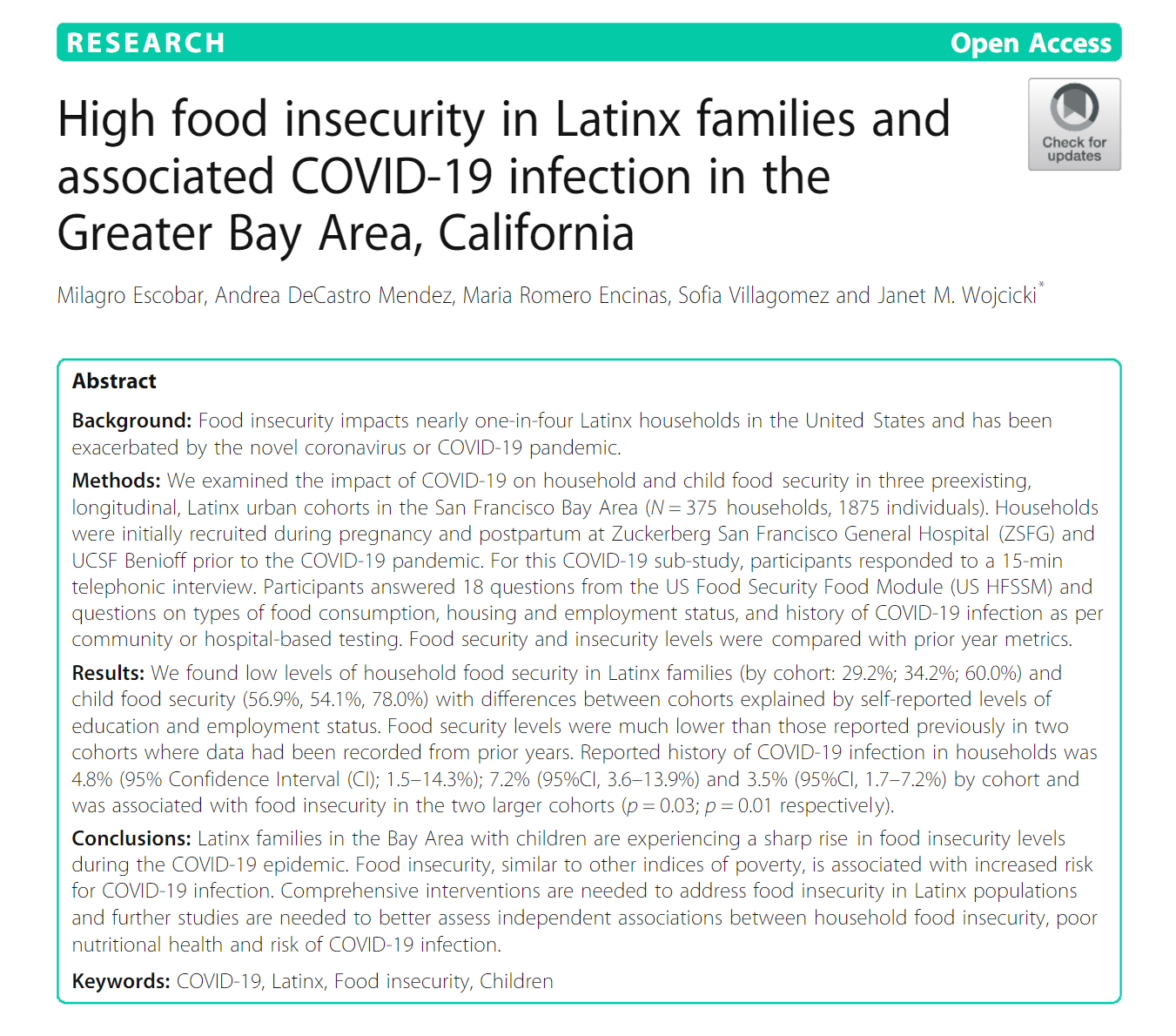
RESEARCH Open Access High food insecurity in Latinx families and Check for updates associated COVID-19 infection in the Greater Bay Area, California Milagro Escobar, Andrea DeCastro Mendez, Maria Romero Encinas, Sofia Villagomez and Janet M. Wojcicki Abstract Background: Food insecurity impacts nearly one-in-four Latinx households in the United States and has been exacerbated by the novel coronavirus or COVID-19 pandemic. Methods: We examined the impact of COVID-19 on household and child food security in three preexisting, longitudinal, Latinx urban cohorts in the San Francisco Bay Area (N = 375 households, 1875 individuals). Households were initially recruited during pregnancy and postpartum at Zuckerberg San Francisco General Hospital (ZSFG) and UCSF Benioff prior to the COVID-19 pandemic. For this COVID-19 sub-study, participants responded to a 15-min telephonic interview. Participants answered 18 questions from the US Food Security Food Module (US HFSSM) and questions on types of food consumption, housing and employment status, and history of COVID-19 infection as per community or hospital-based testing. Food security and insecurity levels were compared with prior year metrics. Results: We found low levels of household food security in Latinx families (by cohort: 29.2%; 34.2%; 60.0%) and child food security (56.9%, 54.1%, 78.0%) with differences between cohorts explained by self-reported levels of education and employment status. Food security levels were much lower than those reported previously in two cohorts where data had been recorded from prior years. Reported history of COVID-19 infection in households was 4.8% (95% Confidence Interval (CI); 1.5-14.3%); 7.2% (95%CI, 3.6-13.9%) and 3.5% (95%CI, 1.7-7.2%) by cohort and was associated with food insecurity in the two larger cohorts (p = 0.03; p = 0.01 respectively). Conclusions: Latinx families in the Bay Area with children are experiencing a sharp rise in food insecurity levels during the COVID-19 epidemic. Food insecurity, similar to other indices of poverty, is associated with increased risk for COVID-19 infection. Comprehensive interventions are needed to address food insecurity in Latinx populations and further studies are needed to better assess independent associations between household food insecurity, poor nutritional health and risk of COVID-19 infection. Keywords: COVID-19, Latinx, Food insecurity, Children
Step by Step Solution
There are 3 Steps involved in it

Get step-by-step solutions from verified subject matter experts
 Study Help