







Question: BASIC 1D KINEMATICS This assignment is about a car moving along a straight line, which we'll take to be the x axis. The car speeds
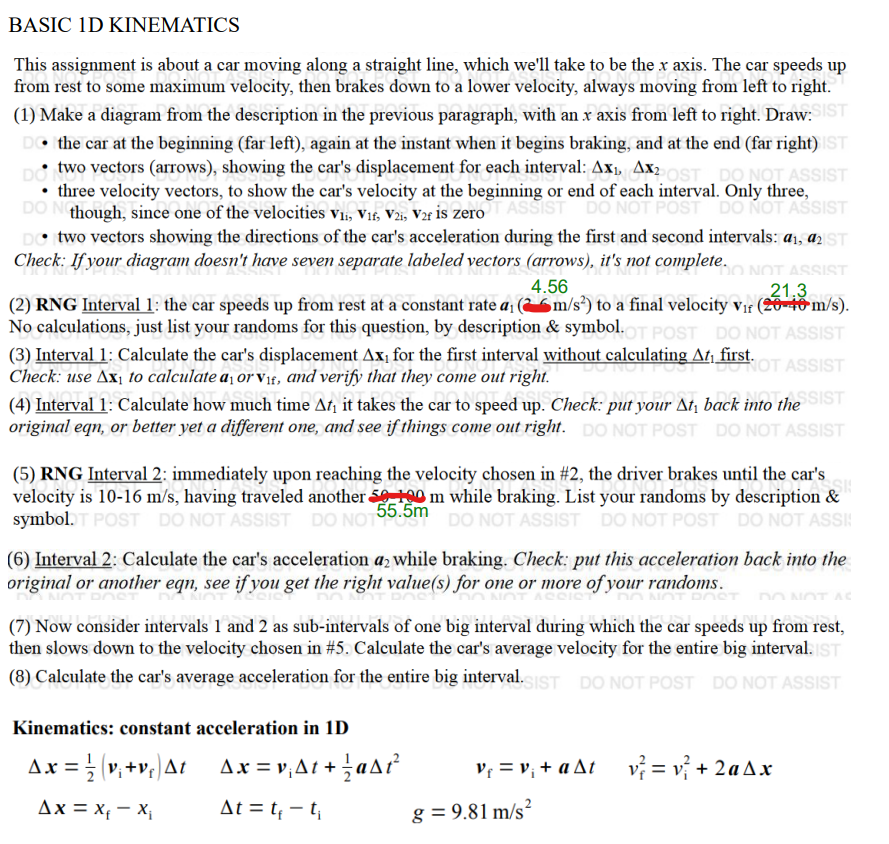
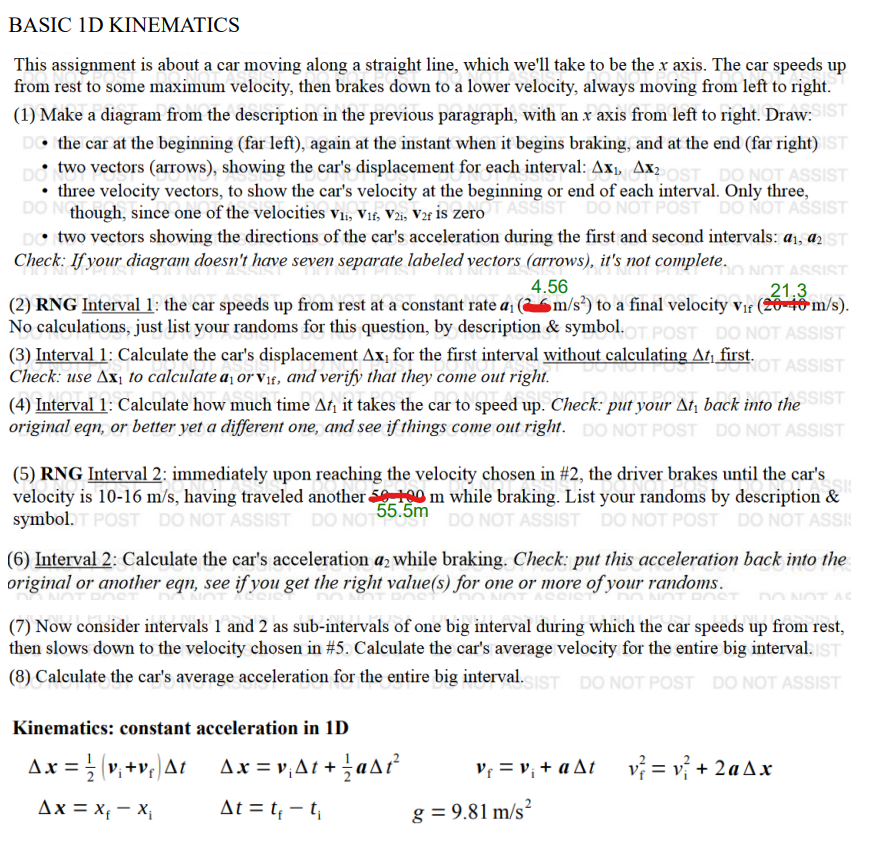
BASIC 1D KINEMATICS This assignment is about a car moving along a straight line, which we'll take to be the x axis. The car speeds up from rest to some maximum velocity, then brakes down to a lower velocity, always moving from left to right. (1) Make a diagram from the description in the previous paragraph, with an x axis from left to right. Draw: ST DO the car at the beginning (far left), again at the instant when it begins braking, and at the end (far right) IST two vectors (arrows), showing the car's displacement for each interval: AX AX OST DO NOT ASSIST . three velocity vectors, to show the car's velocity at the beginning or end of each interval. Only three, DO though, since one of the velocities Vli, Vif, V2i, Ver is zero ASSIST DO two vectors showing the directions of the car's acceleration during the first and second intervals: a1, a2 ST Check: If your diagram doesn't have seven separate labeled vectors (arrows), it's not complete. 30 NOT ASSIST 4.56 21.3 (2) RNG Interval 1: the car speeds up from rest at a constant rate a, (2 5m/s') to a final velocity Vir (20-to m/s). No calculations, just list your randoms for this question, by description & symbol.OT POST DO NOT ASSIST (3) Interval 1: Calculate the car's displacement Ax, for the first interval without calculating Ari first. T ASSIST Check: use Ax to calculate a or vit, and verify that they come out right. (4) Interval 1: Calculate how much time At, it takes the car to speed up. Check: put your At back into the SIST original eqn, or better yet a different one, and see if things come out right. DO NOT POST DO NOT ASSIST (5) RNG Interval 2: immediately upon reaching the velocity chosen in #2, the driver brakes until the car's velocity is 10-16 m/s, having traveled another 59 190 m while braking. List your randoms by description & symbol.T POST DO NOT ASSIST DO NOT53. 55.5m DO NOT ASSIST DO NOT POST DO NOT ASSI! (6) Interval 2: Calculate the car's acceleration a2 while braking. Check: put this acceleration back into the original or another eqn, see if you get the right value(s) for one or more of your randoms. DO NAT AC (7) Now consider intervals 1 and 2 as sub-intervals of one big interval during which the car speeds up from rest, then slows down to the velocity chosen in #5. Calculate the car's average velocity for the entire big interval. IST (8) Calculate the car's average acceleration for the entire big interval.SIST DO NOT POST DO NOT ASSIST Kinematics: constant acceleration in 1D Ax = Vitv, At Ax = v.At+ hat V.=vitaAt vi= vi+ 2aAx Ax = Xf - X; At = t - t; g = 9.81 m/s
Step by Step Solution
There are 3 Steps involved in it

Get step-by-step solutions from verified subject matter experts
 Study Help