







Question: Basic Problems In these problems, you will define some discrete-time signals and the impulse responses of some discrete-time LTI systems. Then the output of the
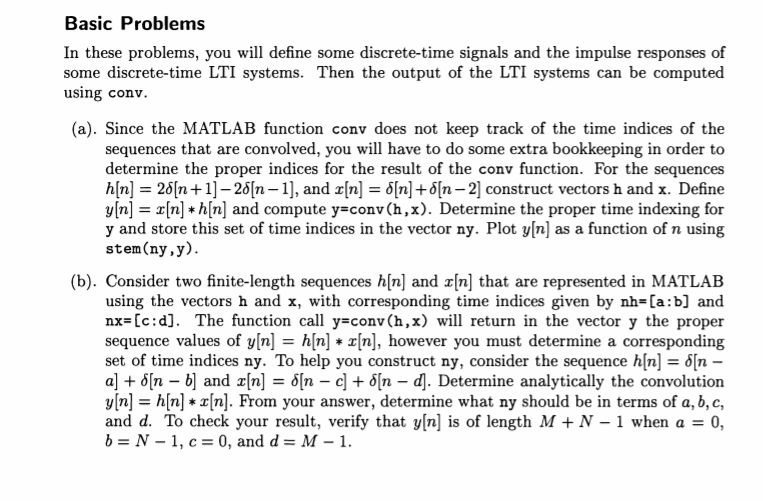
Basic Problems In these problems, you will define some discrete-time signals and the impulse responses of some discrete-time LTI systems. Then the output of the LTI systems can be computed using conv. (a). Since the MATLAB function conv does not keep track of the time indices of the sequences that are convolved, you will have to do some extra bookkeeping in order to determine the proper indices for the result of the conv function. For the sequences h[n] = 28[n+ 1] 28[n 1), and t[n] = 8[n] +8[n 2) construct vectors h and x. Define y[n] = x[n] *h[n] and compute y=conv(h,x). Determine the proper time indexing for y and store this set of time indices in the vector ny. Plot y[n] as a function of n using stem(ny,y). (b). Consider two finite-length sequences h[n] and x[n] that are represented in MATLAB using the vectors h and x, with corresponding time indices given by nh=[a:b) and nx=[c:d]. The function call y=conv(h,x) will return in the vector y the proper sequence values of y[n] = h[n] * [n], however you must determine a corresponding set of time indices ny. To help you construct ny, consider the sequence h[n] = b[n a] + [n b) and x[n] = 0[n - c] + 8[n - d]. Determine analytically the convolution y[n] = h[n] * [n]. From your answer, determine what ny should be in terms of a, b, c, and d. To check your result, verify that y[n] is of length M+N - 1 when a = 0, b= N -1, c= 0, and d= M - 1
Step by Step Solution
There are 3 Steps involved in it

Get step-by-step solutions from verified subject matter experts
 Study Help