







Question: Basics of Patterns (a) (4 points) Given a transaction database TDB, we partition it into two parts, TDB1 and TDB2. If an itemset X is
 Basics of Patterns
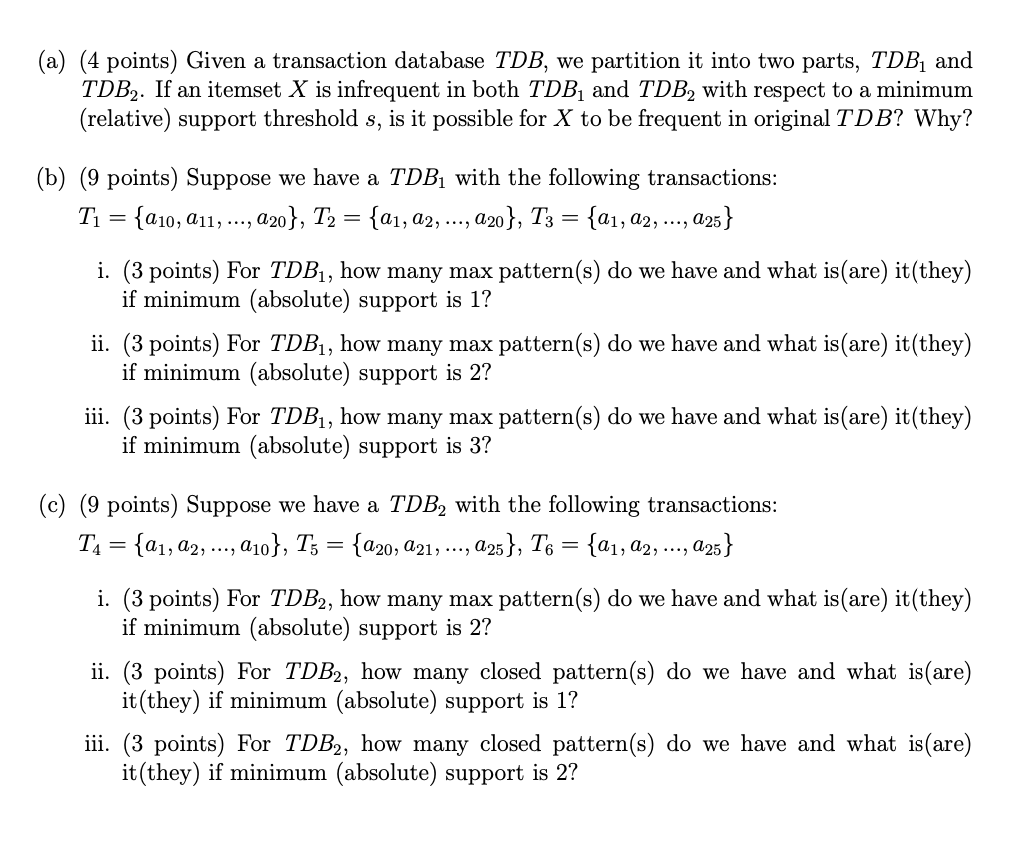
(a) (4 points) Given a transaction database TDB, we partition it into two parts, TDB1 and TDB2. If an itemset X is infrequent in both TDB1 and TDB2 with respect to a minimum (relative) support threshold s, is it possible for X to be frequent in original TDB ? Why? (b) (9 points) Suppose we have a TDB1 with the following transactions: T1={a10,a11,,a20},T2={a1,a2,,a20},T3={a1,a2,,a25} i. (3 points) For TDB1, how many max pattern(s) do we have and what is(are) it(they) if minimum (absolute) support is 1 ? ii. (3 points) For TDB1, how many max pattern(s) do we have and what is(are) it(they) if minimum (absolute) support is 2 ? iii. (3 points) For TDB1, how many max pattern(s) do we have and what is(are) it(they) if minimum (absolute) support is 3 ? (c) (9 points) Suppose we have a TDB2 with the following transactions: T4={a1,a2,,a10},T5={a20,a21,,a25},T6={a1,a2,,a25} i. (3 points) For TDB2, how many max pattern(s) do we have and what is(are) it(they) if minimum (absolute) support is 2 ? ii. (3 points) For TDB2, how many closed pattern(s) do we have and what is(are) it(they) if minimum (absolute) support is 1 ? iii. (3 points) For TDB2, how many closed pattern(s) do we have and what is(are) it(they) if minimum (absolute) support is 2
Step by Step Solution
There are 3 Steps involved in it

Get step-by-step solutions from verified subject matter experts
 Study Help