







Question: Bayesian Regression - joint prior, likelihood and joint posterior my thoughts conercning the likelihood so far: Bayesian Regression Model In order to account for the
Bayesian Regression - joint prior, likelihood and joint posterior
my thoughts conercning the likelihood so far:
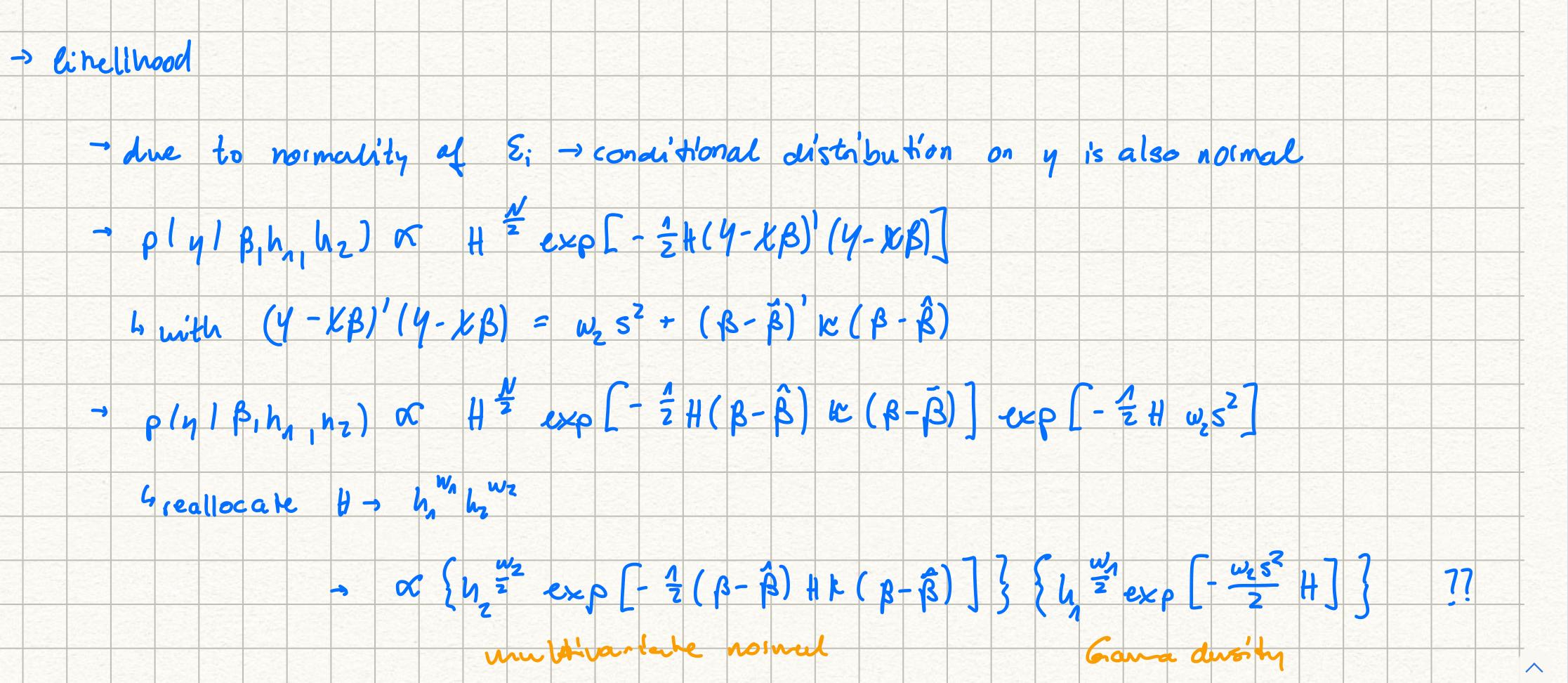
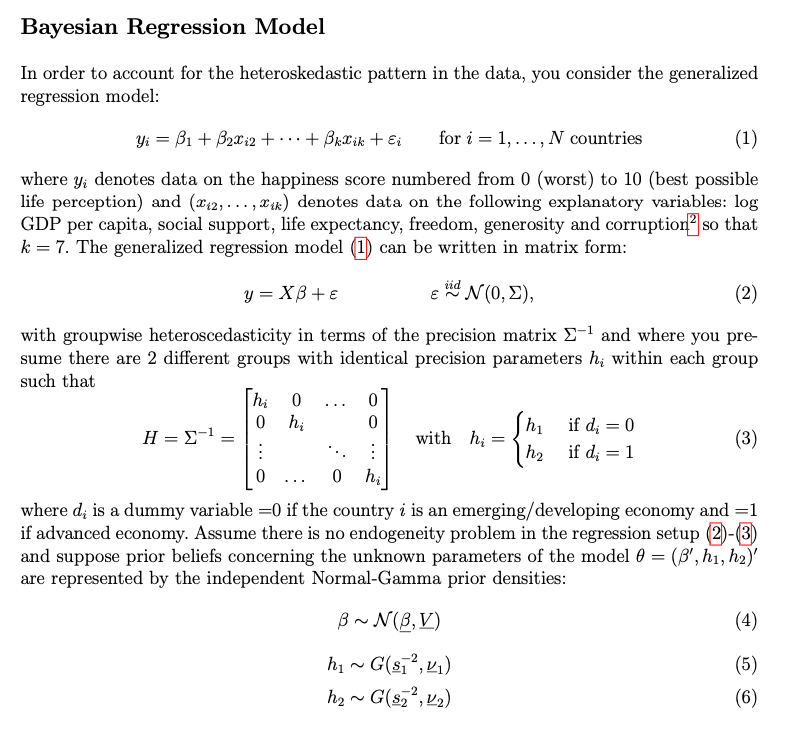
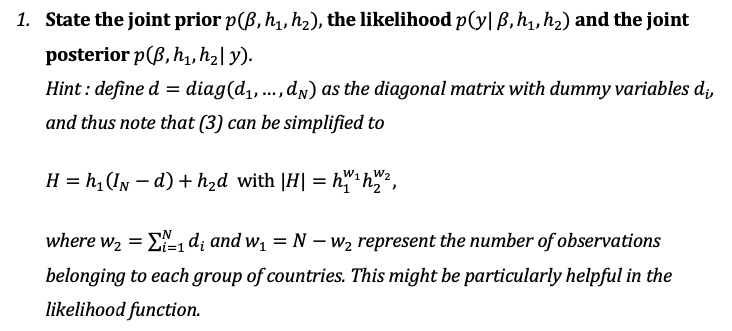
Bayesian Regression Model In order to account for the heteroskedastic pattern in the data, you consider the generalized regression model: Yi = B1 + B2x12 + ... + Brilik + Ei for i = 1, ..., N countries (1) where yi denotes data on the happiness score numbered from 0 (worst) to 10 (best possible life perception) and (342, ..., Xik) denotes data on the following explanatory variables: log GDP per capita, social support, life expectancy, freedom, generosity and corruption so that k = 7. The generalized regression model (1) can be written in matrix form: y= X8+ E vid N (0,2), (2) - with groupwise heteroscedasticity in terms of the precision matrix 5-1 and where you pre sume there are 2 different groups with identical precision parameters hi within each group such that hi 0 0 0 hi 0 hi H = -1 if di = 0 with hi (3) : : The if di = 1 0 0 hi where di is a dummy variable =0 if the country i is an emerging/developing economy and =1 if advanced economy. Assume there is no endogeneity problem in the regression setup (2)-(3) and suppose prior beliefs concerning the unknown parameters of the model 0 = (B', h1, h2)' are represented by the independent Normal-Gamma prior densities: 8 (8,V) (4) h ~ G($1, 41) h2 ~ G(sz?, 12) (5) (6) 1. State the joint prior p(, h1, h2), the likelihood pyll, h1, h2) and the joint posterior p(B, h1, h2|y). Hint: define d = diag(d1, ..., dn as the diagonal matrix with dummy variables di and thus note that (3) can be simplified to H = h1 (In - d) + had with |H| = hyshme, where w, = !-1d; and w = N wz represent the number of observations belonging to each group of countries. This might be particularly helpful in the likelihood function. linellhood on is also normal due to normality of E; conditional distribution - plul Biho, ug) a Hof expf- (4-XB)' (4-xp] be with U-KB' 14- XB) Ws? (-A)'(A-B) - plul pana inz) oc H * exp (- H(8-8) e (A-3) ] exp[- + use] I reallocate the (hta exp [- (P-) ##
Step by Step Solution
There are 3 Steps involved in it

Get step-by-step solutions from verified subject matter experts
 Study Help