







Question: Bb Content -| LED exp 7 Quiz-l-PHY x G 323 Mail - Olam x a Amazon.co X G 2. The elect X Post Questi
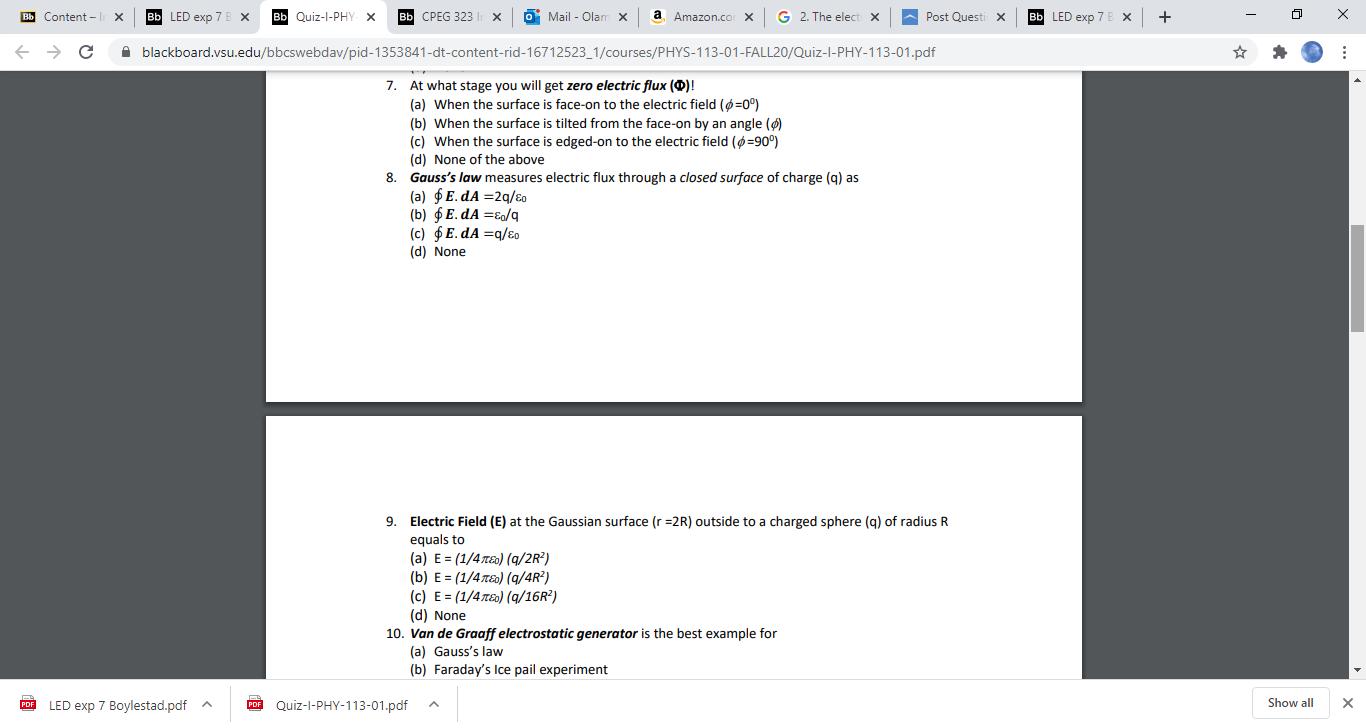
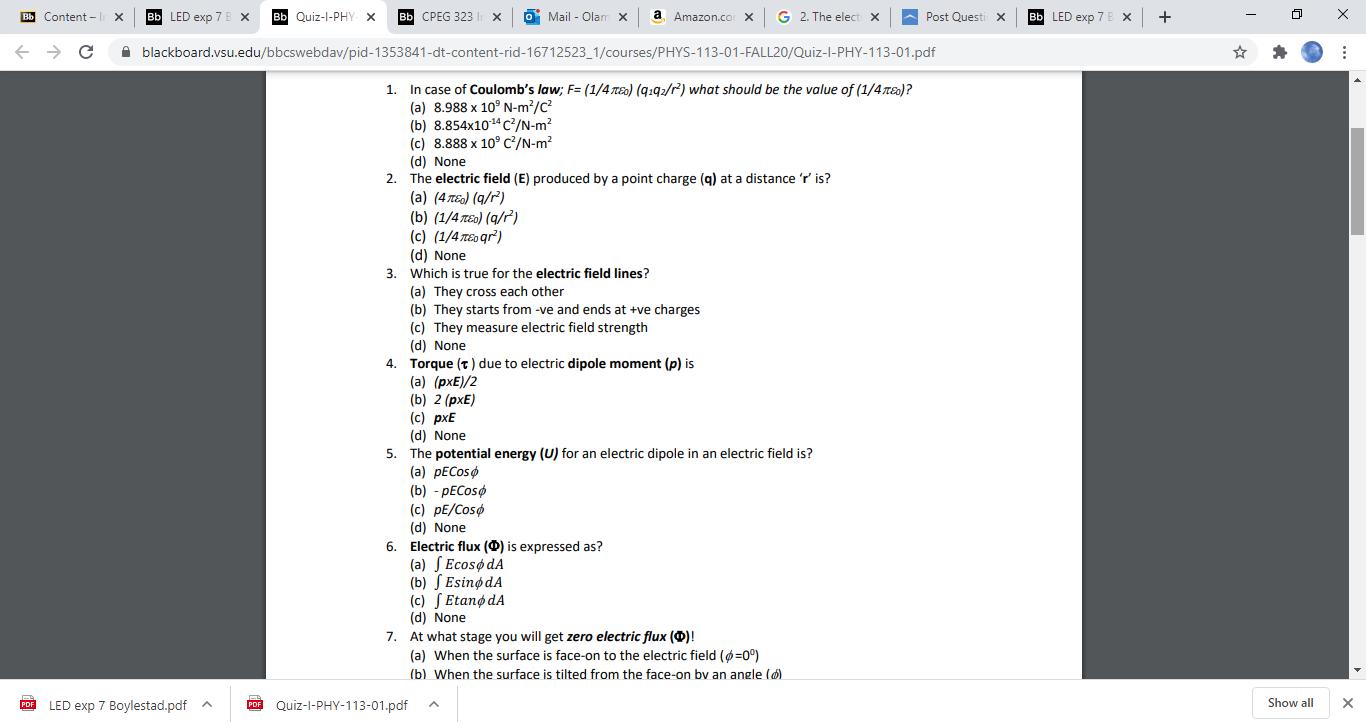
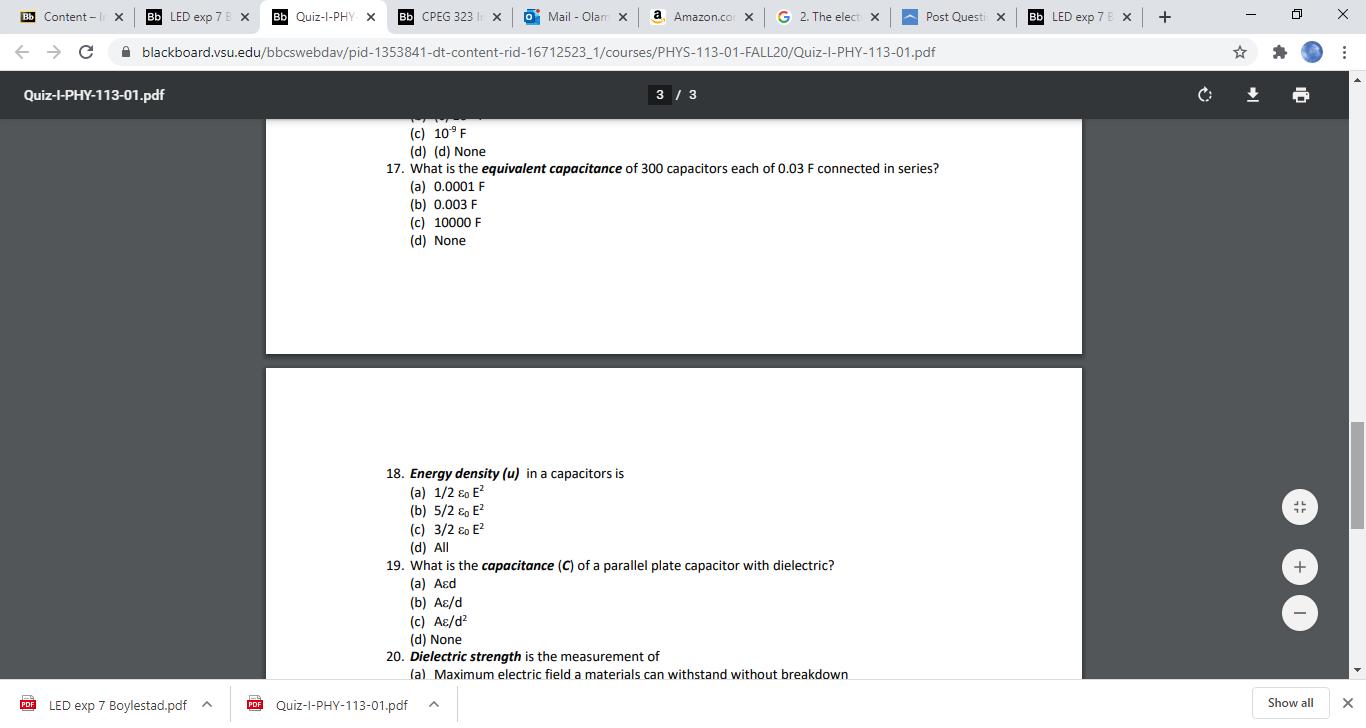
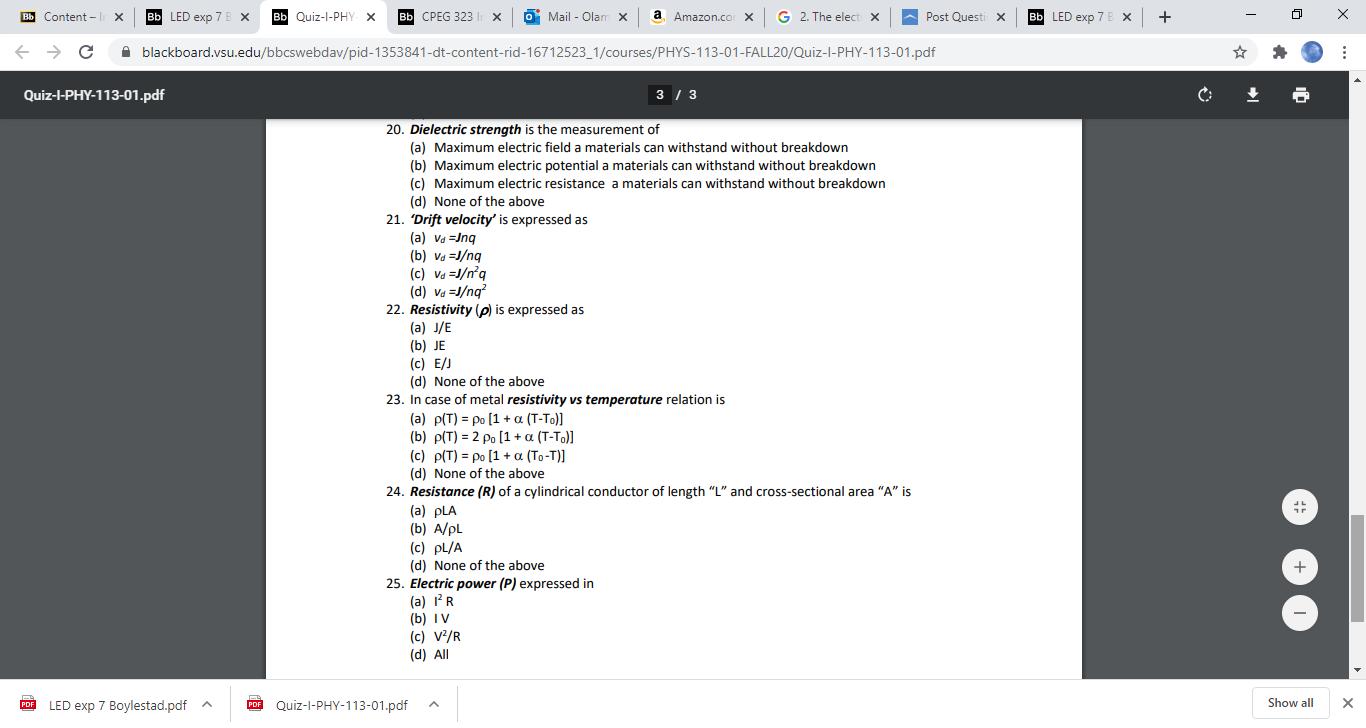
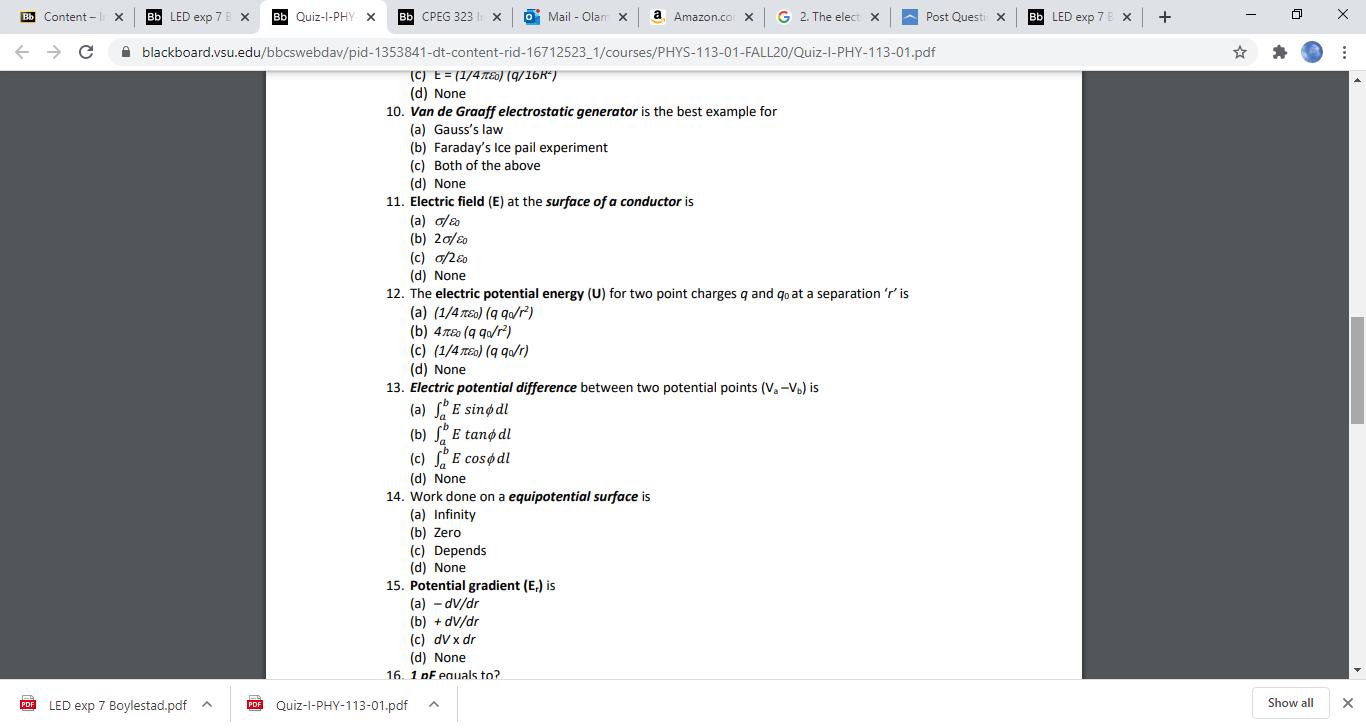
Bb Content -| LED exp 7 Quiz-l-PHY x G 323 Mail - Olam x a Amazon.co X G 2. The elect X Post Questi x Bb LED exp 7 + A blackboard.vsu.edu/bbcswebdav/pid-1353841-dt-content-rid-16712523_1/courses/PHYS-113-01-FALL20/Quiz-l-PHY-113-01.pdf 7. At what stage you will get zero electric flux ()! (a) When the surface is face-on to the electric field (6=0) (b) When the surface is tilted from the face-on by an angle () (c) When the surface is edged-on to the electric field (=90) (d) None of the above 8. Gauss's law measures electric flux through a closed surface of charge (q) as (a) $E. dA =2q/8o (b) $E. dA =Ea/q (c) $E. dA =q/o (d) None 9. Electric Field (E) at the Gaussian surface (r =2R) outside to a charged sphere (g) of radius R equals to (a) E = (1/4reo) (q/2R?) (b) E = (1/4Te0) (q/4R?) (c) E= (1/4re0) (q/16R?) (d) None 10. Van de Graaff electrostatic generator is the best example for (a) Gauss's law (b) Faraday's Ice pail experiment LED exp 7 Boylestad.pdf PDF Quiz-l-PHY-113-01.pdf Show all Bb Content -| LED exp 7 Quiz-l-PHY x G 323 Mail - Olam x a Amazon.co x G 2. The elect x Post Questi X Bb LED exp 7 + A blackboard.vsu.edu/bbcswebdav/pid-1353841-dt-content-rid-16712523_1/courses/PHYS-113-01-FALL20/Quiz-l-PHY-113-01.pdf In case of Coulomb's law; F= (1/4 reo) (g:92/r) what should be the value of (1/4reo)? (a) 8.988 x 10 N-m?/c? (b) 8.854x10¹⁴ c/N-m? (c) 8.888 x 10 c/N-m? (d) None 2. The electric field (E) produced by a point charge (g) at a distance 'r' is? (a) (4TEo) (q/r) (b) (1/4reo) (q/r) (c) (1/4 TEo qr) (d) None 3. Which is true for the electric field lines? (a) They cross each other (b) They starts from -ve and ends at +ve charges (c) They measure electric field strength (d) None 4. Torque (t) due to electric dipole moment (p) is (a) (pxE)/2 (b) 2 (pxE) () 1. (d) None 5. The potential energy (U) for an electric dipole in an electric field is? (a) pECoso (b) - pECos (c) pE/Coso (d) None 6. Electric flux (0) is expressed as? (a) S Ecoso dA (b) S EsinodA (c) SEtanodA (d) None 7. At what stage you will get zero electric flux (0)! (a) When the surface is face-on to the electric field (=0) (b) When the surface is tilted from the face-on bv an angle (O) LED exp 7 Boylestad.pdf PDF Quiz-l-PHY-113-01.pdf Show all Bb Content - Bb LED exp 7 E X Bb Quiz-l-PHY x Bb CPEG 323 I x Mail - Olam x a Amazon.co x G 2. The elect X Post Questi X Bb LED exp 7E X + A blackboard.vsu.edu/bbcswebdav/pid-1353841-dt-content-rid-16712523_1/courses/PHYS-113-01-FALL20/Quiz-l-PHY-113-01.pdf Quiz-l-PHY-113-01.pdf 3 / 3 (c) 10 F (d) (d) None 17. What is the equivalent capacitance of 300 capacitors each of 0.03 F connected in series? (a) 0.0001 F (b) 0.003 F (c) 10000 F (d) None 18. Energy density (u) in a capacitors is (a) 1/2 0 E? (b) 5/2 , E? (c) 3/2 o E? (d) All 19. What is the capacitance (C) of a parallel plate capacitor with dielectric? (a) Ad %23 (b) A/d (c) A/d? (d) None 20. Dielectric strength is the measurement of (a) Maximum electric field a materials can withstand without breakdown LED exp 7 Boylestad.pdf Quiz-l-PHY-113-01.pdf Show all PDF PDF Bb Content - LED exp 7 Quiz-l-PHY x G 323 Mail - Olam x a Amazon.co x G 2. The elect X Post Questi X Bb LED exp 7 + A blackboard.vsu.edu/bbcswebdav/pid-1353841-dt-content-rid-16712523 1/courses/PHYS-113-01-FALL20/Quiz-l-PHY-113-01.pdf Quiz-l-PHY-113-01.pdf 3 / 3 20. Dielectric strength is the measurement of (a) Maximum electric field a materials can withstand without breakdown (b) Maximum electric potential a materials can withstand without breakdown (c) Maximum electric resistance a materials can withstand without breakdown (d) None of the above 21. 'Drift velocity' is expressed as (a) va =Jng (b) va =J/ng (c) va =J/nq (d) va =J/ng? 22. Resistivity (p) is expressed as (a) J/E (b) JE (c) E/J (d) None of the above 23. In case of metal resistivity vs temperature relation is (a) p(T) = po (1 + a (T-To)] (b) p(T) = 2 po (1 + a (T-To)] (c) p(T) = po [1 + a (To-T)] (d) None of the above 24. Resistance (R) of a cylindrical conductor of length "L" and cross-sectional area "A" is (a) pLA (b) A/pL (c) pL/A %23 (d) None of the above + 25. Electric power (P) expressed in (a) ?R (b) IV (c) V/R (d) All LED exp 7 Boylestad.pdf PDF Quiz-l-PHY-113-01.pdf Show all Bb Content -| LED exp 7 Quiz-l-PHY x G 323 Mail - Olam x a Amazon.co X G 2. The elect x Post Questi x Bb LED exp 7 + A blackboard.vsu.edu/bbcswebdav/pid-1353841-dt-content-rid-16712523_1/courses/PHYS-113-01-FALL20/Quiz-l-PHY-113-01.pdf (C) E= (1/4TE0) (9/16R*) (d) None 10. Van de Graaff electrostatic generator is the best example for (a) Gauss's law (b) Faraday's Ice pail experiment (c) Both of the above (d) None 11. Electric field (E) at the surface of a conductor is (a) a/e (b) 20/80 (c) a/280 (d) None 12. The electric potential energy (U) for two point charges q and go at a separation 'r' is (a) (1/4reo) (q qa/r) (b) 4rEo (q qa/r?) (c) (1/4 reo) (q qdr) (d) None 13. Electric potential difference between two potential points (V, -V) is (a) "E sin dl (b) "E tan dl (c) SE cosdl (d) None 14. Work done on a equipotential surface is (a) Infinity (b) Zero (c) Depends (d) None 15. Potential gradient (E,) is (a) - dV/dr (b) + dV/dr (c) dV x dr (d) None 16. 1 DF equals to? LED exp 7 Boylestad.pdf PDF Quiz-l-PHY-113-01.pdf Show all
Step by Step Solution
3.31 Rating (145 Votes )
There are 3 Steps involved in it
oprion es when the surface edged the elechh... View full answer

Get step-by-step solutions from verified subject matter experts
 Study Help