







Question: Be precise with the answers Part II: Longer Problems 1. Luigi, 4) = lage+ on be the (direct) utility function, where on and qu are
Be precise with the answers
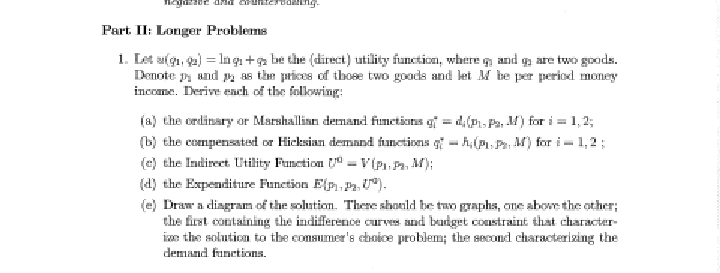

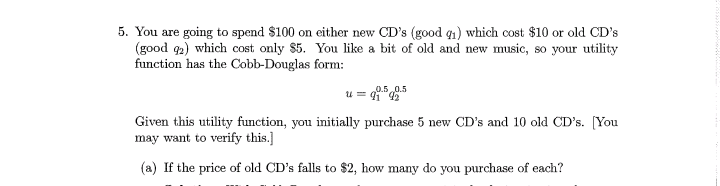

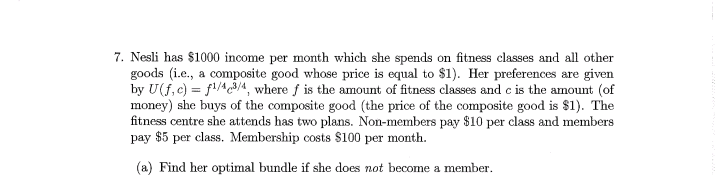
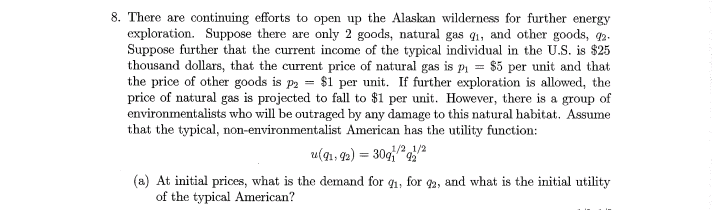
Part II: Longer Problems 1. Luigi, 4) = lage+ on be the (direct) utility function, where on and qu are two goods. Denote my and py as the prices of those two goods and let M be per period money income. Derive each of the following: (a) the ordinary or Marshallian dernand functions of = di(m, pa, W) for i = 1,2; (b) the compensated or Hicksian demand functions of - hi(pp pp, M) for i = 1,2 ; (c) the Indirect Utility Function (" - V(p1, PM); (d) the Expenditure Function Elm, pa. "). (e) Draw a diagram of the solution. There should be two graphs, one above the other; the first containing the indifference curves and budget constraint that character- ize the solution to the consumer's choice problem; the second characterizing the demand functions.3. A consumer has the following utility over childcare c ( measured in hours) and food f (measured in units): u(c, f ) = cdft. The price of childcare is p. = 2, the price of food is py = 4 and income is M = 20. (a) What is the consumer's ordinary or uncompensated demand for childcare and food?5. You are going to spend $100 on either new CD's (good q ) which cost $10 or old CD's (good q2) which cost only $5. You like a bit of old and new music, so your utility function has the Cobb-Douglas form: 0.5 0.5 Given this utility function, you initially purchase 5 new CD's and 10 old CD's. [You may want to verify this.] (a) If the price of old CD's falls to $2, how many do you purchase of each?6. The government wants to raise a specific amount of revenue with either (1) an excise tax t or (2) a lump-sum tax 7. Assuming that preferences for the taxed good and all other goods are strictly convex, and assuming that the lump-sum tax must raise the same exact amount of revenue as the per unit excise tax, which tax do people prefer? Draw a carefully labelled diagram to illustrate your answer.7. Nesli has $1000 income per month which she spends on fitness classes and all other goods (i.e., a composite good whose price is equal to $1). Her preferences are given by U(f, c) = fl/c/4, where f is the amount of fitness classes and c is the amount (of money) she buys of the composite good (the price of the composite good is $1). The fitness centre she attends has two plans. Non-members pay $10 per class and members pay $5 per class. Membership costs $100 per month. (a) Find her optimal bundle if she does not become a member.8. There are continuing efforts to open up the Alaskan wilderness for further energy exploration. Suppose there are only 2 goods, natural gas q1, and other goods, 92. Suppose further that the current income of the typical individual in the U.S. is $25 thousand dollars, that the current price of natural gas is p, = $5 per unit and that the price of other goods is p2 = $1 per unit. If further exploration is allowed, the price of natural gas is projected to fall to $1 per unit. However, there is a group of environmentalists who will be outraged by any damage to this natural habitat, Assume that the typical, non-environmentalist American has the utility function: 2(7, 92) = 3091 93 (a) At initial prices, what is the demand for q, for 92, and what is the initial utility of the typical American
Step by Step Solution
There are 3 Steps involved in it

Get step-by-step solutions from verified subject matter experts
 Study Help