







Question: be represented graphically as lines in a two-dimensional space or planes in a three-dimensional space. In linear algebra, we use matrices and vectors to represent
be represented graphically as lines in a two-dimensional space or planes in a three-dimensional space.
In linear algebra, we use matrices and vectors to represent and solve systems of linear equations. A matrix is a rectangular array of numbers, while a vector is a matrix with only one column or one row. We can use matrices to represent systems of linear equations, where each row of the matrix represents an equation, and each column represents a variable. Vectors can be used to represent a point in space or a direction in which we want to move.
Matrix multiplication is another essential concept in linear algebra. When we multiply two matrices, the resulting matrix is determined by the dot product of the rows of the first matrix and the columns of the second matrix. Matrix multiplication is important because it allows us to perform operations on systems of linear equations, vectors, and transformations efficiently. It is also used to solve problems related to eigenvalues and eigenvectors, which are important in many areas of science and engineering.
DO THE ENTRIE QUESTIONS
Linear algebra is a branch of mathematics that deals with linear equations, vectors, and matrices. It plays a significant role in many fields, including physics, engineering, computer science, and economics. In this essay, we will explore the fundamental concepts of linear algebra, its importance, and its practical applications.
Linear algebra deals with systems of linear equations, which can be represented as a set of equations in which the variables have a degree of one. For example, the system of equations:
2x + 3y = 7 4x - 5y = 2
is a system of linear equations. The goal of linear algebra is to find the values of x and y that satisfy both equations simultaneously. This can be accomplished using techniques such as Gaussian elimination or matrix inversion.
In addition to systems of linear equations, linear algebra deals with vectors and matrices. A vector is a quantity that has both magnitude and direction, represented graphically as an arrow. In linear algebra, a vector is typically represented as a column matrix, which is a matrix with only one column. Matrices are rectangular arrays of numbers that can be used to represent systems of linear equations, vectors, and transformations.
One of the key concepts in linear algebra is matrix multiplication. When two matrices are multiplied together, the resulting matrix is determined by the dot product of the rows of the first matrix and the columns of the second matrix. This concept is important because it allows us to perform operations on systems of linear equations, vectors, and transformations efficiently.
Another important concept in linear algebra is determinants. A determinant is a scalar value that can be computed from a square matrix. The determinant of a matrix is important because it tells us whether a matrix is invertible. If the determinant of a matrix is zero, the matrix is not invertible, and if the determinant is non-zero, the matrix is invertible.
Linear algebra is used in many fields, including physics, engineering, computer science, and economics. In physics, linear algebra is used to represent the physical properties of systems, such as the position and momentum of particles. In engineering, linear algebra is used to solve problems related to electricity, mechanics, and control systems. In computer science, linear algebra is used to perform operations on images, videos, and audio signals. In economics, linear algebra is used to model and analyze economic systems.
In conclusion, linear algebra is a fundamental branch of mathematics that deals with linear equations, vectors, and matrices. It plays a significant role in many fields, including physics, engineering, computer science, and economics. The concepts of linear algebra, such as matrix multiplication and determinants, are important tools for solving problems in these fields. Linear algebra is a powerful tool for modeling and analyzing complex systems, and it is essential for anyone interested in pursuing a career in STEM fields.
Linear algebra is used in many fields, such as physics, engineering, computer science, economics, and data science. In physics, linear algebra is used to represent physical properties of systems, such as the position and momentum of particles. In engineering, linear algebra is used to solve problems related to electricity, mechanics, and control systems. In computer science, linear algebra is used to perform operations on images, videos, and audio signals. In economics, linear algebra is used to model and analyze economic systems. In data science, linear algebra is used to analyze and manipulate large datasets, perform machine learning algorithms, and solve optimization problems.
In conclusion, linear algebra is a powerful and essential tool in many areas of science and engineering. The concepts of linear equations, matrices, vectors, matrix multiplication, and determinants are fundamental concepts in linear algebra. They are used to represent and solve systems of linear equations, perform operations on vectors and matrices, and analyze complex systems. Linear algebra is a fundamental subject for anyone interested in pursuing a career in STEM fields.
- What is a vector and how is it represented mathematically?
- What is a matrix and how is it represented mathematically?
- What is the difference between a row vector and a column vector?
- How do you add and subtract vectors and matrices?
- How do you perform scalar multiplication on vectors and matrices?
- What is the dot product of two vectors?
- What is the cross product of two vectors?
- What is a system of linear equations and how do you solve it using matrices?
- What is the inverse of a matrix and how do you find it?
- What is the determinant of a matrix and how is it useful?
- What is the rank of a matrix and how do you determine it?
- What is a basis for a vector space and how do you find it?
- What is a linear transformation and how is it represented mathematically?
- What is an eigenvector and eigenvalue of a matrix and how are they useful?
- What is the difference between an orthogonal and orthonormal basis?
- What is the Gram-Schmidt process and how is it used to find an orthonormal basis?
- What is a singular value decomposition (SVD) of a matrix and how is it useful?
- What is a projection matrix and how is it used in linear algebra?
- What is the difference between a diagonalizable and nondiagonalizable matrix?
- What is the difference between a positive definite and positive semidefinite matrix?
- What is the value of pi to 5 decimal places?
- What is the square root of 81?
- What is the cube root of 125?
- What is the value of e to 3 decimal places?
- What is the natural logarithm of 10?
- What is the sine of 30 degrees?
- What is the cosine of 45 degrees?
- What is the tangent of 60 degrees?
- What is the value of log base 2 of 16?
- What is the value of 2 to the power of 5?
- What is the value of 3 factorial?
- What is the value of 10 choose 3?
- What is the absolute value of -7?
- What is the modulus of 15 when divided by 4?
- What is the largest prime number less than 50?
- What is the sum of the first 10 odd numbers?
- What is the product of the first 5 prime numbers?
- What is the sum of the first 20 positive integers?
- What is the product of the digits in the number 12345?
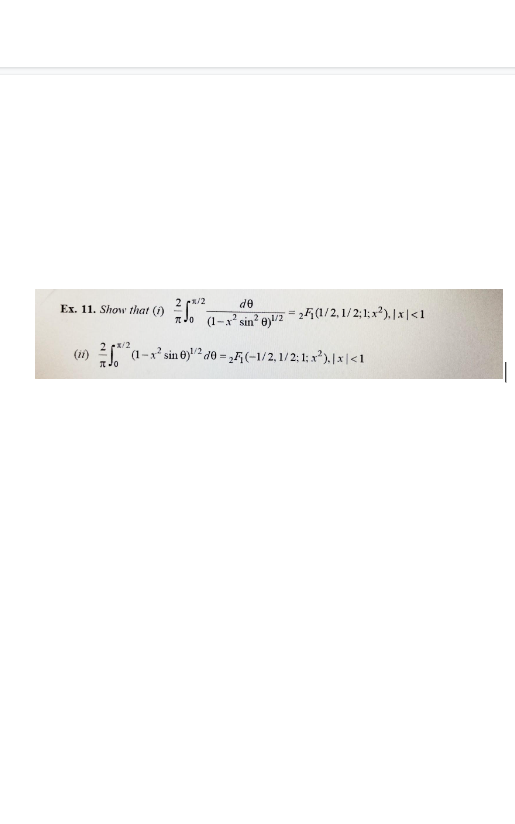
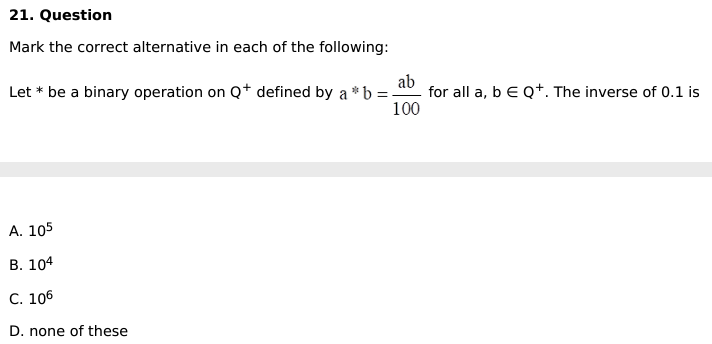
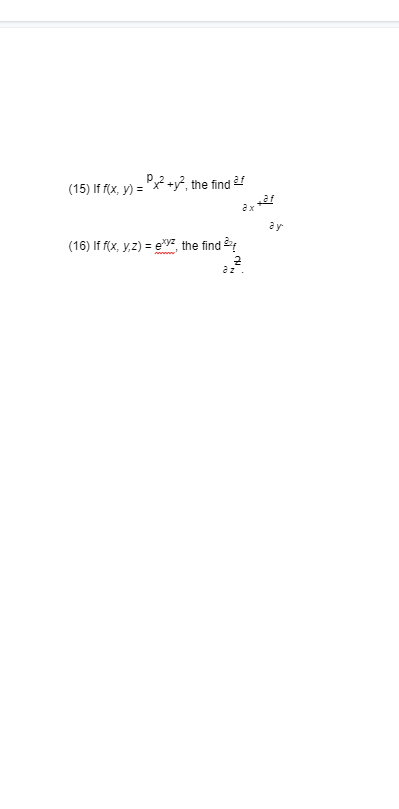

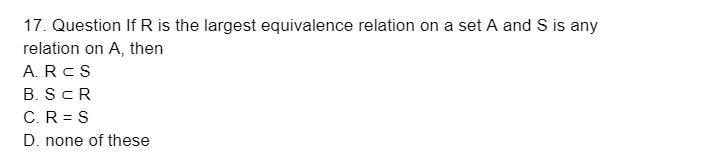

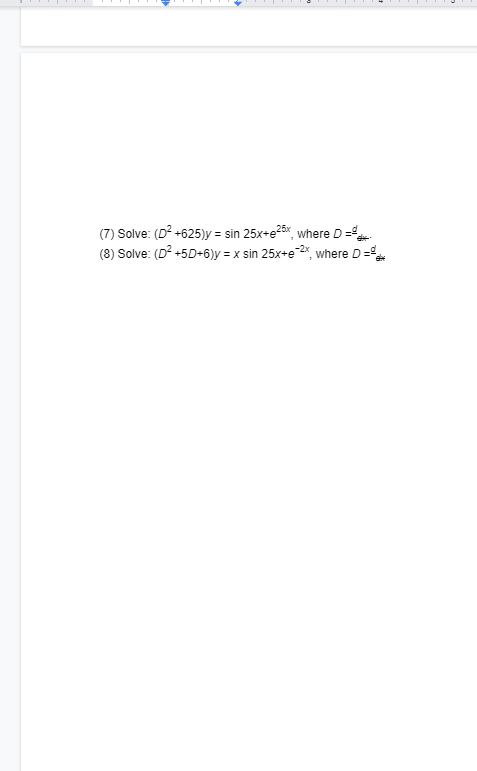

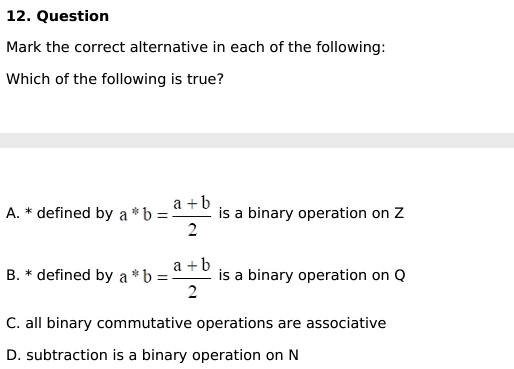
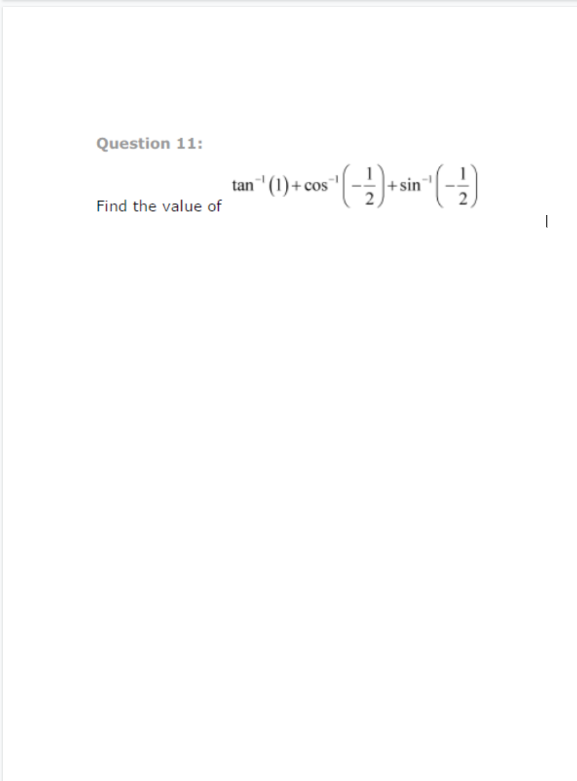
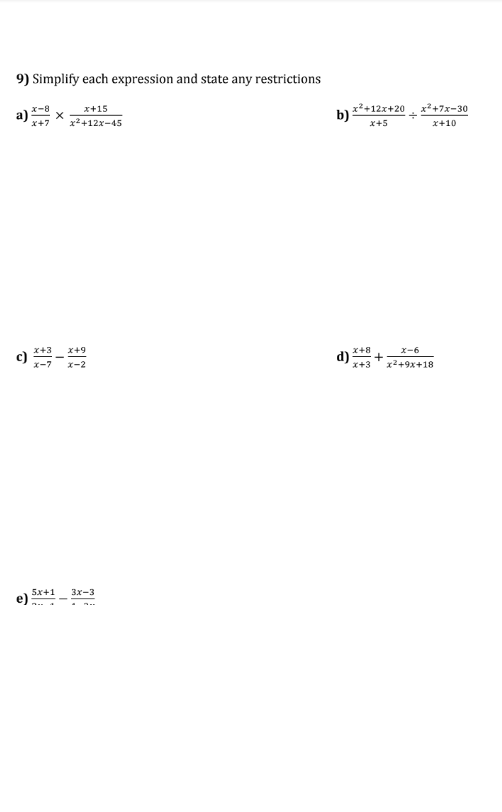
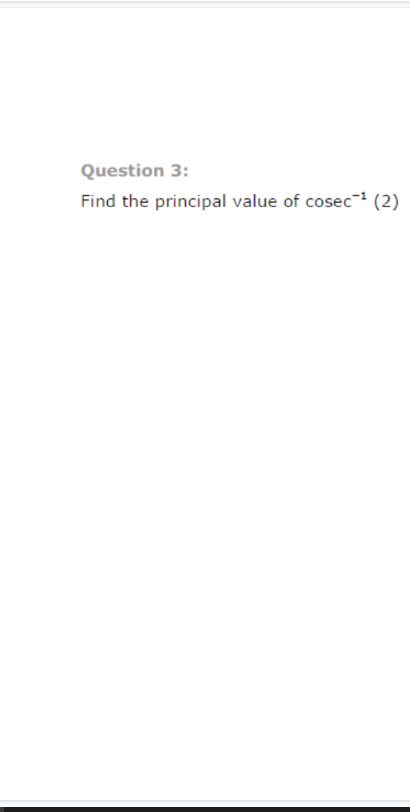
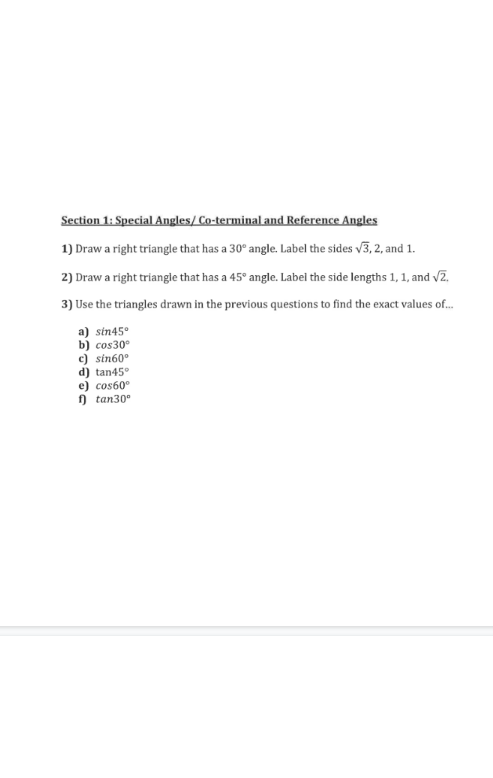
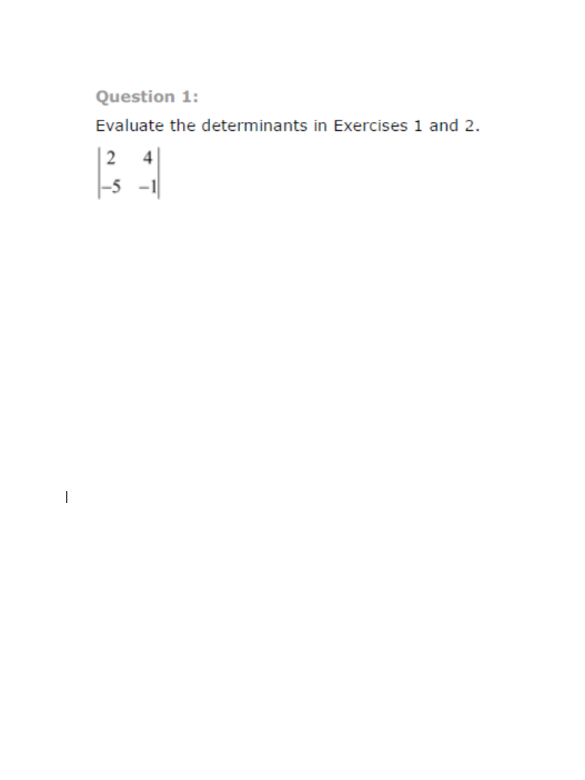


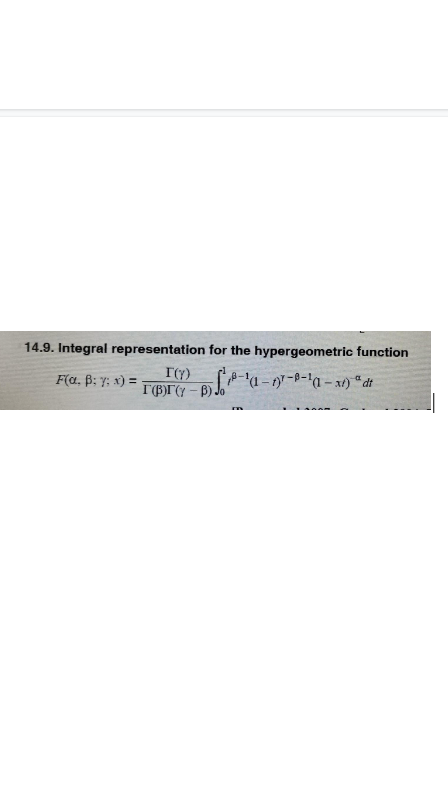
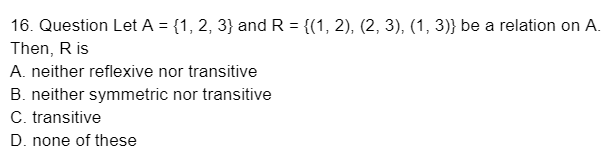
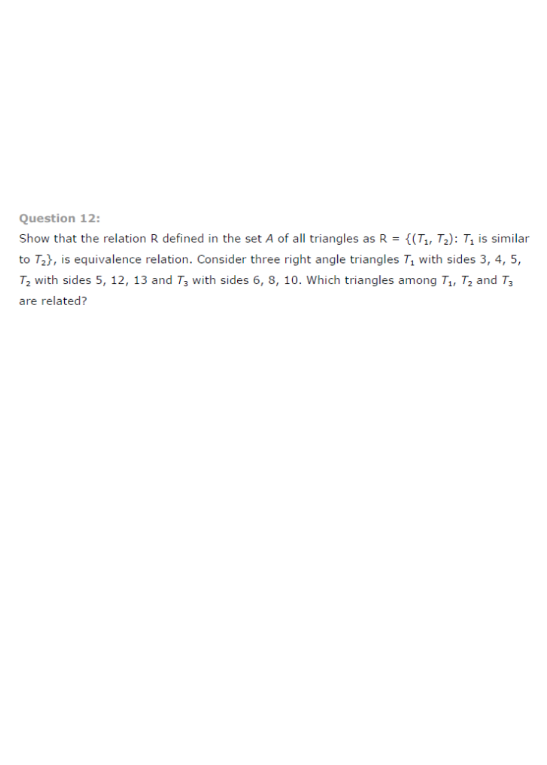
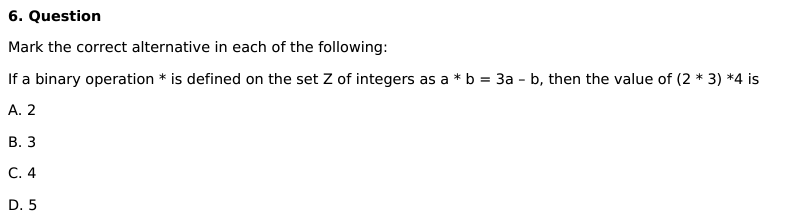
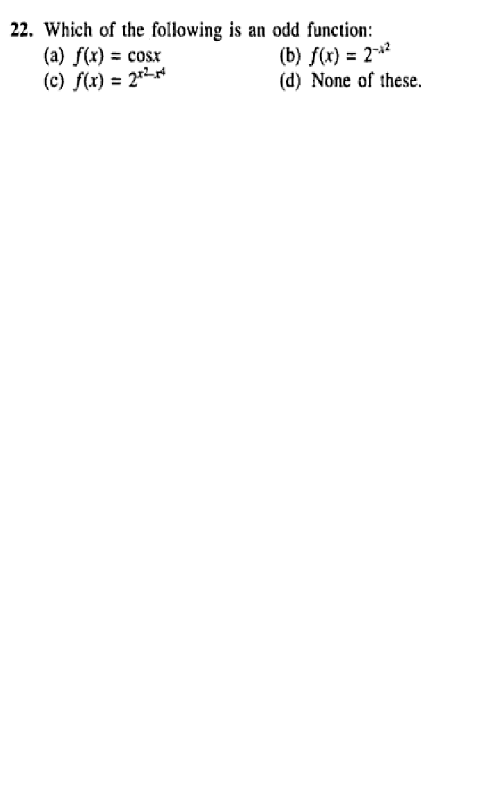
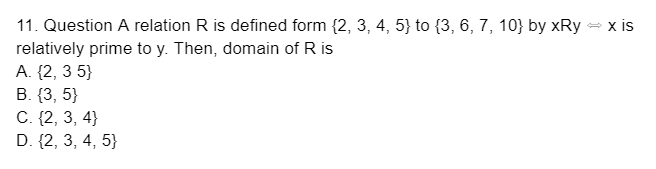
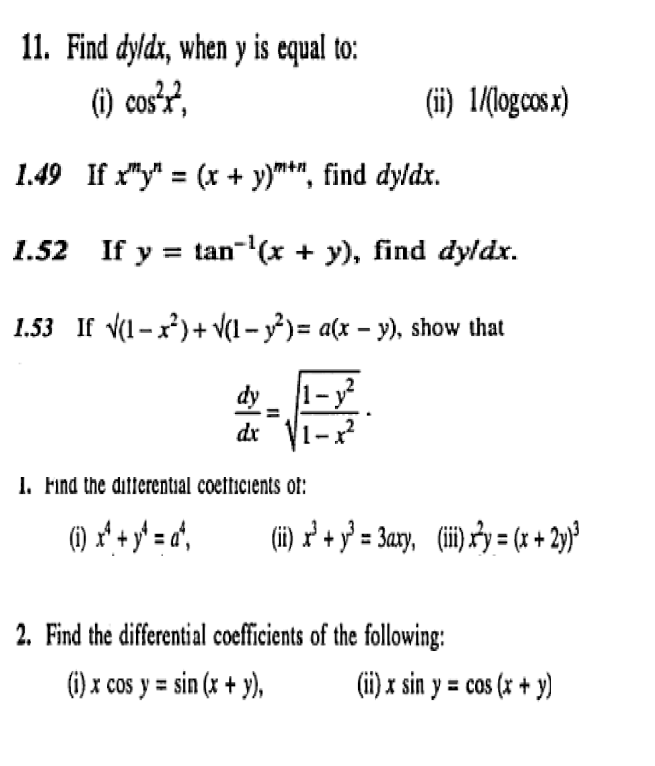
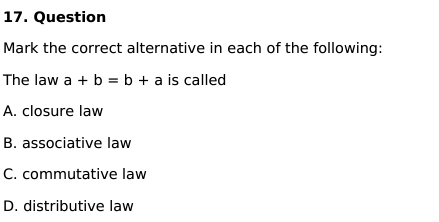
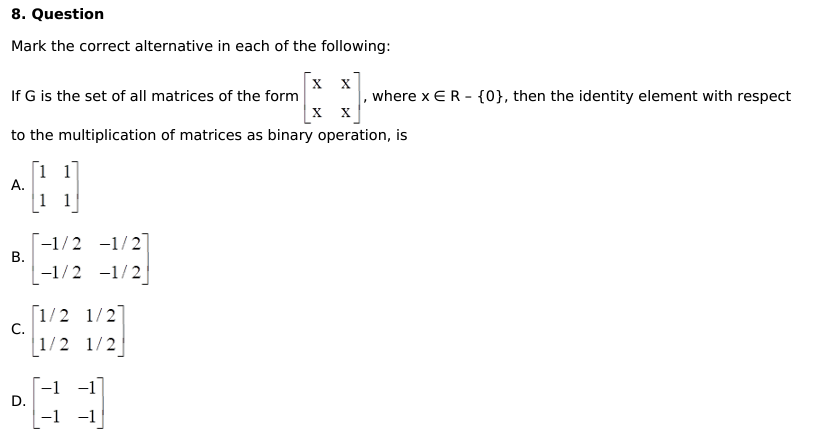
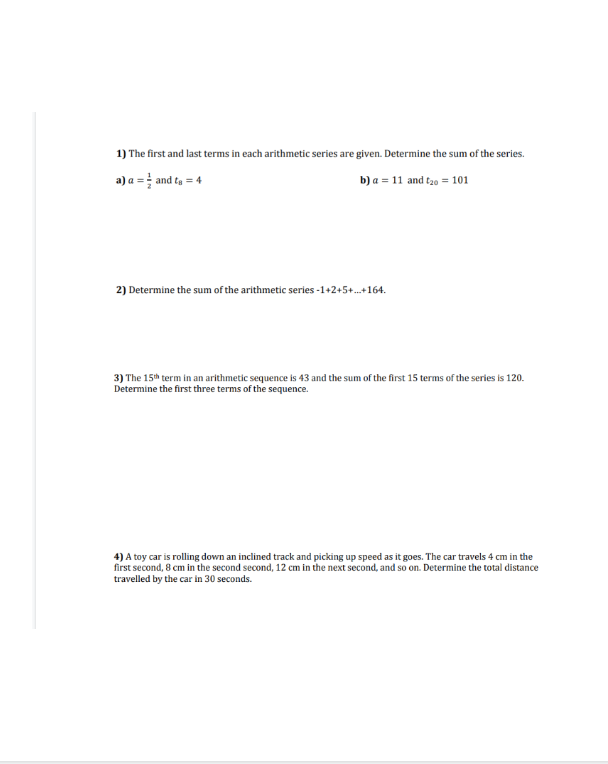
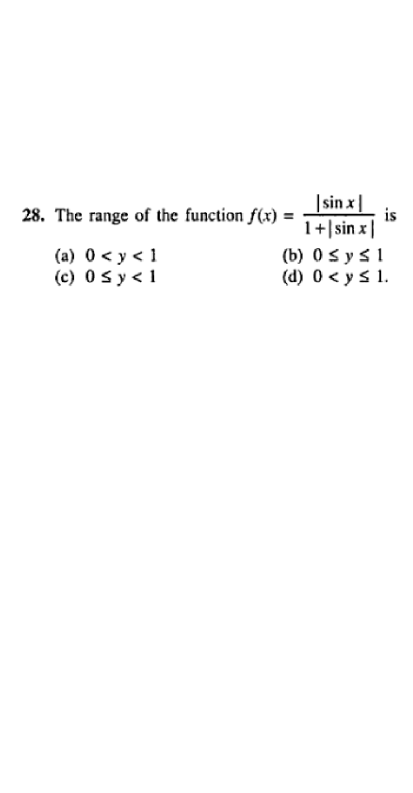
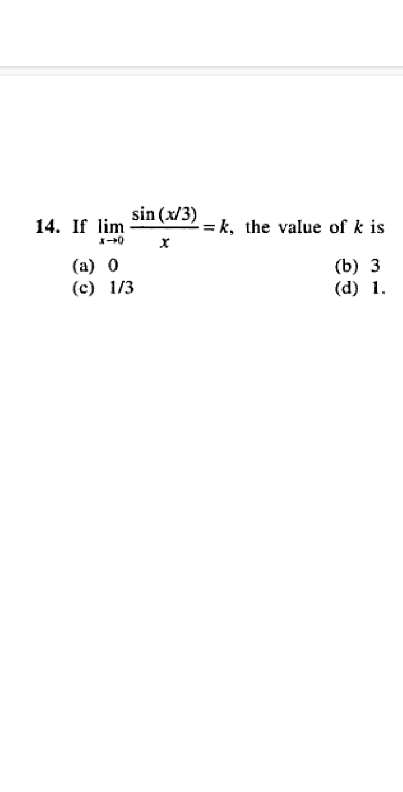
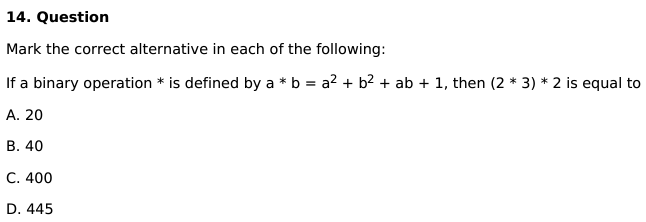
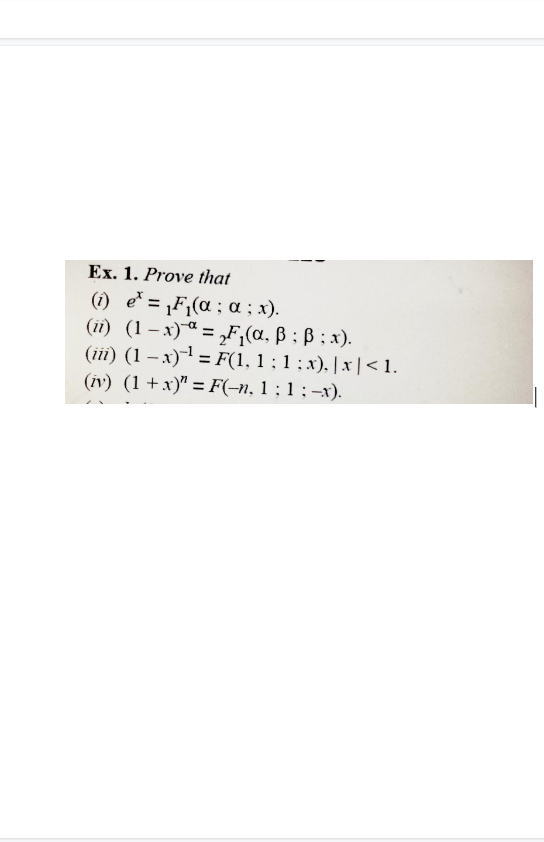
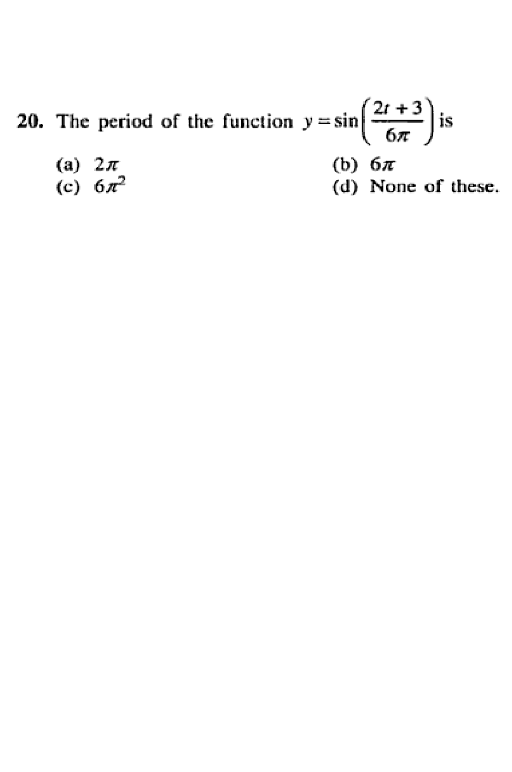
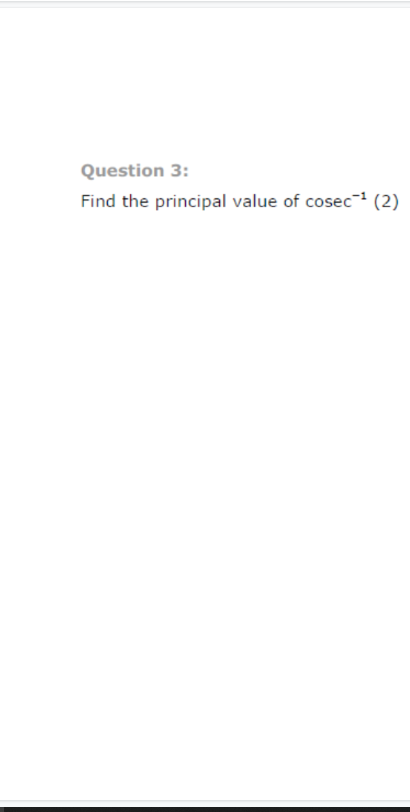
\f21. Question Mark the correct alternative in each of the following: Let * he a binary aperatian on 0" defined by 3 '1' b = i for all a; b E 0+. The inverse of Ill i5 100 A. 105 a. 104 (2. ma D. none at theae \f\f\fQ2: The 1irtmlume cf a cube is increasing at the rate cf 3 cm3rs. How fast is the surface area increasing when the length of an edge is 12 cm? \f\f12. Question Mark the correct alternative in each of the following: |Which of the following is true? 3+1) 8. A. * defined by a 14'13. : is a binary operation on Z a+b a. B. * defined by a \"1'1: : is a binary operation on Q C. a" binary commutative operations are associative D. Subtraction is a binary operation on N \f\f\f\f\f\f\f\f\fQuestion 12: Show that the relation R defined in the set A of all triangles as R = {U}, T3): T, is similar to T,}, is equivalence relan'on. Consider three right angle triangles T, with sides 3, 4. 5. T; with sides 5, 12. 13 and T3 WIth sides 6. 8, 10. which triangles among T1, T; and T; a re related ? 6. Question Mark the correct alternative in each of the following: If a binary' operation * is. defined on the set 2 of integere as a * h = 3a - b, then the value of {2 * 31*4 is A. 2 5.3 {2.4 [1.5 \f\f\f\fB. Question Mark the correct alternative in each of the following: X , where x E R - {El}; then the identity element with respect X If G is the set of all matrices of the form[ x x to the multiplication of matrices as binary operation, is 1 1 A. -1 1: 11!\": 1':' E. i 1: 1*2 '1': 132' C. 1-\": 1:2' :1 _1c D. \f\f\f\f\f\f\f
Step by Step Solution
There are 3 Steps involved in it

Get step-by-step solutions from verified subject matter experts
 Study Help