Question: Bed Bath and Beyond Case Study. References are in the attachments. Please do not say reference is missing. This case allows us to consider the
Bed Bath and Beyond Case Study. References are in the attachments. Please do not say reference is missing.
This case allows us to consider the problem of "excess cash" faced by many companies these days
? Cash balances are on the rise: Large U.S. firms hold $3 Tri in cash today, 5 the amount held 10 years earlier
? Investors often see this as "inefficient balance sheets" and demand stock repurchases
? CFOs must decide what to do with excess cash and modulate firms' capital structure
? The case allows us to consider factors that are important when setting capital structure: Tax shields, costs of financial distress, credit ratings, etc.
Put yourself in the shoes of BBBY's CEO, Steven Temares
? It's April 2004 and you're about to decide what to do with the $400 million "excess cash" in the firm:
1. Keep it?
2. Pay it out?
3. Issue debt?
4. All of the above?
? What factors should you consider when choosing the "optimal capital structure"?
- They look and behave a lot like "secured debt" claims
? An excel spreadsheet is provided to help you with the case (check attachments)
Consider a concrete program...BBBY combines:
1. Use $400 million excess cash, and
2. Borrow funds (at 4.5%) to conduct a share repurchase
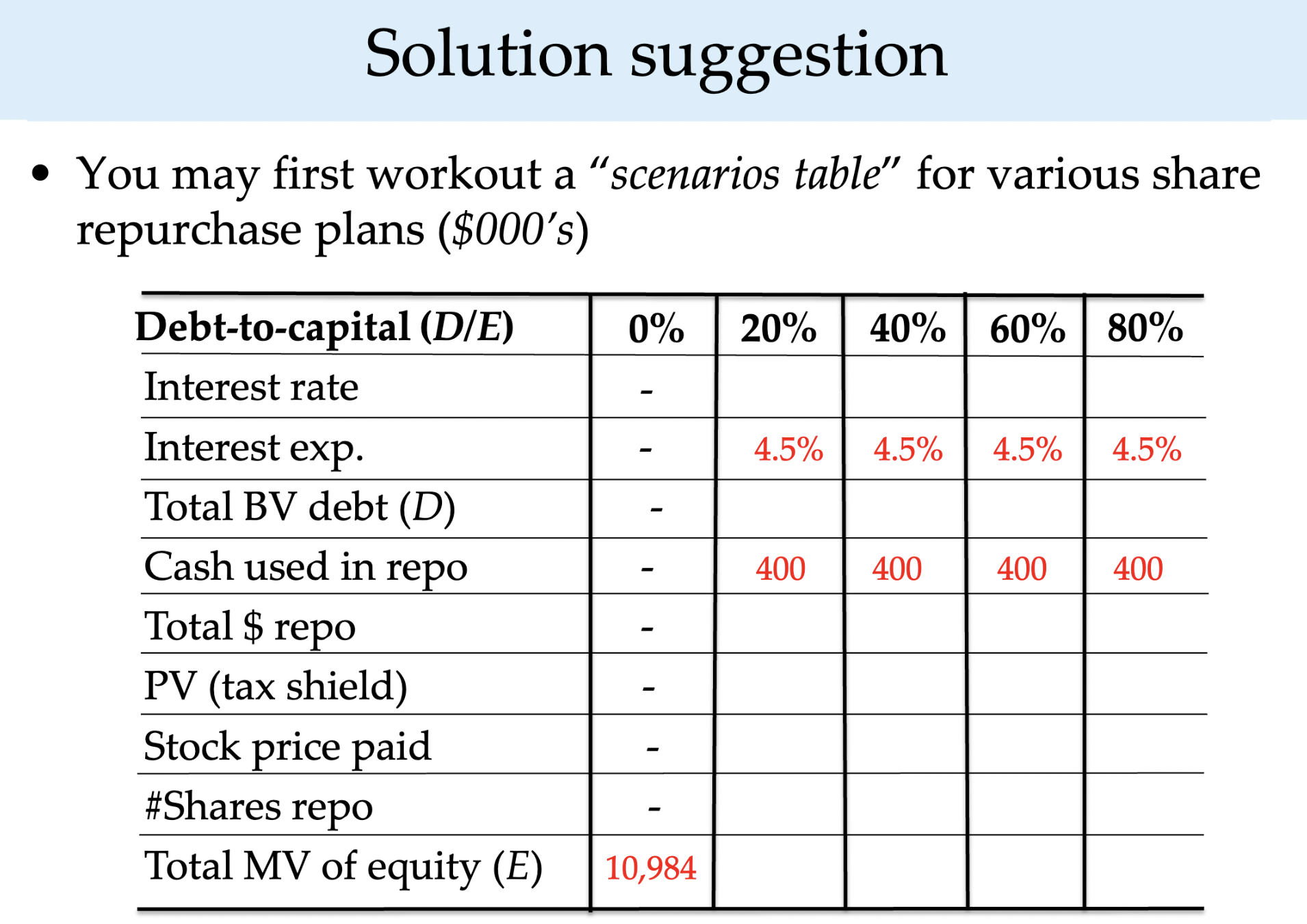
? Under the above program, compute the PV of tax shields and estimate the bond ratings for the following D/E ratios: 20%, 40%, 60%, and 80%
- The corporate tax faced by BBBY is 38.5%
? The rationale and details of your response must be given in a professional memorandum prepared individually
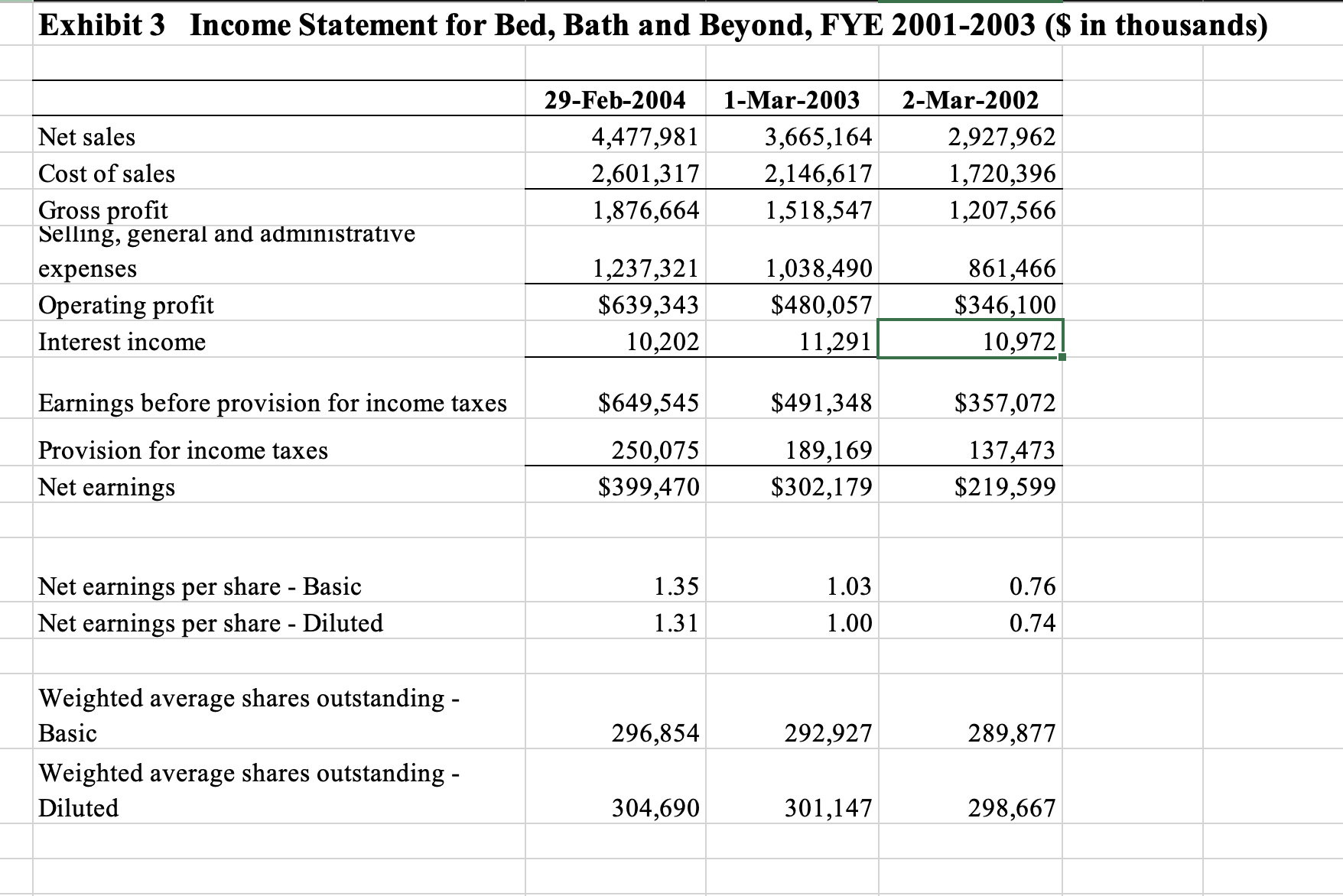
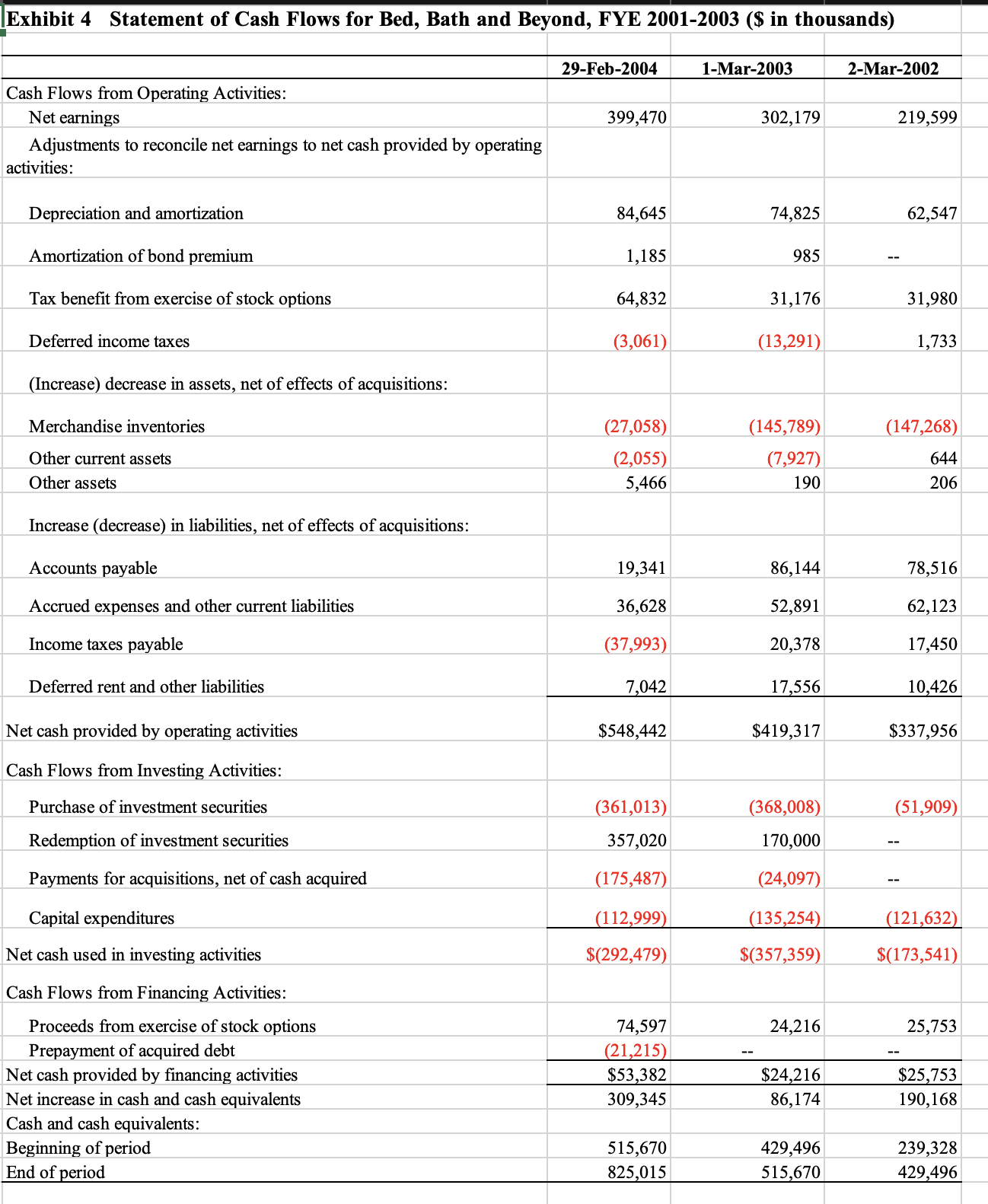
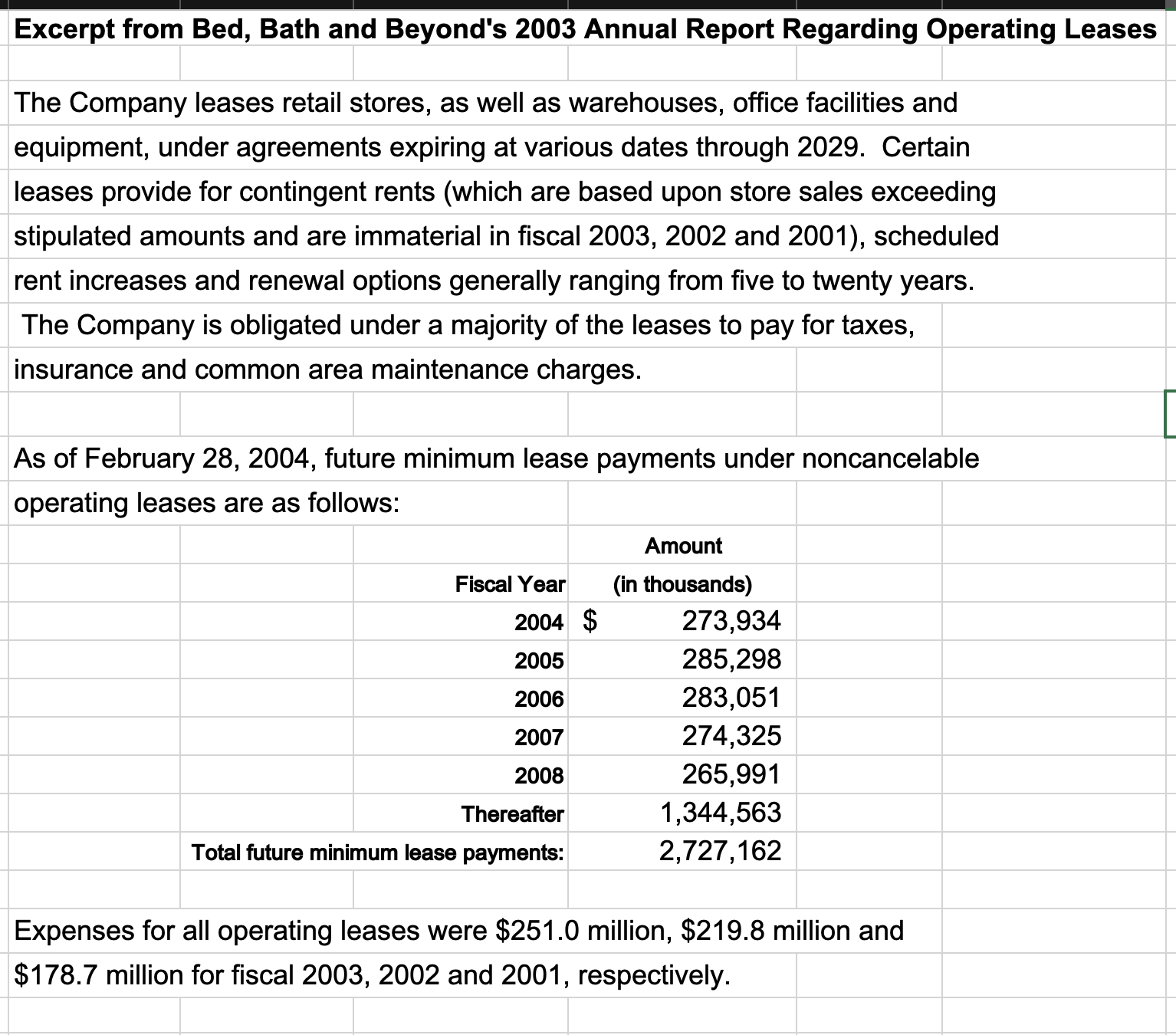
Exhibit 3 Income Statement for Bed, Bath and Beyond, FYE 2001-2003 ($ in thousands) 29-Feb-2004 1-Mar-2003 2-Mar-2002 Net sales 4,477,981 3,665,164 2,927,962 Cost of sales 2,601,317 2,146,617 1,720,396 Gross profit 1,876,664 1,518,547 1,207,566 Selling, general and administrative expenses 1,237,321 1,038,490 861,466 Operating profit $639,343 $480,057 $346,100 Interest income 10,202 11,291 10,972 Earnings before provision for income taxes $649,545 $491,348 $357,072 Provision for income taxes 250,075 189,169 137,473 Net earnings $399,470 $302,179 $219,599 Net earnings per share - Basic 1.35 1.03 0.76 Net earnings per share - Diluted 1.31 1.00 0.74 Weighted average shares outstanding - Basic 296,854 292,927 289,877 Weighted average shares outstanding - Diluted 304,690 301,147 298,667Exhibit 4 Statement of Cash Flows for Bed, Bath and Beyond, FYE 2001-2003 ($ in thousands) 29-Feb-2004 1-Mar-2003 2-Mar-2002 Cash Flows from Operating Activities: Net earnings 399,470 302,179 219,599 Adjustments to reconcile net earnings to net cash provided by operating activities: Depreciation and amortization 84,645 74,825 62,547 Amortization of bond premium 1,185 985 Tax benefit from exercise of stock options 64,832 31,176 31,980 Deferred income taxes (3,061) (13,291) 1,733 Increase) decrease in assets, net of effects of acquisitions: Merchandise inventories (27,058) (145,789) (147,268) Other current assets (2,055) (7,927) 644 Other assets 5,466 190 206 Increase (decrease) in liabilities, net of effects of acquisitions: Accounts payable 19,341 86,144 78,516 Accrued expenses and other current liabilities 36,628 52,891 62,123 Income taxes payable (37,993) 20,378 17,450 Deferred rent and other liabilities 7,042 17,556 10,426 Net cash provided by operating activities $548,442 $419,317 $337,956 Cash Flows from Investing Activities: Purchase of investment securities (361,013) (368,008) (51,909) Redemption of investment securities 357,020 170,000 Payments for acquisitions, net of cash acquired (175,487) (24,097) Capital expenditures (112,999) (135,254) (121,632) Net cash used in investing activities $(292,479) $(357, 359) $(173,541) Cash Flows from Financing Activities: Proceeds from exercise of stock options 74,597 24,216 25,753 Prepayment of acquired debt (21,215) Net cash provided by financing activities $53,382 $24,216 $25,753 Net increase in cash and cash equivalents 309,34 86,174 190,168 Cash and cash equivalents: Beginning of period 515,670 429,496 239,328 End of period 825,015 515,670 429,496Excerpt from Bed, Bath and Beyond's 2003 Annual Report Regarding Operating Leases The Company leases retail stores, as well as warehouses, office facilities and equipment, under agreements expiring at various dates through 2029. Certain leases provide for contingent rents (which are based upon store sales exceeding stipulated amounts and are immaterial in fiscal 2003, 2002 and 2001), scheduled rent increases and renewal options generally ranging from five to twenty years. The Company is obligated under a majority of the leases to pay for taxes, insurance and common area maintenance charges. As of February 28, 2004, future minimum lease payments under noncancelable operating leases are as follows: Amount Fiscal Year (in thousands) 2004 $ 273,934 2005 285,298 2006 283,051 2007 274,325 2008 265,991 Thereafter 1 344,563 Total future minimum lease payments: 2,727,162 Expenses for all operating leases were $251.0 million, $219.8 million and $178.7 million for fiscal 2003, 2002 and 2001, reSpectively. Solution suggestion . You may first workout a "scenarios table" for various share repurchase plans ($000's) Debt-to-capital (D/E) 0% 20% 40% 60% 80% Interest rate Interest exp. 4.5% 4.5% 4.5% 4.5% Total BV debt (D) Cash used in repo 400 400 400 400 Total $ repo PV (tax shield) Stock price paid #Shares repo Total MV of equity (E) 10,984
Step by Step Solution
There are 3 Steps involved in it
1 Expert Approved Answer
Step: 1 Unlock
Question Has Been Solved by an Expert!
Get step-by-step solutions from verified subject matter experts
Step: 2 Unlock
Step: 3 Unlock
Students Have Also Explored These Related Finance Questions!









 Study Help