







Question: #+begin note The : morphify- function already exists by the name =mapcar, and there are several variations and embodiments of this /map/ feature, as you
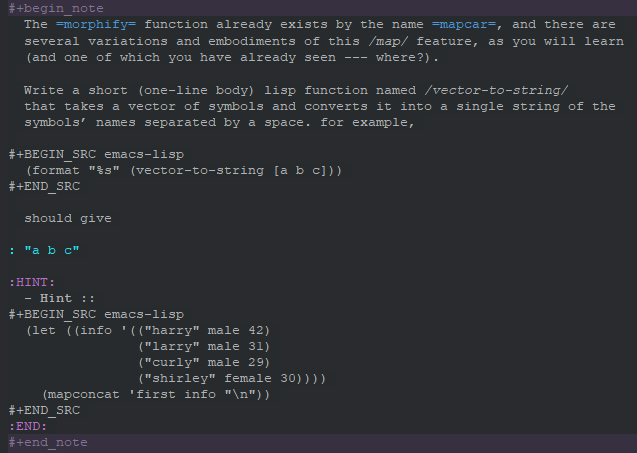
#+begin note The : morphify- function already exists by the name =mapcar, and there are several variations and embodiments of this /map/ feature, as you will learn (and one of which you have already seen--where?). Write a short (one-line body) lisp function named /vector-to-string/ that takes a vector of symbols and converts it into a single string of the symbols' names separated by a space. for example, emacs-lisp "%s" #+BEGIN SRC - (format (vector-to-string [a b c))) #+END SRC should give :"a b c" HINT - Hint:: #+BEGINSRC emacs-lisp - (let ((info '(("harry" male 42) ("larry" male 31) ("curly" male 29) "shirley" female 30)))) (mapconcat 'first info "n")) #+END END: #+end SRC note #+begin note The : morphify- function already exists by the name =mapcar, and there are several variations and embodiments of this /map/ feature, as you will learn (and one of which you have already seen--where?). Write a short (one-line body) lisp function named /vector-to-string/ that takes a vector of symbols and converts it into a single string of the symbols' names separated by a space. for example, emacs-lisp "%s" #+BEGIN SRC - (format (vector-to-string [a b c))) #+END SRC should give :"a b c" HINT - Hint:: #+BEGINSRC emacs-lisp - (let ((info '(("harry" male 42) ("larry" male 31) ("curly" male 29) "shirley" female 30)))) (mapconcat 'first info "n")) #+END END: #+end SRC
Step by Step Solution
There are 3 Steps involved in it

Get step-by-step solutions from verified subject matter experts
 Study Help