Question: beginning on page 395. The assignment is based on question #8 on page 397. I am modifying the question #8 to read as follows: Analyze
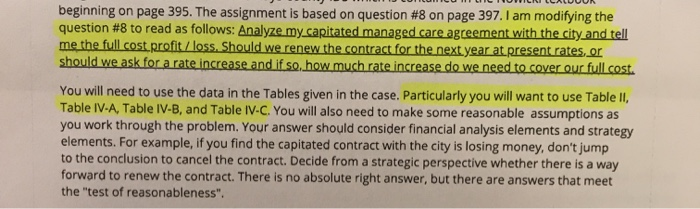
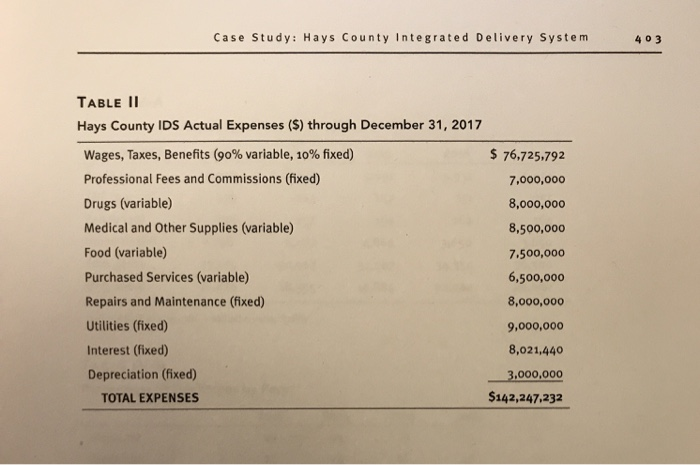
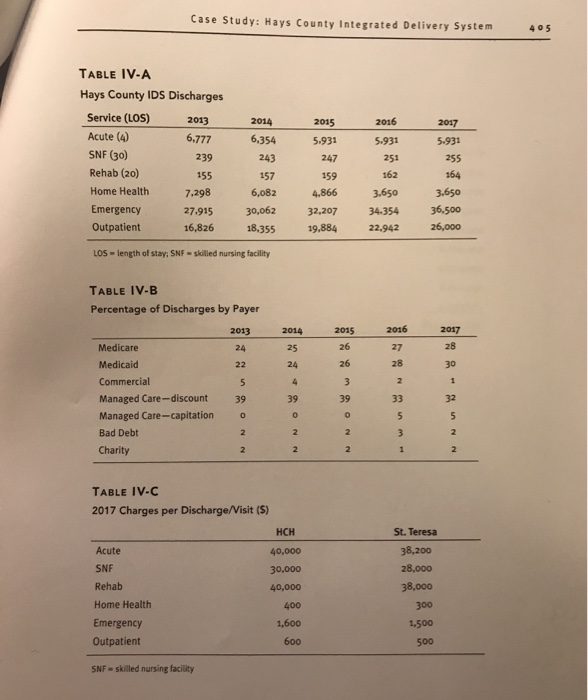
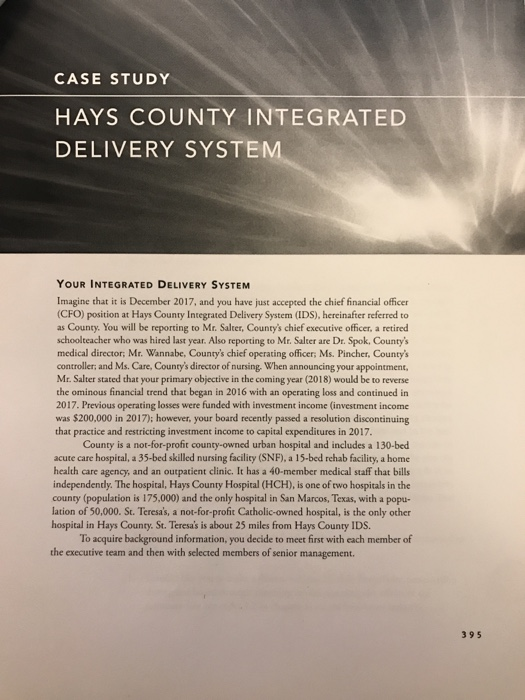
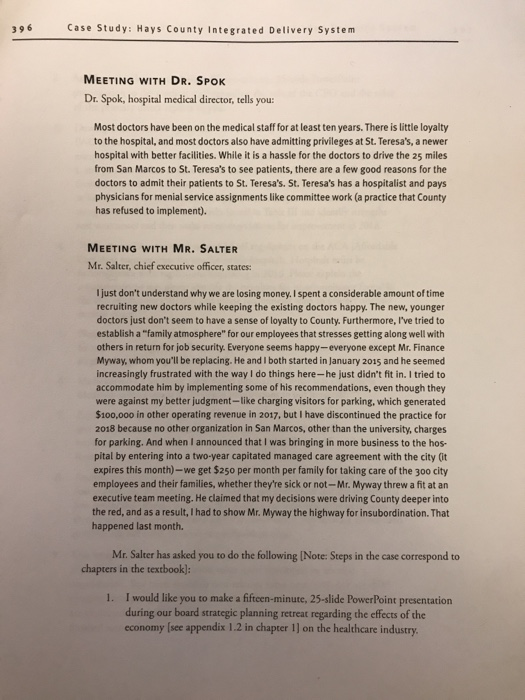
beginning on page 395. The assignment is based on question #8 on page 397. I am modifying the question #8 to read as follows: Analyze my capitated managed care agreement with the city and tell me the full cost profit / loss. Should we renew the contract for the next year at present rates, or should we ask for a rate increase and if so, how much rate increase do we need to cover our full cost You will need to use the data in the Tables given in the case. Particularly you will want to use Table II, Table IV-A, Table IV-B, and Table IV-C. You will also need to make some reasonable assumptions as you work through the problem. Your answer should consider financial analysis elements and strategy elements. For example, if you find the capitated contract with the city is losing money, don't jump to the conclusion to cancel the contract. Decide from a strategic perspective whether there is a way forward to renew the contract. There is no absolute right answer, but there are answers that meet the "test of reasonableness". Case Study: Hays County Integrated Delivery System 403 TABLE 11 Hays County IDS Actual Expenses ($) through December 31, 2017 Wages, Taxes, Benefits (90% variable, 10% fixed) $ 76,725,792 Professional Fees and Commissions (fixed) 7,000,000 Drugs (variable) 8,000,000 Medical and Other Supplies (variable) 8,500,000 Food (variable) 7.500,000 Purchased Services (variable) 6,500,000 Repairs and Maintenance (fixed) 8,000,000 Utilities (fixed) 9,000,000 Interest (fixed) 8,021,440 Depreciation (fixed) 3,000,000 TOTAL EXPENSES $142,247,232 Case Study: Hays County Integrated Delivery System 405 2014 TABLE IV-A Hays County IDS Discharges Service (LOS) 2013 Acute (4) 6,777 SNF (30) 239 Rehab (20) 155 Home Health 7,298 Emergency 27.915 Outpatient 16,826 6,354 243 2016 5.931 251 157 2015 5.931 247 159 4.866 32,207 19,884 162 2017 5.931 255 164 3.650 36,500 26,000 6,082 30,062 18.355 3,650 34.354 22,942 LOS -length of stay: SNF skilled nursing facility 2015 2016 2017 TABLE IV-B Percentage of Discharges by Payer 2013 Medicare Medicaid Commercial Managed Care-discount Managed Care-capitation o Bad Debt Charity TABLE IV-C 2017 Charges per Discharge/Visit (5) HCH Acute SNF St. Teresa 38,200 28,000 38,000 300 1,500 40,000 30,000 40,000 400 1,600 600 Rehab Home Health Emergency Outpatient 500 SNF skilled nursing facility CASE STUDY HAYS COUNTY INTEGRATED DELIVERY SYSTEM YOUR INTEGRATED DELIVERY SYSTEM Imagine that it is December 2017, and you have just accepted the chief financial officer (CFO) position at Hays County Integrated Delivery System (IDS), hereinafter referred to as County. You will be reporting to Mr. Salter, County's chief executive officer, a retired schoolteacher who was hired last year. Also reporting to Mr. Salter are Dr. Spok, County's medical director: Mr. Wannabe, County's chief operating officer, Ms. Pincher, County's controller; and Ms. Care, County's director of nursing. When announcing your appointment, Mr. Salter stated that your primary objective in the coming year (2018) would be to reverse the ominous financial trend that began in 2016 with an operating loss and continued in 2017. Previous operating losses were funded with investment income investment income was $200,000 in 2017); however, your board recently passed a resolution discontinuing that practice and restricting investment income to capital expenditures in 2017. County is a not-for-profit county-owned urban hospital and includes a 130-bed acute care hospital, a 35-bed skilled nursing facility (SNF), a 15-bed rehab facility, a home health care agency, and an outpatient clinic. It has a 40-member medical staff that bills independently. The hospital, Hays County Hospital (HCH), is one of two hospitals in the county (population is 175.000) and the only hospital in San Marcos, Texas, with a popu. lation of 50,000. St. Teresa's, a not-for-profit Catholic-owned hospital, is the only other hospital in Hays County, St. Teresa's is about 25 miles from Hays County IDS. To acquire background information, you decide to meet first with each member of the executive team and then with selected members of senior management. 396 Case Study: Hays County Integrated Delivery System MEETING WITH DR. SPOK Dr. Spok, hospital medical director, tells you: Most doctors have been on the medical staff for at least ten years. There is little loyalty to the hospital, and most doctors also have admitting privileges at St. Teresa's, a newer hospital with better facilities. While it is a hassle for the doctors to drive the 25 miles from San Marcos to St. Teresa's to see patients, there are a few good reasons for the doctors to admit their patients to St. Teresa's. St. Teresa's has a hospitalist and pays physicians for menial service assignments like committee work (a practice that County has refused to implement). MEETING WITH MR. SALTER Mr. Salter, chief executive officer, states: I just don't understand why we are losing money. I spent a considerable amount of time recruiting new doctors while keeping the existing doctors happy. The new, younger doctors just don't seem to have a sense of loyalty to County. Furthermore, I've tried to establish a "family atmosphere" for our employees that stresses getting along well with others in return for job security. Everyone seems happy-everyone except Mr. Finance Myway, whom you'll be replacing. He and I both started in January 2015 and he seemed increasingly frustrated with the way I do things here-he just didn't fit in. I tried to accommodate him by implementing some of his recommendations, even though they were against my better judgment-like charging visitors for parking, which generated $100,000 in other operating revenue in 2017, but I have discontinued the practice for 2018 because no other organization in San Marcos, other than the university, charges for parking. And when I announced that I was bringing in more business to the hos pital by entering into a two-year capitated managed care agreement with the city expires this month) -we get $250 per month per family for taking care of the 300 city employees and their families, whether they're sick or not-Mr. Myway threw a fit at an executive team meeting. He claimed that my decisions were driving County deeper into the red, and as a result, I had to show Mr. Myway the highway for insubordination. That happened last month. Mr. Salter has asked you to do the following (Note: Steps in the case correspond to chapters in the textbook): 1. I would like you to make a fifteen-minute, 25-slide PowerPoint presentation during our board strategic planning retreat regarding the effects of the economy (see appendix 1.2 in chapter 1) on the healthcare industry, beginning on page 395. The assignment is based on question #8 on page 397. I am modifying the question #8 to read as follows: Analyze my capitated managed care agreement with the city and tell me the full cost profit / loss. Should we renew the contract for the next year at present rates, or should we ask for a rate increase and if so, how much rate increase do we need to cover our full cost You will need to use the data in the Tables given in the case. Particularly you will want to use Table II, Table IV-A, Table IV-B, and Table IV-C. You will also need to make some reasonable assumptions as you work through the problem. Your answer should consider financial analysis elements and strategy elements. For example, if you find the capitated contract with the city is losing money, don't jump to the conclusion to cancel the contract. Decide from a strategic perspective whether there is a way forward to renew the contract. There is no absolute right answer, but there are answers that meet the "test of reasonableness". Case Study: Hays County Integrated Delivery System 403 TABLE 11 Hays County IDS Actual Expenses ($) through December 31, 2017 Wages, Taxes, Benefits (90% variable, 10% fixed) $ 76,725,792 Professional Fees and Commissions (fixed) 7,000,000 Drugs (variable) 8,000,000 Medical and Other Supplies (variable) 8,500,000 Food (variable) 7.500,000 Purchased Services (variable) 6,500,000 Repairs and Maintenance (fixed) 8,000,000 Utilities (fixed) 9,000,000 Interest (fixed) 8,021,440 Depreciation (fixed) 3,000,000 TOTAL EXPENSES $142,247,232 Case Study: Hays County Integrated Delivery System 405 2014 TABLE IV-A Hays County IDS Discharges Service (LOS) 2013 Acute (4) 6,777 SNF (30) 239 Rehab (20) 155 Home Health 7,298 Emergency 27.915 Outpatient 16,826 6,354 243 2016 5.931 251 157 2015 5.931 247 159 4.866 32,207 19,884 162 2017 5.931 255 164 3.650 36,500 26,000 6,082 30,062 18.355 3,650 34.354 22,942 LOS -length of stay: SNF skilled nursing facility 2015 2016 2017 TABLE IV-B Percentage of Discharges by Payer 2013 Medicare Medicaid Commercial Managed Care-discount Managed Care-capitation o Bad Debt Charity TABLE IV-C 2017 Charges per Discharge/Visit (5) HCH Acute SNF St. Teresa 38,200 28,000 38,000 300 1,500 40,000 30,000 40,000 400 1,600 600 Rehab Home Health Emergency Outpatient 500 SNF skilled nursing facility CASE STUDY HAYS COUNTY INTEGRATED DELIVERY SYSTEM YOUR INTEGRATED DELIVERY SYSTEM Imagine that it is December 2017, and you have just accepted the chief financial officer (CFO) position at Hays County Integrated Delivery System (IDS), hereinafter referred to as County. You will be reporting to Mr. Salter, County's chief executive officer, a retired schoolteacher who was hired last year. Also reporting to Mr. Salter are Dr. Spok, County's medical director: Mr. Wannabe, County's chief operating officer, Ms. Pincher, County's controller; and Ms. Care, County's director of nursing. When announcing your appointment, Mr. Salter stated that your primary objective in the coming year (2018) would be to reverse the ominous financial trend that began in 2016 with an operating loss and continued in 2017. Previous operating losses were funded with investment income investment income was $200,000 in 2017); however, your board recently passed a resolution discontinuing that practice and restricting investment income to capital expenditures in 2017. County is a not-for-profit county-owned urban hospital and includes a 130-bed acute care hospital, a 35-bed skilled nursing facility (SNF), a 15-bed rehab facility, a home health care agency, and an outpatient clinic. It has a 40-member medical staff that bills independently. The hospital, Hays County Hospital (HCH), is one of two hospitals in the county (population is 175.000) and the only hospital in San Marcos, Texas, with a popu. lation of 50,000. St. Teresa's, a not-for-profit Catholic-owned hospital, is the only other hospital in Hays County, St. Teresa's is about 25 miles from Hays County IDS. To acquire background information, you decide to meet first with each member of the executive team and then with selected members of senior management. 396 Case Study: Hays County Integrated Delivery System MEETING WITH DR. SPOK Dr. Spok, hospital medical director, tells you: Most doctors have been on the medical staff for at least ten years. There is little loyalty to the hospital, and most doctors also have admitting privileges at St. Teresa's, a newer hospital with better facilities. While it is a hassle for the doctors to drive the 25 miles from San Marcos to St. Teresa's to see patients, there are a few good reasons for the doctors to admit their patients to St. Teresa's. St. Teresa's has a hospitalist and pays physicians for menial service assignments like committee work (a practice that County has refused to implement). MEETING WITH MR. SALTER Mr. Salter, chief executive officer, states: I just don't understand why we are losing money. I spent a considerable amount of time recruiting new doctors while keeping the existing doctors happy. The new, younger doctors just don't seem to have a sense of loyalty to County. Furthermore, I've tried to establish a "family atmosphere" for our employees that stresses getting along well with others in return for job security. Everyone seems happy-everyone except Mr. Finance Myway, whom you'll be replacing. He and I both started in January 2015 and he seemed increasingly frustrated with the way I do things here-he just didn't fit in. I tried to accommodate him by implementing some of his recommendations, even though they were against my better judgment-like charging visitors for parking, which generated $100,000 in other operating revenue in 2017, but I have discontinued the practice for 2018 because no other organization in San Marcos, other than the university, charges for parking. And when I announced that I was bringing in more business to the hos pital by entering into a two-year capitated managed care agreement with the city expires this month) -we get $250 per month per family for taking care of the 300 city employees and their families, whether they're sick or not-Mr. Myway threw a fit at an executive team meeting. He claimed that my decisions were driving County deeper into the red, and as a result, I had to show Mr. Myway the highway for insubordination. That happened last month. Mr. Salter has asked you to do the following (Note: Steps in the case correspond to chapters in the textbook): 1. I would like you to make a fifteen-minute, 25-slide PowerPoint presentation during our board strategic planning retreat regarding the effects of the economy (see appendix 1.2 in chapter 1) on the healthcare industry









 Study Help