







Question: Below are the details for Assignment 1. Please read the instructions carefully. If you have any questions, please contact the Professor prior to submitting the
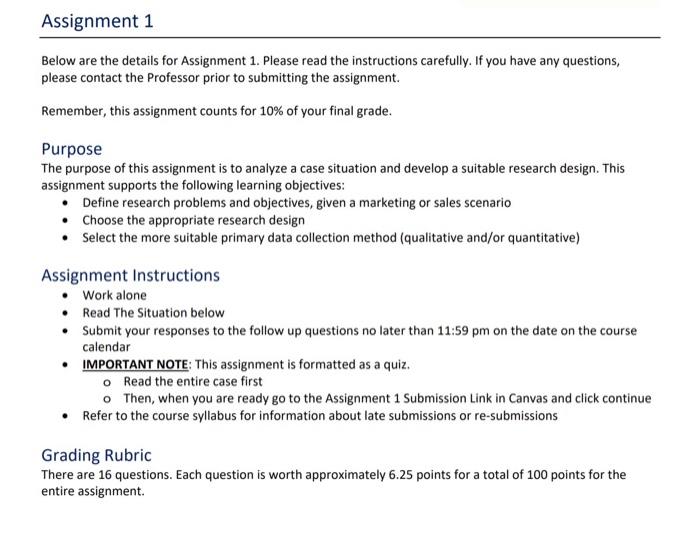
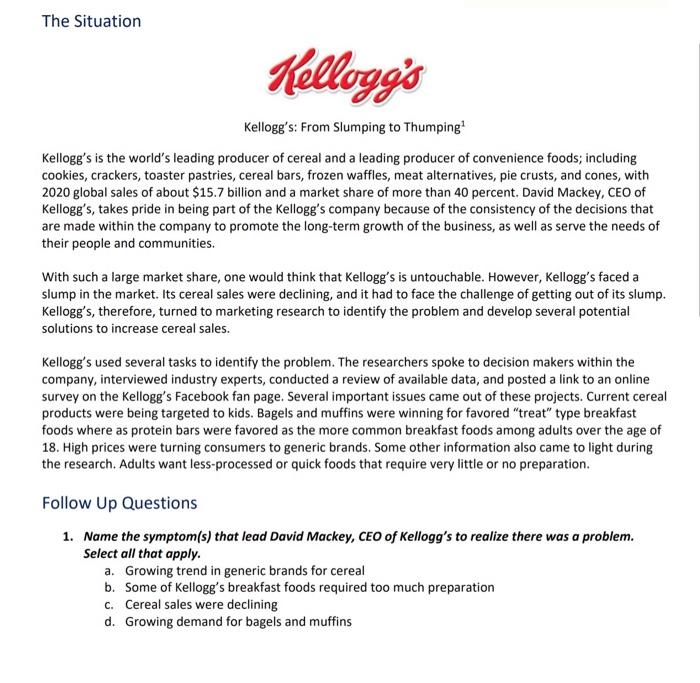
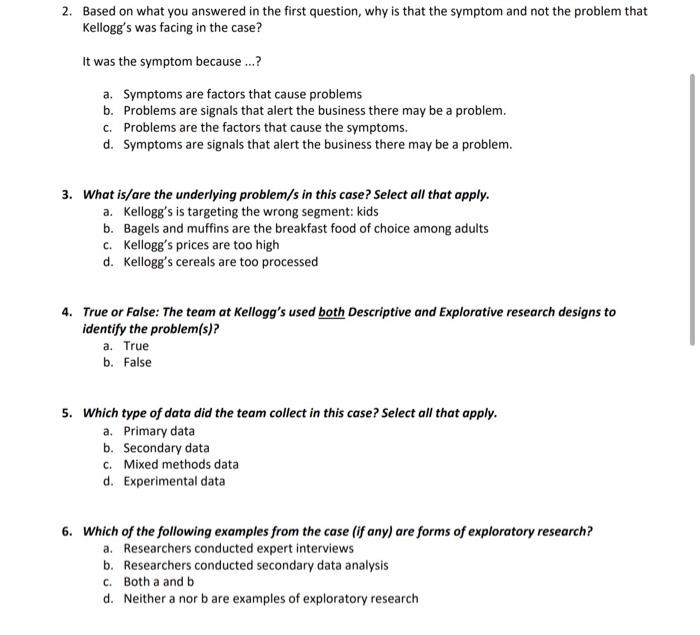
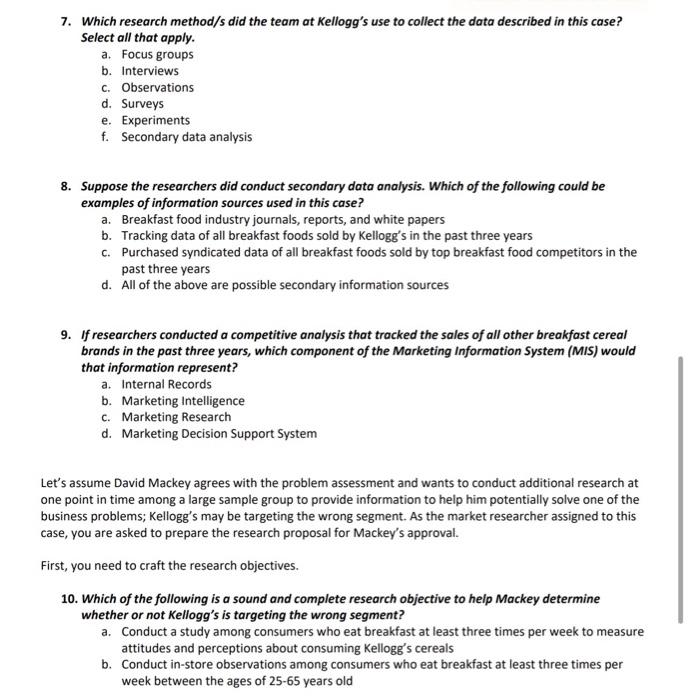
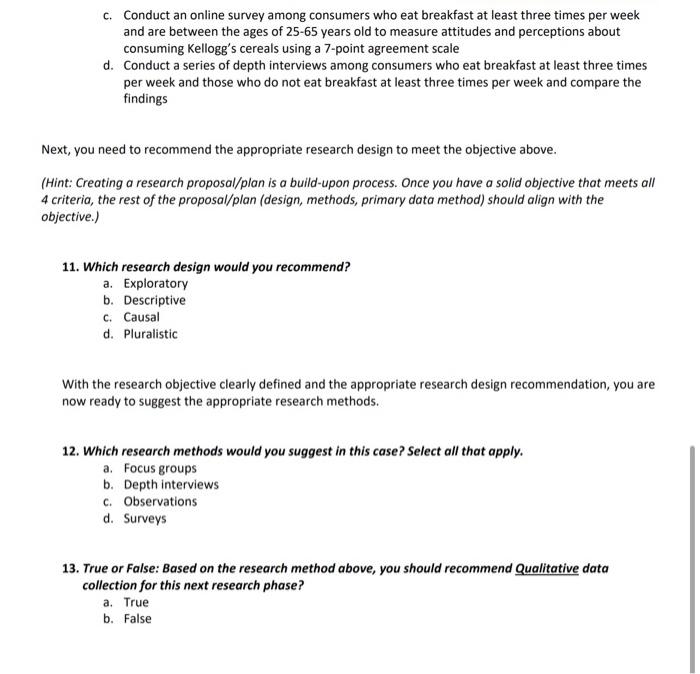
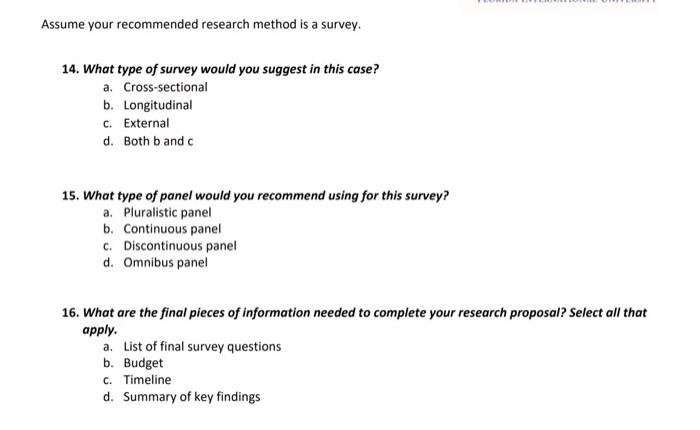
Below are the details for Assignment 1. Please read the instructions carefully. If you have any questions, please contact the Professor prior to submitting the assignment. Remember, this assignment counts for 10% of your final grade. Purpose The purpose of this assignment is to analyze a case situation and develop a suitable research design. This assignment supports the following learning objectives: - Define research problems and objectives, given a marketing or sales scenario - Choose the appropriate research design - Select the more suitable primary data collection method (qualitative and/or quantitative) Assignment Instructions - Work alone - Read The Situation below - Submit your responses to the follow up questions no later than 11:59 pm on the date on the course calendar - IMPORTANT NOTE: This assignment is formatted as a quiz. - Read the entire case first - Then, when you are ready go to the Assignment 1 Submission Link in Canvas and click continue - Refer to the course syllabus for information about late submissions or re-submissions Grading Rubric There are 16 questions. Each question is worth approximately 6.25 points for a total of 100 points for the entire assignment. The Situation Kellogg's: From Slumping to Thumping 1 Kellogg's is the world's leading producer of cereal and a leading producer of convenience foods; including cookies, crackers, toaster pastries, cereal bars, frozen waffles, meat alternatives, pie crusts, and cones, with 2020 global sales of about $15.7 billion and a market share of more than 40 percent. David Mackey, CEO of Kellogg's, takes pride in being part of the Kellogg's company because of the consistency of the decisions that are made within the company to promote the long-term growth of the business, as well as serve the needs of their people and communities. With such a large market share, one would think that Kellogg's is untouchable. However, Kellogg's faced a slump in the market. Its cereal sales were declining, and it had to face the challenge of getting out of its slump. Kellogg's, therefore, turned to marketing research to identify the problem and develop several potential solutions to increase cereal sales. Kellogg's used several tasks to identify the problem. The researchers spoke to decision makers within the company, interviewed industry experts, conducted a review of available data, and posted a link to an online survey on the Kellogg's Facebook fan page. Several important issues came out of these projects. Current cereal products were being targeted to kids. Bagels and muffins were winning for favored "treat" type breakfast foods where as protein bars were favored as the more common breakfast foods among adults over the age of 18. High prices were turning consumers to generic brands. Some other information also came to light during the research. Adults want less-processed or quick foods that require very little or no preparation. Follow Up Questions 1. Name the symptom(s) that lead David Mackey, CEO of Kellogg's to realize there was a problem. Select all that apply. a. Growing trend in generic brands for cereal b. Some of Kellogg's breakfast foods required too much preparation c. Cereal sales were declining d. Growing demand for bagels and muffins 2. Based on what you answered in the first question, why is that the symptom and not the problem that Kellogg's was facing in the case? It was the symptom because ...? a. Symptoms are factors that cause problems b. Problems are signals that alert the business there may be a problem. c. Problems are the factors that cause the symptoms. d. Symptoms are signals that alert the business there may be a problem. 3. What is/are the underlying problem/s in this case? Select all that apply. a. Kellogg's is targeting the wrong segment: kids b. Bagels and muffins are the breakfast food of choice among adults c. Kellogg's prices are too high d. Kellogg's cereals are too processed 4. True or False: The team at Kellogg's used both Descriptive and Explorative research designs to identify the problem(s)? a. True b. False 5. Which type of data did the team collect in this case? Select all that apply. a. Primary data b. Secondary data c. Mixed methods data d. Experimental data 6. Which of the following examples from the case (if any) are forms of exploratory research? a. Researchers conducted expert interviews b. Researchers conducted secondary data analysis c. Both a and b d. Neither a nor b are examples of exploratory research 7. Which research method/s did the team at Kellogg's use to collect the data described in this case? Select all that apply. a. Focus groups b. Interviews c. Observations d. Surveys e. Experiments f. Secondary data analysis 8. Suppose the researchers did conduct secondary data analysis. Which of the following could be examples of information sources used in this case? a. Breakfast food industry journals, reports, and white papers b. Tracking data of all breakfast foods sold by Kellogg's in the past three years c. Purchased syndicated data of all breakfast foods sold by top breakfast food competitors in the past three years d. All of the above are possible secondary information sources 9. If researchers conducted a competitive analysis that tracked the sales of all other breakfast cereal brands in the past three years, which component of the Marketing Information System (MIS) would that information represent? a. Internal Records b. Marketing Intelligence c. Marketing Research d. Marketing Decision Support System Let's assume David Mackey agrees with the problem assessment and wants to conduct additional research at one point in time among a large sample group to provide information to help him potentially solve one of the business problems; Kellogg's may be targeting the wrong segment. As the market researcher assigned to this case, you are asked to prepare the research proposal for Mackey's approval. First, you need to craft the research objectives. 10. Which of the following is a sound and complete research objective to help Mackey determine whether or not Kellogg's is targeting the wrong segment? a. Conduct a study among consumers who eat breakfast at least three times per week to measure attitudes and perceptions about consuming Kellogg's cereals b. Conduct in-store observations among consumers who eat breakfast at least three times per week between the ages of 25-65 years old c. Conduct an online survey among consumers who eat breakfast at least three times per week and are between the ages of 25-65 years old to measure attitudes and perceptions about consuming Kellogg's cereals using a 7-point agreement scale d. Conduct a series of depth interviews among consumers who eat breakfast at least three times per week and those who do not eat breakfast at least three times per week and compare the findings Vext, you need to recommend the appropriate research design to meet the objective above. Hint: Creating a research proposal/plan is a build-upon process. Once you have a solid objective that meets all icriteria, the rest of the proposal/plan (design, methods, primary data method) should align with the biective.) 11. Which research design would you recommend? a. Exploratory b. Descriptive c. Causal d. Pluralistic With the research objective clearly defined and the appropriate research design recommendation, you are now ready to suggest the appropriate research methods. 12. Which research methods would you suggest in this case? Select all that apply. a. Focus groups b. Depth interviews c. Observations d. Surveys 13. True or False: Based on the research method above, you should recommend Qualitative data collection for this next research phase? a. True b. False Assume your recommended research method is a survey. 14. What type of survey would you suggest in this case? a. Cross-sectional b. Longitudinal c. External d. Both b and c 15. What type of panel would you recommend using for this survey? a. Pluralistic panel b. Continuous panel c. Discontinuous panel d. Omnibus panel 16. What are the final pieces of information needed to complete your research proposal? Select all that apply. a. List of final survey questions b. Budget c. Timeline d. Summary of key findings
Step by Step Solution
There are 3 Steps involved in it

Get step-by-step solutions from verified subject matter experts
 Study Help