



Question: Below is a paper machine with a width of 5 meter. It produces copy paper at a speed of 20 m/s. Dry paper has 5%
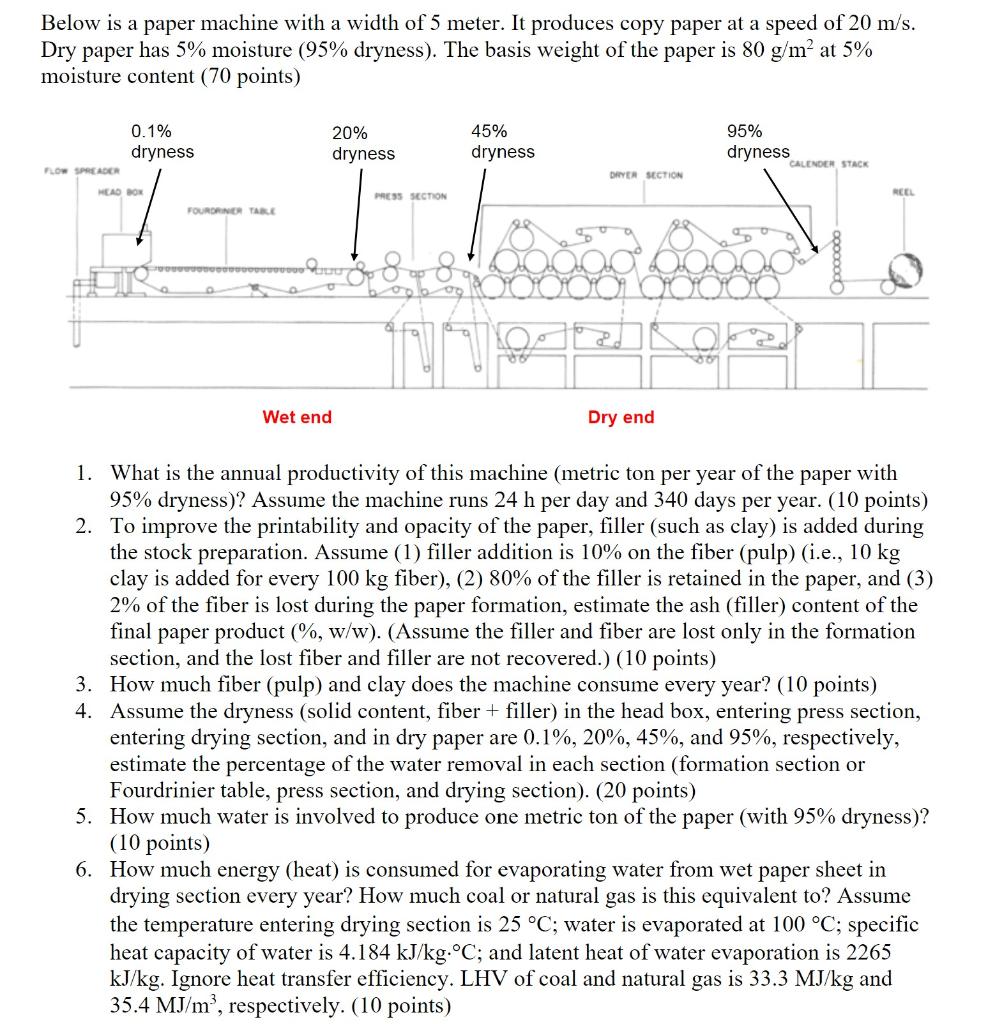
Below is a paper machine with a width of 5 meter. It produces copy paper at a speed of 20 m/s. Dry paper has 5% moisture (95% dryness). The basis weight of the paper is 80 g/m at 5% moisture content (70 points) 0.1% dryness 20% dryness 45% dryness 95% dryness CALENDER STACK LO SPREADER DAYER SECTION HEAD ON - EEN PRESS SECTION FOURDINER TARE 8 BA 88 Wet end Dry end 1. What is the annual productivity of this machine (metric ton per year of the paper with 95% dryness)? Assume the machine runs 24 h per day and 340 days per year. (10 points) 2. To improve the printability and opacity of the paper, filler (such as clay) is added during the stock preparation. Assume (1) filler addition is 10% on the fiber (pulp) (i.e., 10 kg clay is added for every 100 kg fiber), (2) 80% of the filler is retained in the paper, and (3) 2% of the fiber is lost during the paper formation, estimate the ash (filler) content of the final paper product (%, w/w). (Assume the filler and fiber are lost only in the formation section, and the lost fiber and filler are not recovered.) (10 points) 3. How much fiber (pulp) and clay does the machine consume every year? (10 points) 4. Assume the dryness (solid content, fiber + filler) in the head box, entering press section, entering drying section, and in dry paper are 0.1%, 20%, 45%, and 95%, respectively, estimate the percentage of the water removal in each section (formation section or Fourdrinier table, press section, and drying section) (20 points) 5. How much water is involved to produce one metric ton of the paper (with 95% dryness)? (10 points) 6. How much energy (heat) is consumed for evaporating water from wet paper sheet in drying section every year? How much coal or natural gas is this equivalent to? Assume the temperature entering drying section is 25 C; water is evaporated at 100 C; specific heat capacity of water is 4.184 kJ/kg.C; and latent heat of water evaporation is 2265 kJ/kg. Ignore heat transfer efficiency. LHV of coal and natural gas is 33.3 MJ/kg and 35.4 MJ/m, respectively. (10 points)
Step by Step Solution
There are 3 Steps involved in it

Get step-by-step solutions from verified subject matter experts