







Question: BELOW IS A SCENARIO USE IT TO ANSWER BELOW QUESTION. Questions It is worker A's birthday. While working they discussed how much they enjoyed the
BELOW IS A SCENARIO USE IT TO ANSWER BELOW QUESTION.
Questions 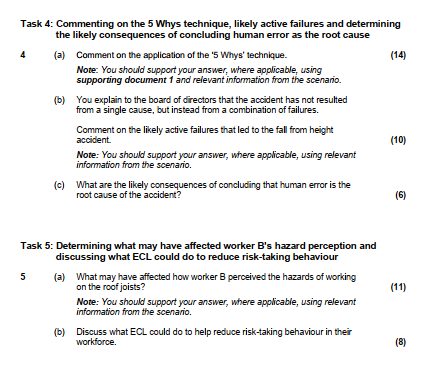
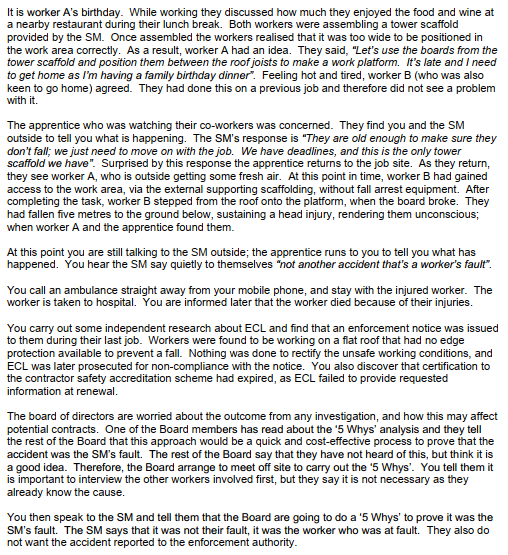
It is worker A's birthday. While working they discussed how much they enjoyed the food and wine at a nearby restaurant during their lunch break. Both workers were assembling a tower scaffold provided by the SM. Once assembled the workers realised that it was too wide to be positioned in the work area correctly. As a result, worker A had an idea. They said, "Let's use the boards from the tower scaffold and position them between the roof joists to make a work platform. It's late and I need to get home as I'm having a family birthday dinner". Feeling hot and tired, worker B (who was also keen to go home) agreed. They had done this on a previous job and therefore did not see a problem with it. The apprentice who was watching their co-workers was concerned. They find you and the SM outside to tell you what is happening. The SM's response is "They are old enough to make sure they don't fall; we just need to move on with the job. We have deadlines, and this is the only tower scaffold we have". Surprised by this response the apprentice returns to the job site. As they return, they see worker A, who is outside getting some fresh air. At this point in time, worker B had gained access to the work area, via the external supporting scaffolding, without fall arrest equipment. After completing the task, worker B stepped from the roof onto the platform, when the board broke. They had fallen five metres to the ground below, sustaining a head injury, rendering them unconscious; when worker A and the apprentice found them. At this point you are still talking to the SM outside; the apprentice runs to you to tell you what has happened. You hear the SM say quietly to themselves "not another accident that's a worker's fault". You call an ambulance straight away from your mobile phone, and stay with the injured worker. The worker is taken to hospital. You are informed later that the worker died because of their injuries. You carry out some independent research about ECL and find that an enforcement notice was issued to them during their last job. Workers were found to be working on a flat roof that had no edge protection available to prevent a fall. Nothing was done to rectify the unsafe working conditions, and ECL was later prosecuted for non-compliance with the notice. You also discover that certification to the contractor safety accreditation scheme had expired, as ECL failed to provide requested information at renewal. The board of directors are worried about the outcome from any investigation, and how this may affect potential contracts. One of the Board members has read about the ' 5 Whys' analysis and they tell the rest of the Board that this approach would be a quick and cost-effective process to prove that the accident was the SM's fault. The rest of the Board say that they have not heard of this, but think it is a good idea. Therefore, the Board arrange to meet off site to carry out the ' 5 Whys'. You tell them it is important to interview the other workers involved first, but they say it is not necessary as they already know the cause. You then speak to the SM and tell them that the Board are going to do a ' 5 Whys' to prove it was the SM's fault. The SM says that it was not their fault, it was the worker who was at fault. They also do not want the accident reported to the enforcement authority. Task 4: Commenting on the 5 Whys technique, likely active failures and determining the likely consequences of concluding human error as the root cause 4 (a) Comment on the application of the ' 5 Whys' technique. (14) Note: You should support your answer, where applicable, using supporting document 1 and relevant information from the scenario. (b) You explain to the board of directors that the accident has not resulted from a single cause, but instead from a combination of failures. Comment on the likely active failures that led to the fall from height accident. (10) Note: You should support your answer, where applicable, using relevant information from the scenario. (c) What are the likely consequences of concluding that human error is the root cause of the accident? (6) Task 5: Determining what may have affected worker B's hazard perception and discussing what ECL could do to reduce risk-taking behaviour 5 (a) What may have affected how worker B perceived the hazards of working on the roof joists? (11) Note: You should support your answer, where applicable, using relevant information from the scenario. (b) Discuss what ECL could do to help reduce risk-taking behaviour in their workforce. (8)
Step by Step Solution
There are 3 Steps involved in it

Get step-by-step solutions from verified subject matter experts
 Study Help