







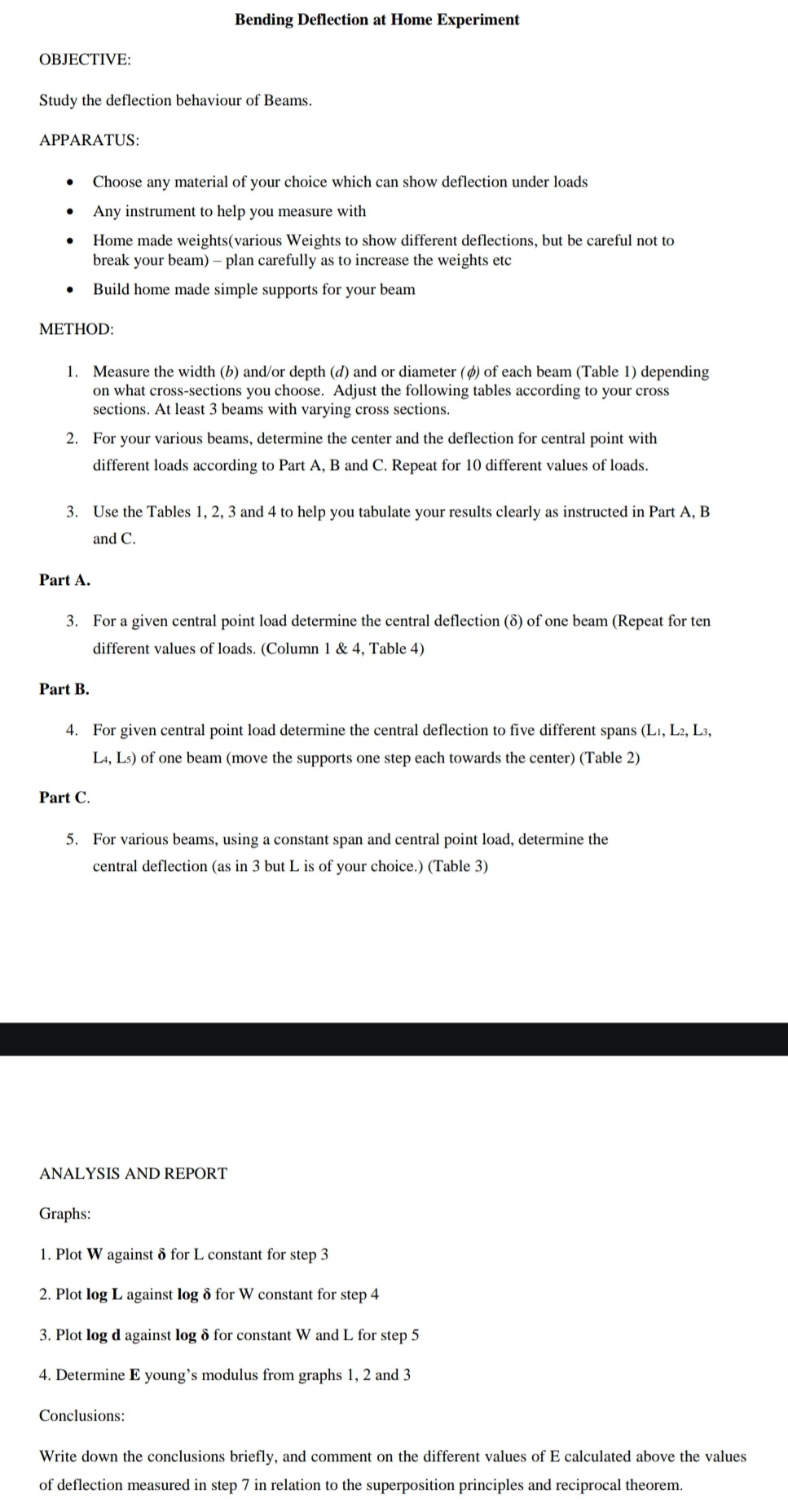
Question: Bending Deflection at Home Experiment OBJECTIVE: Study the deflection behaviour of Beams. APPARATUS: Choose any material of your choice which can show deflection under loads
Bending Deflection at Home Experiment
OBJECTIVE:
Study the deflection behaviour of Beams.
APPARATUS:
Choose any material of your choice which can show deflection under loads
Any instrument to help you measure with
Home made weightsvarious Weights to show different deflections, but be careful not to break your beam plan carefully as to increase the weights etc
Build home made simple supports for your beam
METHOD:
Measure the width andor depth and or diameter of each beam Table depending on what crosssections you choose. Adjust the following tables according to your cross sections. At least beams with varying cross sections.
For your various beams, determine the center and the deflection for central point with different loads according to Part A B and C Repeat for different values of loads.
Use the Tables and to help you tabulate your results clearly as instructed in Part A B and C
Part A
For a given central point load determine the central deflection of one beam Repeat for ten different values of loads. Column & Table
Part B
For given central point load determine the central deflection to five different spans s of one beam move the supports one step each towards the centerTable
Part C
For various beams, using a constant span and central point load, determine the central deflection as in but is of your choice.Table
ANALYSIS AND REPORT
Graphs:
Plot against for L constant for step
Plot against for constant for step
Plot against for constant and for step
Determine young's modulus from graphs and
Conclusions:
Write down the conclusions briefly, and comment on the different values of E calculated above the values of deflection measured in step in relation to the superposition principles and reciprocal theorem.
Step by Step Solution
There are 3 Steps involved in it
1 Expert Approved Answer
Step: 1 Unlock

Question Has Been Solved by an Expert!
Get step-by-step solutions from verified subject matter experts
Step: 2 Unlock
Step: 3 Unlock
 Study Help