







Question: Big - O notation. We have learnt big - O notation to Big - O notation. We have learnt big - O notation to compare
BigO notation. We have learnt bigO notation to BigO notation. We have learnt bigO notation to compare the growth rates of func
tions, this exercise helps you to better understand its definition and properties.
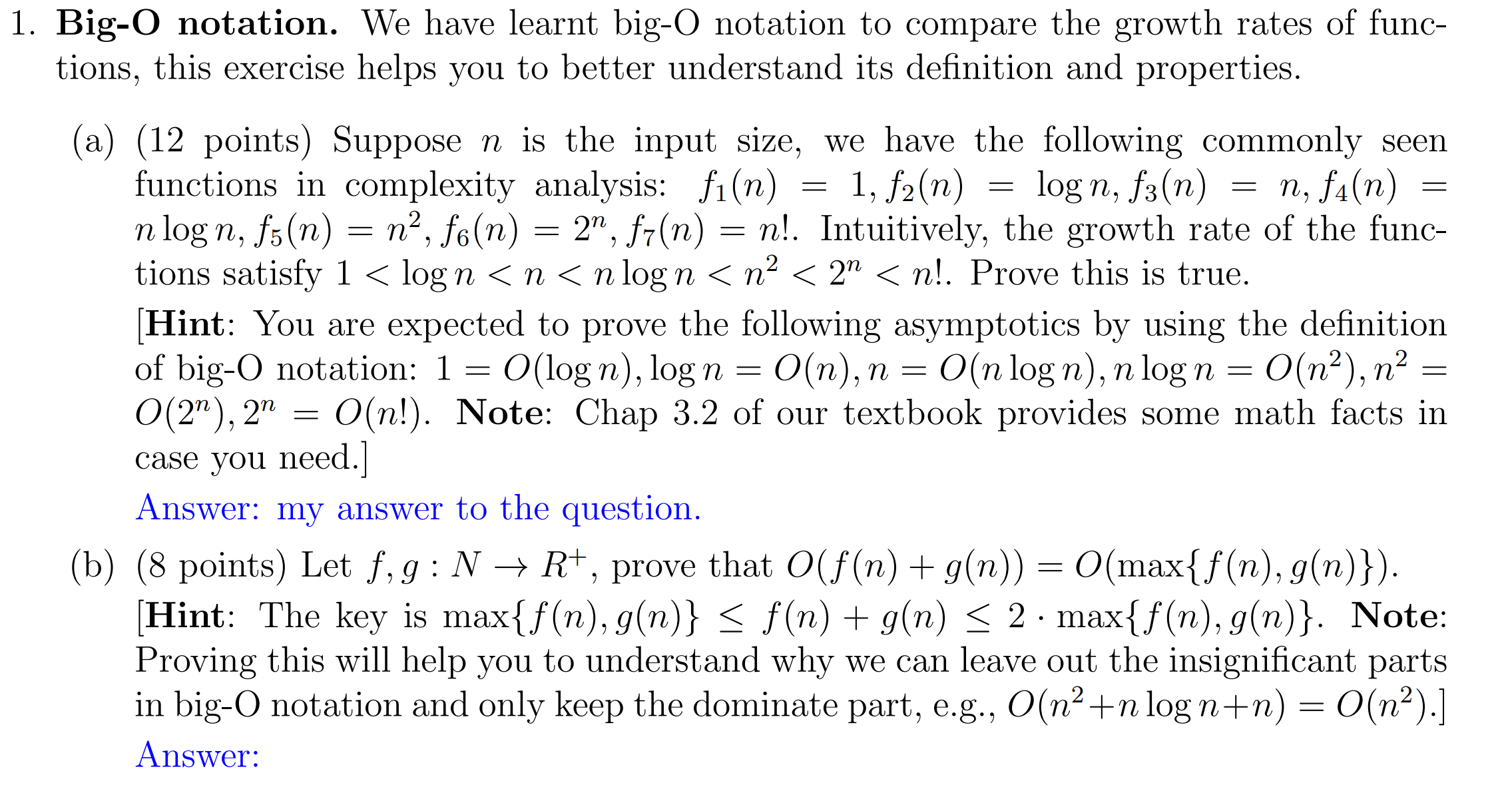
a points Suppose is the input size, we have the following commonly seen
functions in complexity analysis:
Intuitively, the growth rate of the func
tions satisfy : Prove this true.
: You are expected prove the following asymptotics using the definition
big notation:
Note: Chap our textbook provides some math facts
case you need.
Answer: answer the question.
points Let : prove that
: The key max Note:
Proving this will help you understand why can leave out the insignificant parts
big notation and only keep the dominate part,
Answer:compare the growth rates of func
tions, this exercise helps you to better understand its definition and properties.
a points Suppose n is the input size, we have the following commonly seen functions in complexity analysis: fn fn log n fn n fn n log n fn n fnn fn n Intuitively, the growth rate of the func tionssatisfy
Step by Step Solution
There are 3 Steps involved in it
1 Expert Approved Answer
Step: 1 Unlock

Question Has Been Solved by an Expert!
Get step-by-step solutions from verified subject matter experts
Step: 2 Unlock
Step: 3 Unlock
 Study Help