



Question: Binomial tree: European and American puts Consider a two-step binomial tree, where a stock that pays no dividends has current price 100, and at each
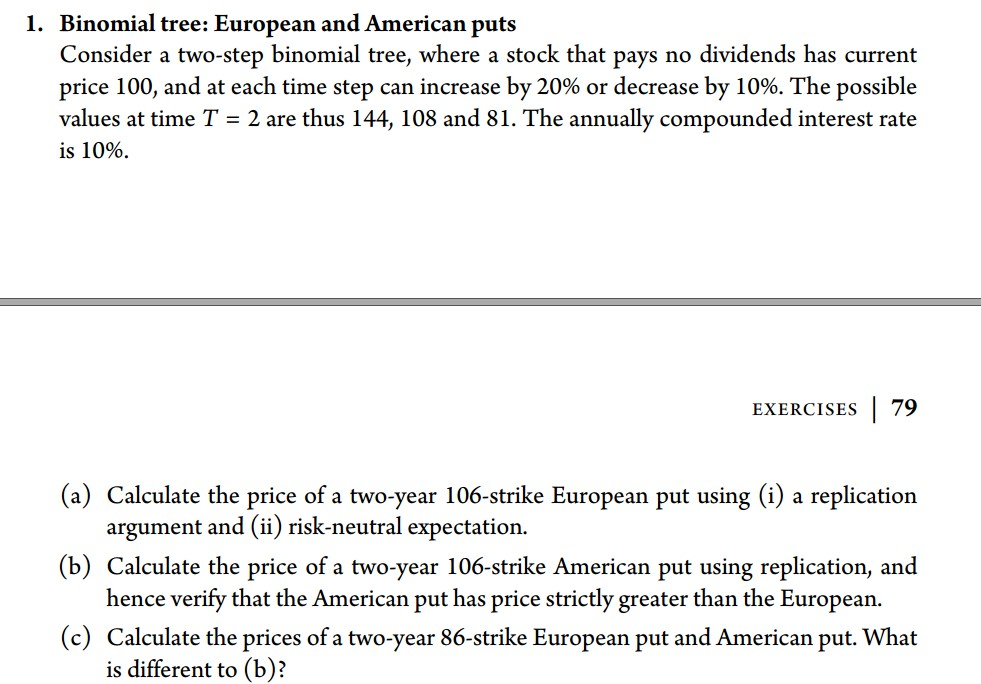
Binomial tree: European and American puts Consider a two-step binomial tree, where a stock that pays no dividends has current price 100, and at each time step can increase by 20% or decrease by 10%. The possible values at time T = 2 are thus 144, 108 and 81 . The annually compounded interest rate is 10%. 1. EXERCISES | 79 strike European put using (1) a replication argument and (ii) risk-neutral expectation. (b) Calculate the price of a two-year 106-strike American put using replication, and hence verify that the American put has price strictly greater than the European. Calculate the prices of a two-year 86-strike European put and American put. What is different to (b)? (c) Binomial tree: European and American puts Consider a two-step binomial tree, where a stock that pays no dividends has current price 100, and at each time step can increase by 20% or decrease by 10%. The possible values at time T = 2 are thus 144, 108 and 81 . The annually compounded interest rate is 10%. 1. EXERCISES | 79 strike European put using (1) a replication argument and (ii) risk-neutral expectation. (b) Calculate the price of a two-year 106-strike American put using replication, and hence verify that the American put has price strictly greater than the European. Calculate the prices of a two-year 86-strike European put and American put. What is different to (b)? (c)
Step by Step Solution
There are 3 Steps involved in it

Get step-by-step solutions from verified subject matter experts