







Question: BIOINFORMATICS QUESTION. No other information is needed. Please include each optimal alignment for each alignment type. This is your first set of Exercises: Fill in
BIOINFORMATICS QUESTION. No other information is needed.
Please include each optimal alignment for each alignment type.
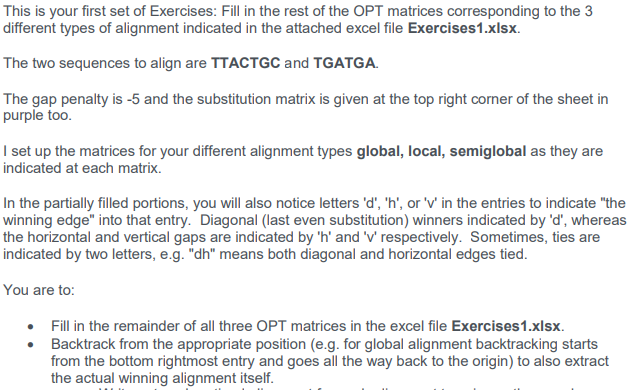
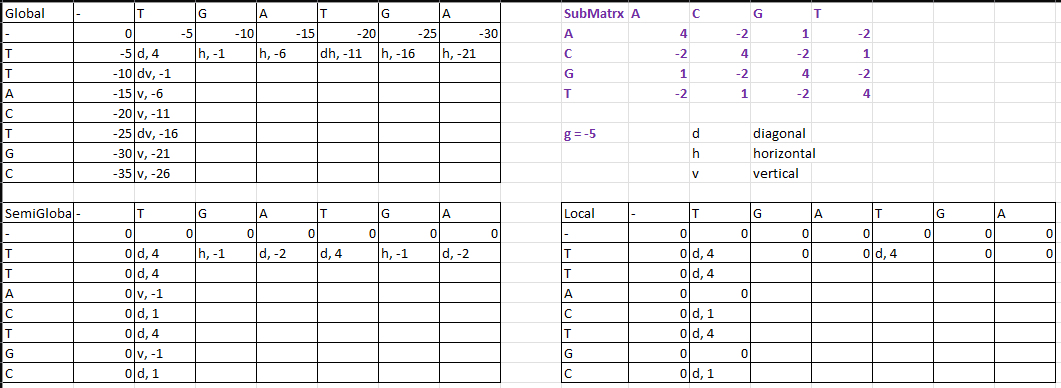
This is your first set of Exercises: Fill in the rest of the OPT matrices corresponding to the 3 different types of alignment indicated in the attached excel file Exercises1.xlsx. The two sequences to align are TTACTGC and TGATGA. The gap penalty is -5 and the substitution matrix is given at the top right corner of the sheet in purple too. I set up the matrices for your different alignment types global, local, semiglobal as they are indicated at each matrix. In the partially filled portions, you will also notice letters 'd', 'h', or 'v' in the entries to indicate "the winning edge" into that entry. Diagonal (last even substitution) winners indicated by 'd', whereas the horizontal and vertical gaps are indicated by 'h' and 'V' respectively. Sometimes, ties are indicated by two letters, e.g. "dh" means both diagonal and horizontal edges tied. You are to: Fill in the remainder of all three OPT matrices in the excel file Exercises 1.xlsx. Backtrack from the appropriate position (e.g. for global alignment backtracking starts from the bottom rightmost entry and goes all the way back to the origin) to also extract the actual winning alignment itself. Global T G A T G G T SubMatrx A 0 -5 -2 4 4 -2 1 -10 h, -6 -2 - 15 -20 -25 -30 dh, -11 h, -16 th, -21 T h, -1 C 4 -2 1 T G -2 4 -2 1 1 -2 A T 1 -2 4 C -5 d, 4 -10 dv, -1 -15 v, -6 -20 v, -11 -25 dv, -16 -30 v, -21 -35 v, -26 T g=-5 d d G h diagonal horizontal vertical V SemiGlobal IT T IG T G Local T A G IG ol 0 0 A 0 d, -2 0 0 0 0 d, -2 0 0 0 h, -1 T 0 0 old, 4 0 01 0 ol T h, -1 d, 4 T T 0 0 T T A 0 0 old, 4 4 old, 4 Olv, -1 old, 1 old, 4 0 v, -1 old, 1 01 old, 4 0 d, 4 0 0d, 1 old, 4 ol old, 1 C C T T G G 0 C C This is your first set of Exercises: Fill in the rest of the OPT matrices corresponding to the 3 different types of alignment indicated in the attached excel file Exercises1.xlsx. The two sequences to align are TTACTGC and TGATGA. The gap penalty is -5 and the substitution matrix is given at the top right corner of the sheet in purple too. I set up the matrices for your different alignment types global, local, semiglobal as they are indicated at each matrix. In the partially filled portions, you will also notice letters 'd', 'h', or 'v' in the entries to indicate "the winning edge" into that entry. Diagonal (last even substitution) winners indicated by 'd', whereas the horizontal and vertical gaps are indicated by 'h' and 'V' respectively. Sometimes, ties are indicated by two letters, e.g. "dh" means both diagonal and horizontal edges tied. You are to: Fill in the remainder of all three OPT matrices in the excel file Exercises 1.xlsx. Backtrack from the appropriate position (e.g. for global alignment backtracking starts from the bottom rightmost entry and goes all the way back to the origin) to also extract the actual winning alignment itself. Global T G A T G G T SubMatrx A 0 -5 -2 4 4 -2 1 -10 h, -6 -2 - 15 -20 -25 -30 dh, -11 h, -16 th, -21 T h, -1 C 4 -2 1 T G -2 4 -2 1 1 -2 A T 1 -2 4 C -5 d, 4 -10 dv, -1 -15 v, -6 -20 v, -11 -25 dv, -16 -30 v, -21 -35 v, -26 T g=-5 d d G h diagonal horizontal vertical V SemiGlobal IT T IG T G Local T A G IG ol 0 0 A 0 d, -2 0 0 0 0 d, -2 0 0 0 h, -1 T 0 0 old, 4 0 01 0 ol T h, -1 d, 4 T T 0 0 T T A 0 0 old, 4 4 old, 4 Olv, -1 old, 1 old, 4 0 v, -1 old, 1 01 old, 4 0 d, 4 0 0d, 1 old, 4 ol old, 1 C C T T G G 0 C C
Step by Step Solution
There are 3 Steps involved in it

Get step-by-step solutions from verified subject matter experts
 Study Help