



Question: BLOOMS TAXONOMY Another way to look at the learning process is to differentiate between lower and higher levels of cognitive development. Benjamin Bloom chaired a
BLOOMS TAXONOMY
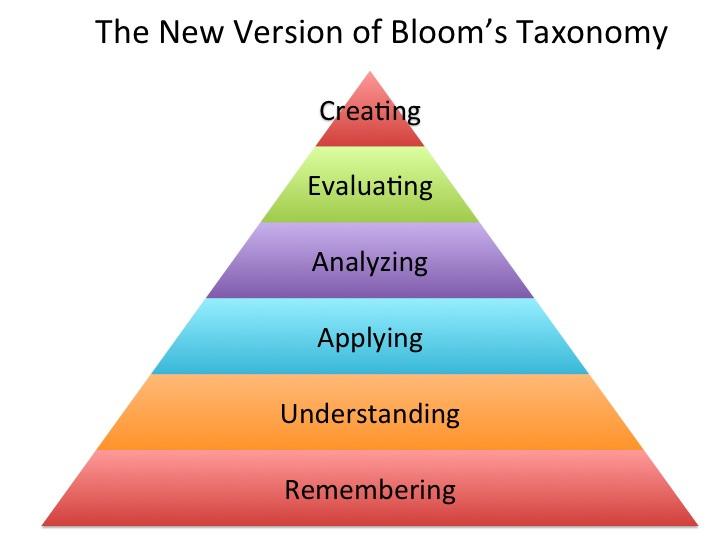
Another way to look at the learning process is to differentiate between lower and higher levels of cognitive development. Benjamin Bloom chaired a committee of educators in 1956 whose goal was to create consistency in educational goals and course objectives. The committee created what is now commonly known as Blooms Taxonomy; it consists of level descriptions in three areas: the cognitive domain, the affective domain, and the psychomotor domain. Each domain has a gradient that moves from lower to higher levels of achievement. Educators use the levels for the cognitive domain widely. The list below gives a breakdown of these six categories together with a brief definition of how each builds on the cognitive skills of the previous, with the higher levels including all the skills from the lower levels.
-
Knowledge: remembering or recalling appropriate, previously learned information to draw out factual (usually right or wrong) answers. Typical words and phrases: how many, when, where, list, define, tell, describe, identify, etc. These draw out factual answers, testing recall and recognition.
-
Comprehension: grasping or understanding the meaning of informational materials. Typical words and phrases: describe, explain, estimate, predict, identify, differentiate, etc. These encourage students to translate, interpret and extrapolate.
-
Application: applying previously learned information (or knowledge) to new and unfamiliar situations. Typical words and phrases: demonstrate, apply, illustrate, show, solve, examine, classify, experiment, etc. These encourage students to apply knowledge to situations that are new and unfamiliar.
-
Analysis: breaking down information into parts, or examining (and trying to understand the organizational structure of) information. Typical words and phrases: what are the differences, analyze, explain, compare, separate, classify, arrange, etc. These encourage students to break information down into parts.
-
Synthesis: applying prior knowledge and skills to combine elements into a pattern not clearly there before. Typical words and phrases: combine, rearrange, substitute, create, design, invent, what if, etc. These encourage students to combine elements into a pattern that's new.
-
Evaluation: judging or deciding according to some set of criteria, without real right or wrong answers. Typical words and phrases: assess, decide, measure, select, explain, conclude, compare, summarize, etc. These encourage students to make judgments according to a set of criteria.
Answer the following questions in a narrative of several paragraphs.
How would someone determine their level of understanding of a subject using Blooms Taxonomy? How would they demonstrate that knowledge?
The New Version of Bloom's Taxonomy Creating Evaluating Analyzing Applying Understanding RememberingStep by Step Solution
There are 3 Steps involved in it

Get step-by-step solutions from verified subject matter experts