







Question: Bond Pricing using Present Value Tables using Excel's Multi-tab Cell Reference and Basic Math Functions Ruiz Company issued bonds on January 1 and has provided
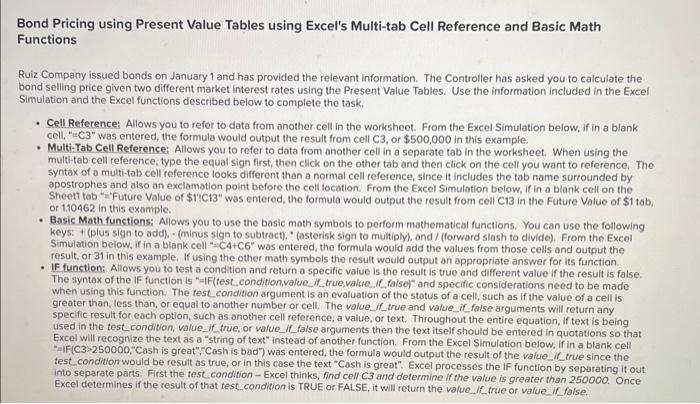
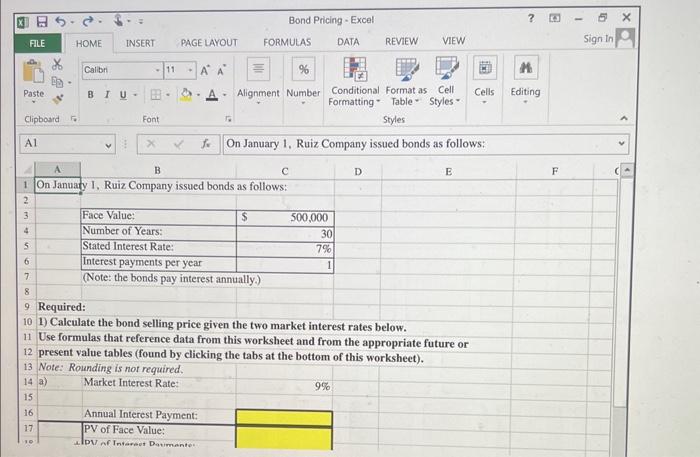
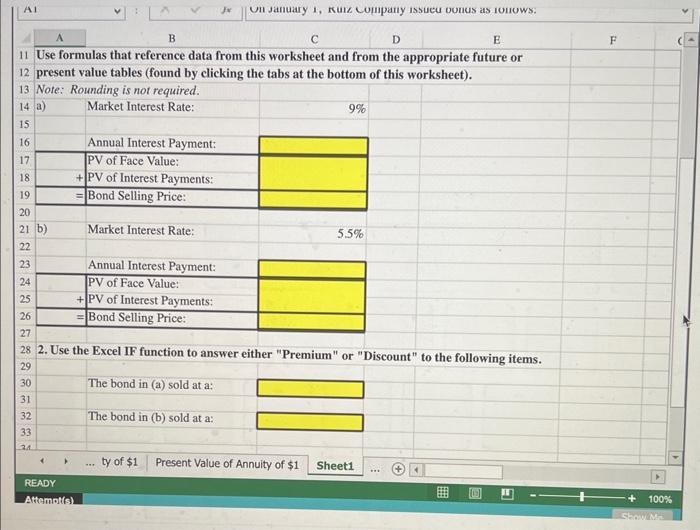
Bond Pricing using Present Value Tables using Excel's Multi-tab Cell Reference and Basic Math Functions Ruiz Company issued bonds on January 1 and has provided the relevant information. The Controller has asked you to caiculate the bond selling price given two different market interest rates using the Present Value Tables. Use the information included in the Excel Simulation and the Excel functions described below to complete the task. - Cell Reference: Allows you to refer to data from another cell in the worksheet. From the Excel Simulation below, if in a blank cell, " C3 " was entered, the formula would output the result from cell C3, or $500,000 in this example. - Multi-Tab Cell Reference: Allows you to refer to data from another cell in a separate tab in the worksheet. When using the mult-tab cell reference, type the equal sign first, then click on the other tab and then click on the cell you want to reference. The syntax of a multi-tab cell reference looks different than a normal cell reference, since it includes the tab name surrounded by apostrophes and also an exclamation point before the cell location. From the Excel Simulation below, If in a blank cell on the Sheet1 tab "i' 'Future Value of \$1'C13" was entered, the formula would output the result from cell C13 in the Future Value of $1 tab. or 1.10462 in this example. - Basic Math functions: Allows you to use the basic math symbols to perform mathematical functions. You can use the following keys: + (plus sign to add), (minus sign to subtract), " (asterisk sign to multiply), and / (forward slash to divide). From the Excel Simulation below, if in a blank cell "=C4+C6" was entered, the formula would add the values from those cells and output the result, or 31 in this example. If using the other math symbols the result would output an appropriate answer for its function. - IF function: Allows you to test a condition and return a specific value is the result is true and different value if the result is false. The syntax of the If function is "=IF(test_condition,value if true,value. if. falso)" and specific considerations need to be made when using this function. The test condition argument is an evaluation of the status of a cell, such as if the value of a cell is greater than, less than, or equal to another number or cell. The value, if true and value. if false arguments will return any specific result for each option, such as another cell reference, a value, or text. Throughout the entire equation, If text is being used in the test condition, value. If true, or value if false arguments then the text itself should be entered in quotations so that Excel will recognize the text as a "string of text" instead of another function. From the Excel Simulation below, if in a blank cell "=IF(C3>250000," Cash is great", "Cash is bad") was entered, the formula would output the result of the value, if true since the test condition would be result as true, or in this case the text "Cash is great". Excel processes the IF function by separating it out. into separate parts. First the test.condition- Excel thinks, find cell C3 and determine if the value is greater than 250000 . Once Excel determines if the result of that test_condition is TRUE or FALSE, it will return the value, if true or value if false. Use formulas that reference data from this worksheet and from the appropriate future o 2 nresent value tahlec (found hv clickina tha tahe at tha hattam of this worksheet)
Step by Step Solution
There are 3 Steps involved in it

Get step-by-step solutions from verified subject matter experts
 Study Help