







Question: Bondi Cerealsoperators ( laying off ) , under - utilise its current work force or build up inventories. All these options have a cost associated
Bondi Cerealsoperators laying off underutilise its current work force or build up inventories. All these options
have a cost associated with them and businesses often use a combination of these strategies and
policies, not just a single option. Determining the least expensive option is difficult and a challenge
for many businesses and an important issue for Bondi Cereals.
Useful Formulae
All demand in each week must be met, either by producing product, or by supplying orders out of
inventory or by creating backorders. For instance, at the beginning of each period week the
factory knows what inventory it has in stock at the end of the previous period The net demand
for that period will then be the gross demand refer Tables and minus what it has in inventory
if : plus any backorders carried forward if : The factory will then decide how
much to produce we will call this This will depend on the demand as well as whether we want
to produce more than demand and build inventory or produce less than demand and create
backorders.
We can derive a formula for :
Where:
equals gross demand in period
equals a positive inventory holding carried forward from the previous period.
equals backorders carried fTable shows the selling price, retail markup, discount and manufacturing cost structure
e
The purpose of this question is to apply one of the most important and widely used
mathematical algorithms, Linear Programming, to solve one of the most common issues faced
by corporations, the allocation of resources to achieve an optimum outcome. In this
assignment you are given a realistic business scenario complete with operational data and
costing information. You will work through the assignment in a systematic way by
establishing the decision variables, the objective function, identifying the constraints, building
the model, verifying and validating, running the model, interpreting the results, testing different
scenarios, and making recommendatione
Close
Bondi Cereals is a newly formed company that wants to become a premium supplier of high
quality cereals and is based right here in Sydney's eastern beaches. The company offers three
varieties: Vanilla, Hazelnut, and Chocolate.
Bondi produces its product from locally produced grains and ingredients as well as some
imported product, such as vanilla and chocolate. The operation involves mixing, blending, and
baking in strict conformance with their unique recipes.
In March a meeting is scheduled between Tillie and Merle, the two owners. Fixed
volume purchase contracts have been signed with suppliers and it is time to plan the
production of the cereal. The purpose of the meeting is to discuss the production strategy and
the allocation and scheduling of resources to meet the production forecast.
Sales Forecast
Since Bondi is a newcomer to the market, its brand is not yet well known and therefore this
product will initially be sold through a limited number of local supermarkets as a trial. Bondi is
hopeful that its cereal will catch on and that its product line will continue to grow. However, since
their brand is new and unproven and competition is strong, especially from established suppliers,
Merle has come up with a conservative and perhaps even a pessimistic sales forecast, on a
weekly basis for the first six weeks of the trial period. This is shown in Table The Factory
The factory currently employs casual operators. An operator can produce of product per
hour shift. The factory only works a single shift of hours per day minus hour for breaks days
per week. Merle and Tillie are not considering adding a second shift to any of the days but are
willing to commit to overtime. The overtime rate of pay is higher than standard pay.
The production strategy is to manage the variation in sales forecasts and production schedules in
three ways:
By varying the level of operators hiring and firing
Working overtime nb currently capped to hours per week in total. Not per person per
week
Underutilising capacity by maintaining the current workforce level but reducing the
production rate
Building inventory.
Creating backorders nb currently capped to boxes in total each week, regardless of
flavour
When sales are increasing, the business may increase casual operators hiring use overtime, or
draw down existing inventory. Similarly, when sales are decreasing, the firm might decrease casual
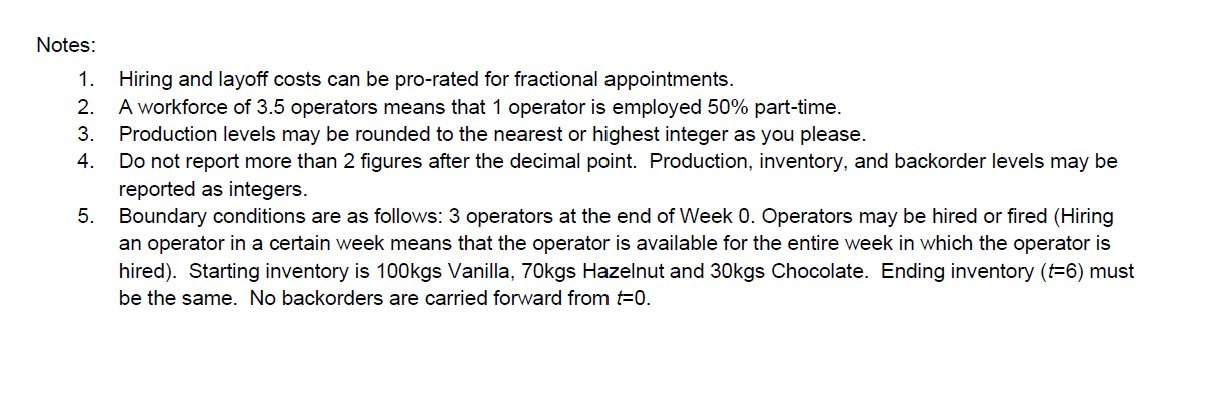
Step by Step Solution
There are 3 Steps involved in it
1 Expert Approved Answer
Step: 1 Unlock

Question Has Been Solved by an Expert!
Get step-by-step solutions from verified subject matter experts
Step: 2 Unlock
Step: 3 Unlock
 Study Help