







Question: Book: Real-Time Systems: Scheduling, Analysis and Veirfication by Albert M K Cheng Chapter 6: Real-Time Logic, Graph-Theoretic Analysis, and Modechart' Need Q5 and Q6 both
Book: Real-Time Systems: Scheduling, Analysis and Veirfication by Albert M K Cheng Chapter 6: Real-Time Logic, Graph-Theoretic Analysis, and Modechart'
Need Q5 and Q6 both
VERY URGENTLY REQUIRED!
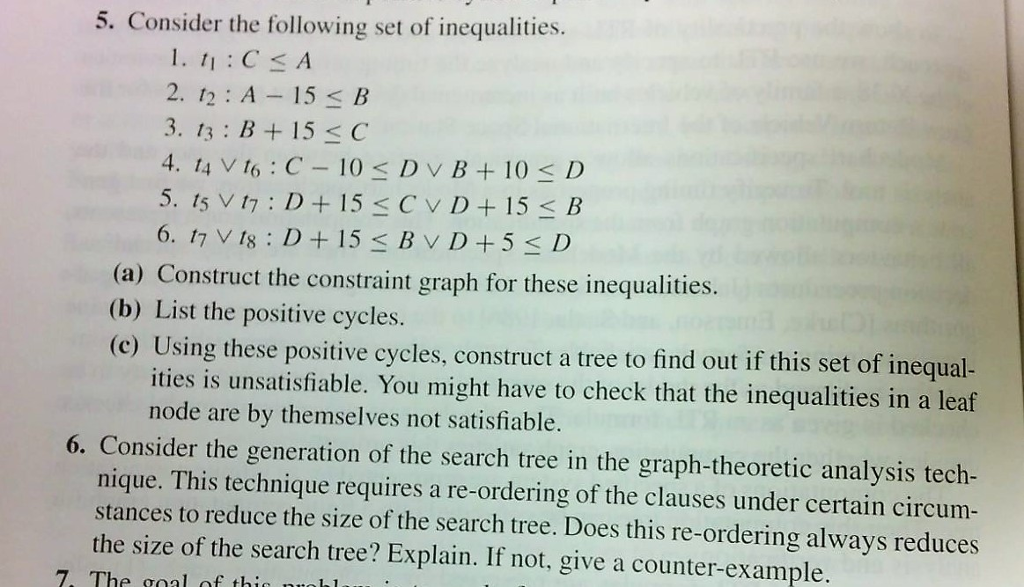
5. Consider the following set of inequalities. ?.ti : C A 2.12 : A-15 3. 13 B+15 B C (a) Construct the constraint graph for these inequalities. (b) List the positive cycles. (c) Using these positive cycles, construct a tree to find out if this set of inequal- ities is unsatisfiable. You might have to check that the inequalities in a leaf node are by themselves not satisfiable. 6. Consider the generation of the search tree in the graph-theoretic analysis tech- nique. This technique requires a re-ordering of the clauses under certain circum- stances to reduce the size of the search tree. Does this re-ordering always reduces the size of the search tree? Explain. If not, give a counter-example. 7. The goal f this no 5. Consider the following set of inequalities. ?.ti : C A 2.12 : A-15 3. 13 B+15 B C (a) Construct the constraint graph for these inequalities. (b) List the positive cycles. (c) Using these positive cycles, construct a tree to find out if this set of inequal- ities is unsatisfiable. You might have to check that the inequalities in a leaf node are by themselves not satisfiable. 6. Consider the generation of the search tree in the graph-theoretic analysis tech- nique. This technique requires a re-ordering of the clauses under certain circum- stances to reduce the size of the search tree. Does this re-ordering always reduces the size of the search tree? Explain. If not, give a counter-example. 7. The goal f this no
Step by Step Solution
There are 3 Steps involved in it

Get step-by-step solutions from verified subject matter experts
 Study Help