







Question: boyles law, data collection and PV calculations. help!! Preparing for the Experiment Enter the atmospheric pressure in inches Hg (inHg) 30.08 Temperature at beginning of
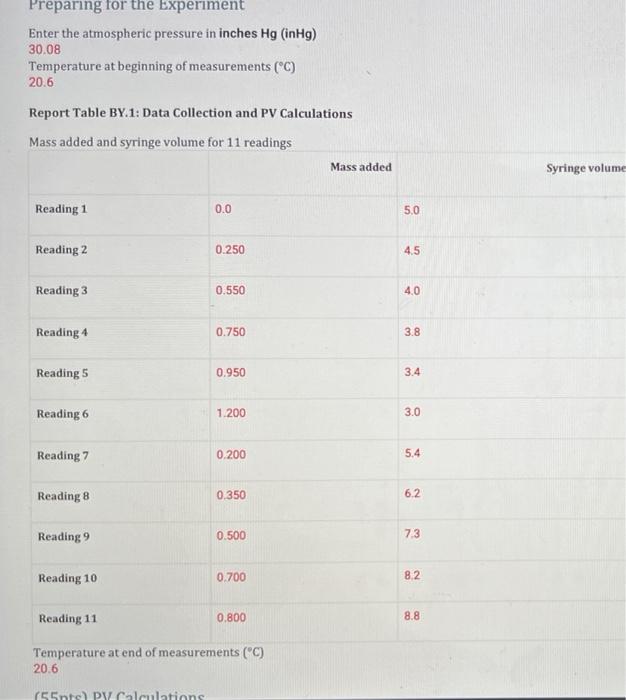
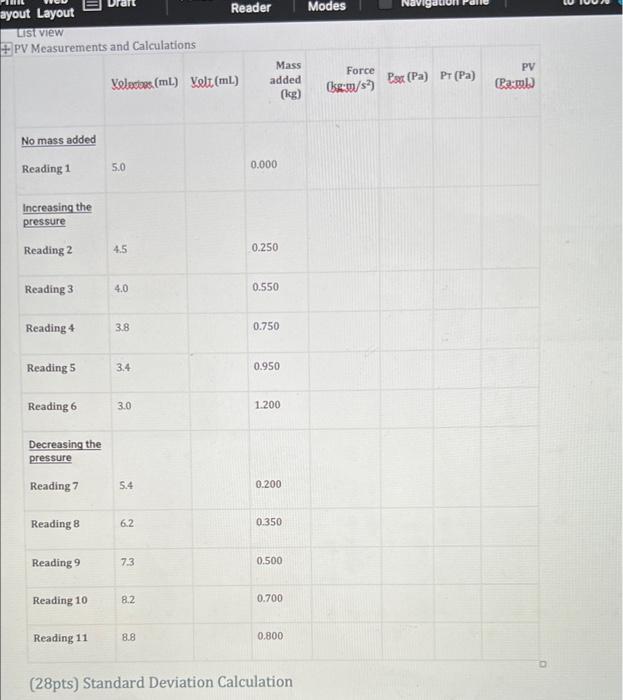
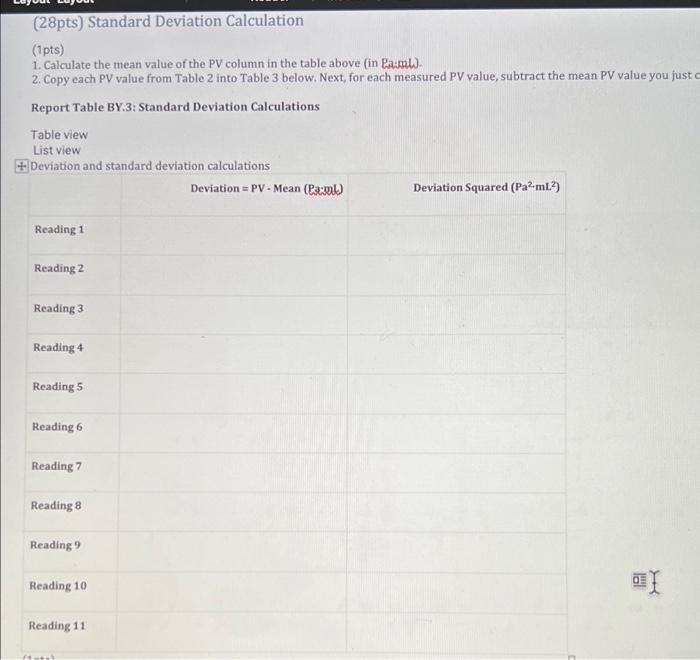
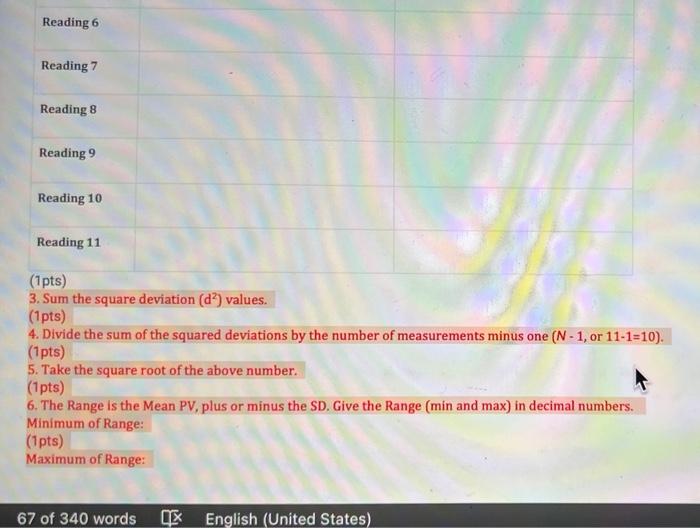
Preparing for the Experiment Enter the atmospheric pressure in inches Hg (inHg) 30.08 Temperature at beginning of measurements ("C) 20.6 Report Table BY.1: Data Collection and PV Calculations Mass added and syringe volume for 11 readings Mass added Syringe volume Reading 1 0.0 5.0 Reading 2 0.250 4.5 Reading 3 0.550 4.0 Reading 4 0.750 3.8 Reading 5 0.950 3.4 Reading 6 1.200 3.0 Reading 7 0.200 5.4 Reading 8 0.350 6.2 Reading 9 0.500 7.3 Reading 10 0.700 8.2 Reading 11 0.800 8.8 Temperature at end of measurements (C) 20.6 (55nts) PY Calculations Reader Modes ayout Layout LIST View PV Measurements and Calculations Velecas (ml) Velt (ml) Mass added (kg) Force (kgm/s) Pox (Pa) PT (Pa) PV (Paw No mass added Reading 1 5.0 0.000 Increasing the pressure Reading 2 4.5 0.250 Reading 3 4.0 0.550 Reading 4 38 0.750 Reading 5 3.4 0.950 Reading 6 3.0 1.200 Decreasing the pressure Reading 7 5.4 0.200 Reading 8 6.2 0.350 Reading 9 W 7.3 0.500 Reading 10 8.2 0.700 Reading 11 8.8 0.800 (28pts) Standard Deviation Calculation (28pts) Standard Deviation Calculation (1pts) 1. Calculate the mean value of the PV column in the table above (in Pamu. 2. Copy each PV value from Table 2 into Table 3 below. Next, for each measured PV value, subtract the mean PV value you just Report Table BY.3: Standard Deviation Calculations Table view List view Deviation and standard deviation calculations Deviation = PV - Mean (Pamo Deviation Squared (Pa?-mt.?) Reading 1 Reading 2 Reading 3 Reading 4 Reading 5 Reading 6 Reading 7 Reading 8 Reading 9 Reading 10 I Reading 11 - Reading 6 Reading 7 Reading 8 Reading 9 Reading 10 Reading 11 (1 pts) 3. Sum the square deviation (d?) values. (1pts) 4. Divide the sum of the squared deviations by the number of measurements minus one (N-1, or 11-1=10). (1 pts) 5. Take the square root of the above number. (1pts) 6. The Range is the Mean PV, plus or minus the SD. Give the Range (min and max) in decimal numbers. Minimum of Range: (1 pts) Maximum of Range: 67 of 340 words AX English (United States)
Step by Step Solution
There are 3 Steps involved in it

Get step-by-step solutions from verified subject matter experts
 Study Help