







Question: Bread-Making with Two Parallel Baking Lines Following the Process Fundamentals note, lets continue imagining that you are managing a bakery business. To begin with, assume
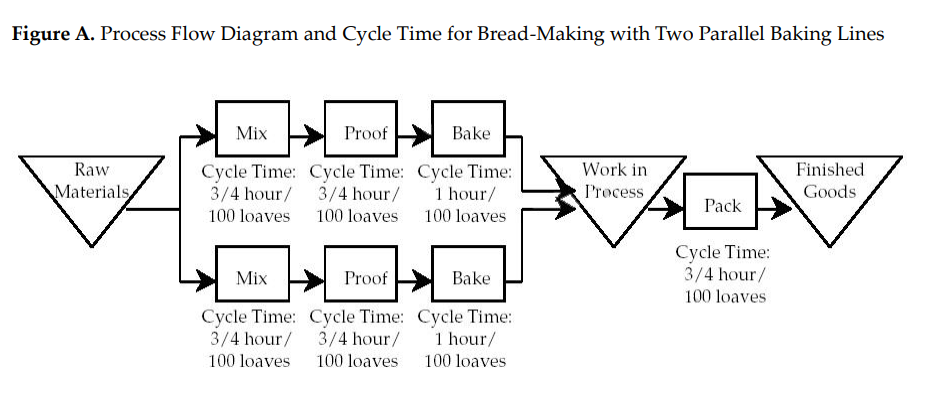
Bread-Making with Two Parallel Baking Lines Following the Process Fundamentals note, lets continue imagining that you are managing a bakery business. To begin with, assume the bakery sells and produces only one type of bread white bread. The bakery operates two parallel baking lines, each equipped with a mixer, a proofer, and an oven. In addition, the bakery operates a single packaging line which is shared by the two baking lines. A process flow diagram for the bakery is given in Figure A below, along with the cycle times of each step of the baking and packaging process.
The second option is to alternate the scheduling of the two bread-making lines so that every 1/2 hour one of the ovens completes its baking time. Assume that we follow the second option to schedule the baking line.
Now consider that the cycle time of the packaging process is 3/4 hour per 100 loaves.
(Q1.3.a.) What is the bottleneck activity in the entire bread-making process (mix/proof/bake/pack)?
(Q1.3.b.) What is the cycle time (per 100 loaves) of the entire bread-making process (mix/proof/bake/pack)?
(Q1.3.c.) What is the bakerys overall daily capacity (loaves/day), assuming it operates 8 hours a day?
Figure A. Process Flow Diagram and Cycle Time for Bread-Making with Two Parallel Baking Lines
Step by Step Solution
There are 3 Steps involved in it

Get step-by-step solutions from verified subject matter experts
 Study Help