Question: (Bsk7777) introduction- briefly summarises the issue problem statement-major problems that must be resolved stakeholder analysis - alternatives- recommended solutions - conculsion- ANALYZING MANAGEMENT DECISIONS The
(Bsk7777)
introduction- briefly summarises the issue
problem statement-major problems that must be resolved
stakeholder analysis -
alternatives-
recommended solutions -
conculsion-
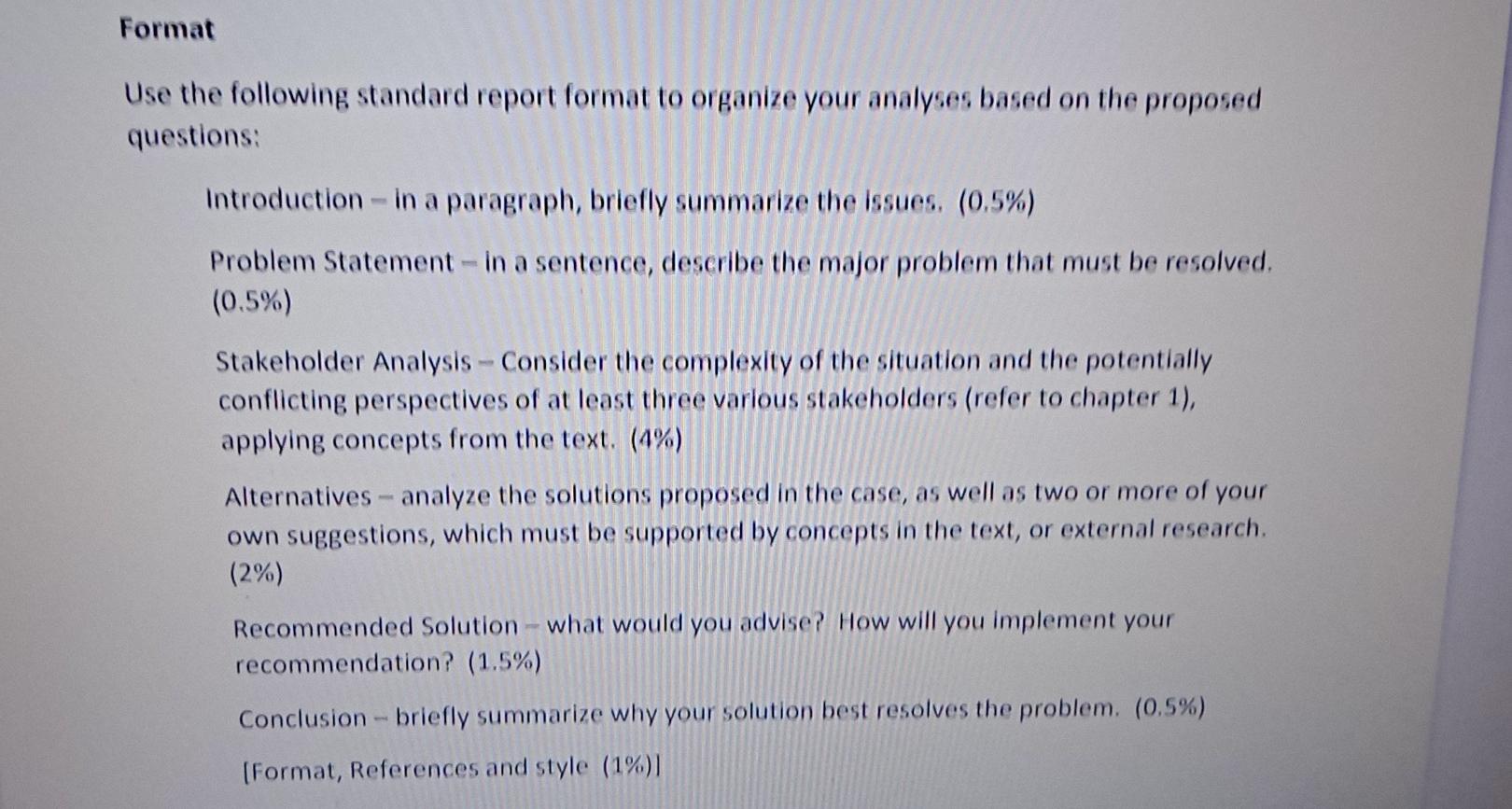
ANALYZING MANAGEMENT DECISIONS The Challenge of Offshoring Outsourcing, as noted in Chapter 1, is the process of Canadian job market than was the first, which primar- assigning various functions, such as accounting, pro- ily involved manufacturing jobs. The pros and cons of duction, security, maintenance, and legal work to offshoring were identified earlier in this chapter (sce outside organizations. In Canada, companies have out- Figure 3.11). China and India are oftentimes named as sourced payroll functions, accounting, and some man- I country providers of offshoring. Currently, China is pri- ufacturing operations for many years. However, the marily involved with manufacturing at the low end of shift to primarily low wage global markets, called off- the technology scale, and India focuses on call centres, shoring (or offshore outsourcing), has become a major telemarketing, data entry, billing, and low-end software issue. Export Development Canada believes that there development. However, China is intent on developing are about 4000 Canadian companies with some sort of advanced manufacturing technology and India has a deep overseas presence, an increase from 10 years ago. pool of scientists, software engineers, chemists, accoun- Canadian companies such as Bombardier Inc. tants, lawyers, and physicians. The technology talent (manufactures state-of-the-art planes and trains) and in these nations also keeps growing: China graduates Gildan Activewear Inc. (one of the world's largest 250 000 engineers ench year and India about 150 000. T-shirt makers) have outsourced manufacturing When you consider the impact of offshoring on offshore for years. Fundamentally, as lower-level Canada, research supports that more than two-thirds of manufacturing became more simplified, Canadian imported services are from the United States, not China companies shifted focus from assembling products to and India. A Statistics Canada paper finds that global- design and architecture. Today, economists agree that ization and technology are the two key factors driving We are moving into the "Second wave" of offshoring offshoring by Canadian companies. Services offshoring that involves sizable numbers of skilled, well-educated does not seem to affect productivity or employment. It middle-income workers in service-sector jobs such as does seem to reduce wages in the services producing accounting, law, financial and risk management, health sector, though not in the goods-producing sector. care, and information technology that were thought to Finally, on an industry-by-industry basis, rising offshor- be safe from foreign market competition. ing of services seems to be associated with rising value- For example, the financial sector, including the added activities. In the financial sector, for instance, Royal Bank of Canada, has been enticized for making low value-added activities such as general accounting its employees tran the foreign workers hired to replace are outsourced while high value-added activities such them. This shift is potentially more disruptive to the as strategizing are kept in-house and in-country, that add satisfact that othe services LO2 Responding to the Various Business Stakeholders Stakeholders are all of the people who stand to gain or lose by the policies and activities of a business and whose concerns the business needs to address. As noted in Figure 1.3, stakeholders include many different groups such as customers, employees, financial insti- tutions (e.g., banks and credit unions), investors (e.g., shareholders), environmentalists, and government. Stakeholders may also have direct and indirect impact upon a business or Identify organization. Each of the stakeholder types shown in Figure 1.3 can be considered either stakeho primary, those who without their participation the business would not exist, or secondary, their imp those whose influence is not essential to the survival of a business. Don't forget that busi- to non-p nesses can also influence government policies through the activities and efforts of their organizar associations, lobbyists, and trade unions. business stakeholders All the people who stand to gain or lose by the policies and activities of a business. offshoring Sourcing part of the purchased inputs outside of the country, 15 The challenge of the twenty-first century will be for organizations to balance, as much as possible, the needs of all stakcholders. For example, the need for the business to make profits must be balanced against the needs of employees for sufficient income. Ignore the mediu, and they might attack your business with articles that hurt sales. Oppose the local community, and it may stop you from expanding. The need to stay competitive may call for offshoring jobs to other countries, recognizing that this sound business strategy might do harm to the community because jobs would be lost. Offshoring entails sourcing part of the purchased inputs outside of the country. Outsourcing means contracting with other companies to do some or all of the functions of a firm, such as production or accounting." You may be wondering, how are the terms insourcing, outsourcing, and offshoring different? A Statistics Canada report highlights the distinction. As stated, "Outsourcing decisions affect the boundaries of the firm what production takes place within the firm and what is purchased from outside the firm. Changes in offshoring may be, but are not necessarily related to changes in outsourcing. They involve decisions both to purchase outside of the firm and to do so from abroad. Considerations to do the latter are at the heart of the study of international trade. Interest in outsourcing arises because it outsourcing Assigning various functions, such as accounting, production, security, maintenance, and / on legal work, to outside organizations 16 may foretell 10 20 functions that could changes in industrial structure. Interest in offshoring arises because it may signify changes in international trading patterns."17 Companies have gone from outsourcing production jobs to offshoring research and development and design functions. Such decisions may prove disastrous to these firms doing the offshoring if the overseas companies use the information to produce their own competitive products. 18 In Canada, most of the offshoring that occurs is with the United States, though there has been some increase over the last decade with developing countries.19 A recent study indicated outsourcing will continue to grow at 12 to 26 percent across functions such as information technology, legal services, and human resource manage- ment. It is also expected that governments will create legislation to reduce offshoring. Insourcing initiatives to return jobs to companies exist in various industries, such as the insourcing automotive sector, where Ford Motor Company advanced workers to higher pay scales and Assigning various as a result, hired more entry-level employees. 21 go to an outside It is legal to outsource and offshore, but is that best for all stakeholders, includ- organization to ing workers? Business leaders must make decisions based on all factors, including the employees in the need to make a profit. As you can see, pleasing all stakeholders is not easy and it calls for trade-offs that are not always acceptable to one or another stakeholder. Keep in mind that regardless of temptations, company officials do have a responsibility to their non-profit stakeholders. organization Such trade-offs are also apparent in the political arena, As will be discussed in An organization whose Chapter 4, governments make policies that affect many stakeholders. However, bud- goals do not include get limitations force governments to make difficult choices, and these decisions are making a personal profit for its owners or often not popular. Consequently, after years of insufficient funding, any changes in the organizers areas of the environment, health care. and education generate a great deal of attention, As you will learn, balancing the demands of stakeholders is not limited to for-profit businesses. company Format Use the following standard report format to organize your analyses based on the proposed questions: Introduction - in a paragraph, briefly summarize the issues. (0.5%) Problem Statement - in a sentence, describe the major problem that must be resolved. (0.5%) Stakeholder Analysis - Consider the complexity of the situation and the potentially conflicting perspectives of at least three various stakeholders (refer to chapter 1), applying concepts from the text. (4%) Alternatives - analyze the solutions proposed in the case, as well as two or more of your own suggestions, which must be supported by concepts in the text, or external research. (2%) Recommended Solution - what would you advise? How will you implement your recommendation? (1.5%) Conclusion - briefly summarize why your solution best resolves the problem. (0.5%) [Format, References and style (1%)









 Study Help