







Question: Build the code in listing_1.m with the formula given below. (a) Execute the program using 3 even inputs: [2 20 92]. (b) Explain what will
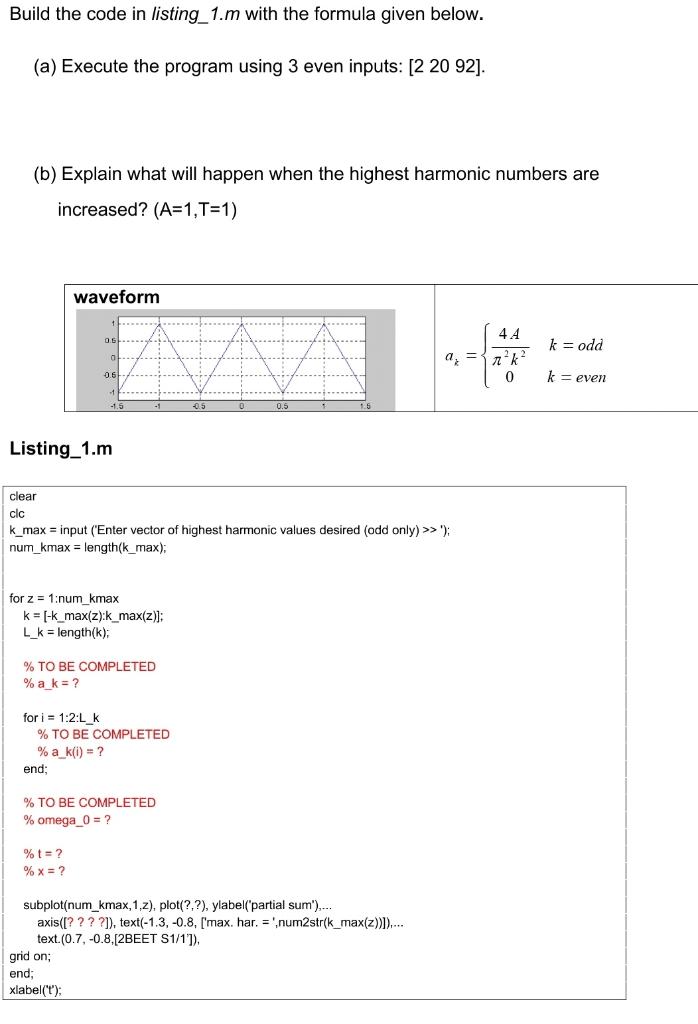
Build the code in listing_1.m with the formula given below. (a) Execute the program using 3 even inputs: [2 20 92]. (b) Explain what will happen when the highest harmonic numbers are increased? (A=1,T=1) waveform 05. k = odd 01 ... a = ink 0 0.6 k = even -1.5 -0.5 0.5 1.5 Listing_1.m clear clc k_max = input ("Enter vector of highest harmonic values desired (odd only) >>'); num_kmax = length(k_max): for z = 1:num_kmax k = [-k_max(z):k_max(z)); L_k = length(k); % TO BE COMPLETED % a k = ? for i = 1:2:L K % TO BE COMPLETED % a_k(i) = ? end: % TO BE COMPLETED % omega_0 = ? % t = ? % x = ? subplot(num_kmax, 1,z), plot(?,?), ylabel('partial sum').... axis([??? ?]), text(-1.3,-0.8, ['max. har. = ', num2str(k_max(z)))..... text.(0.7,-0.8,[2BEET S1/1']), grid on; end; xlabel(t); Build the code in listing_1.m with the formula given below. (a) Execute the program using 3 even inputs: [2 20 92]. (b) Explain what will happen when the highest harmonic numbers are increased? (A=1,T=1) waveform 05. k = odd 01 ... a = ink 0 0.6 k = even -1.5 -0.5 0.5 1.5 Listing_1.m clear clc k_max = input ("Enter vector of highest harmonic values desired (odd only) >>'); num_kmax = length(k_max): for z = 1:num_kmax k = [-k_max(z):k_max(z)); L_k = length(k); % TO BE COMPLETED % a k = ? for i = 1:2:L K % TO BE COMPLETED % a_k(i) = ? end: % TO BE COMPLETED % omega_0 = ? % t = ? % x = ? subplot(num_kmax, 1,z), plot(?,?), ylabel('partial sum').... axis([??? ?]), text(-1.3,-0.8, ['max. har. = ', num2str(k_max(z)))..... text.(0.7,-0.8,[2BEET S1/1']), grid on; end; xlabel(t)
Step by Step Solution
There are 3 Steps involved in it

Get step-by-step solutions from verified subject matter experts
 Study Help