Question: Build the following modeling exercises using Arena simulation software: Q1. Travelers arrive at the main entrance door of an airline terminal according to an exponential
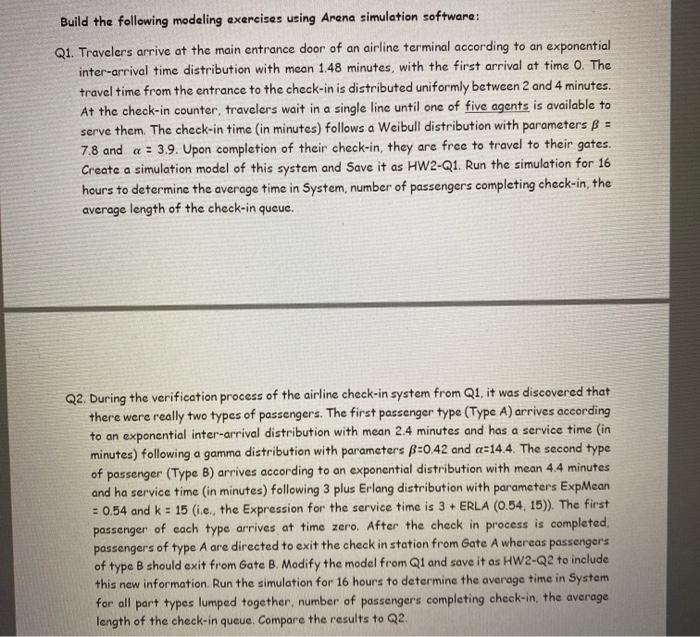
Build the following modeling exercises using Arena simulation software: Q1. Travelers arrive at the main entrance door of an airline terminal according to an exponential inter-arrival time distribution with mean 1.48 minutes, with the first arrival at time 0. The travel time from the entrance to the check-in is distributed uniformly between 2 and 4 minutes. At the check-in counter, travelers wait in a single line until one of five agents is available to serve them. The check-in time (in minutes) follows a Weibull distribution with parameters B = 7.8 and a = 3.9. Upon completion of their check-in, they are free to travel to their gates. Create a simulation model of this system and Save it as HW2-Q1. Run the simulation for 16 hours to determine the average time in System number of passengers completing check-in, the average length of the check-in queue. Q2. During the verification process of the airline check-in system from Q1, it was discovered that there were really two types of passengers. The first passenger type (Type A) arrives according to an exponential inter-arrival distribution with mean 2.4 minutes and has a service time (in minutes) following a gamma distribution with parameters B=0.42 and a=14.4. The second type of passenger (Type B) arrives according to an exponential distribution with mean 4.4 minutes and ha service time (in minutes) following 3 plus Erlang distribution with parameters ExpMean = 0.54 and k = 15 (i.c., the Expression for the service time is 3 + ERLA (0.54, 15)). The first passenger of each type arrives at time zero. After the check in process is completed, passengers of type A are directed to exit the check in station from Gate A whereas passengers of type B should exit from Gate B. Modify the model from Q1 and save it as HW2-Q2 to include this new information. Run the simulation for 16 hours to determine the average time in System for all part types lumped together, number of passengers completing check-in, the average length of the check-in queue. Compare the results to Q2. Build the following modeling exercises using Arena simulation software: Q1. Travelers arrive at the main entrance door of an airline terminal according to an exponential inter-arrival time distribution with mean 1.48 minutes, with the first arrival at time 0. The travel time from the entrance to the check-in is distributed uniformly between 2 and 4 minutes. At the check-in counter, travelers wait in a single line until one of five agents is available to serve them. The check-in time (in minutes) follows a Weibull distribution with parameters B = 7.8 and a = 3.9. Upon completion of their check-in, they are free to travel to their gates. Create a simulation model of this system and Save it as HW2-Q1. Run the simulation for 16 hours to determine the average time in System number of passengers completing check-in, the average length of the check-in queue. Q2. During the verification process of the airline check-in system from Q1, it was discovered that there were really two types of passengers. The first passenger type (Type A) arrives according to an exponential inter-arrival distribution with mean 2.4 minutes and has a service time (in minutes) following a gamma distribution with parameters B=0.42 and a=14.4. The second type of passenger (Type B) arrives according to an exponential distribution with mean 4.4 minutes and ha service time (in minutes) following 3 plus Erlang distribution with parameters ExpMean = 0.54 and k = 15 (i.c., the Expression for the service time is 3 + ERLA (0.54, 15)). The first passenger of each type arrives at time zero. After the check in process is completed, passengers of type A are directed to exit the check in station from Gate A whereas passengers of type B should exit from Gate B. Modify the model from Q1 and save it as HW2-Q2 to include this new information. Run the simulation for 16 hours to determine the average time in System for all part types lumped together, number of passengers completing check-in, the average length of the check-in queue. Compare the results to Q2









 Study Help