







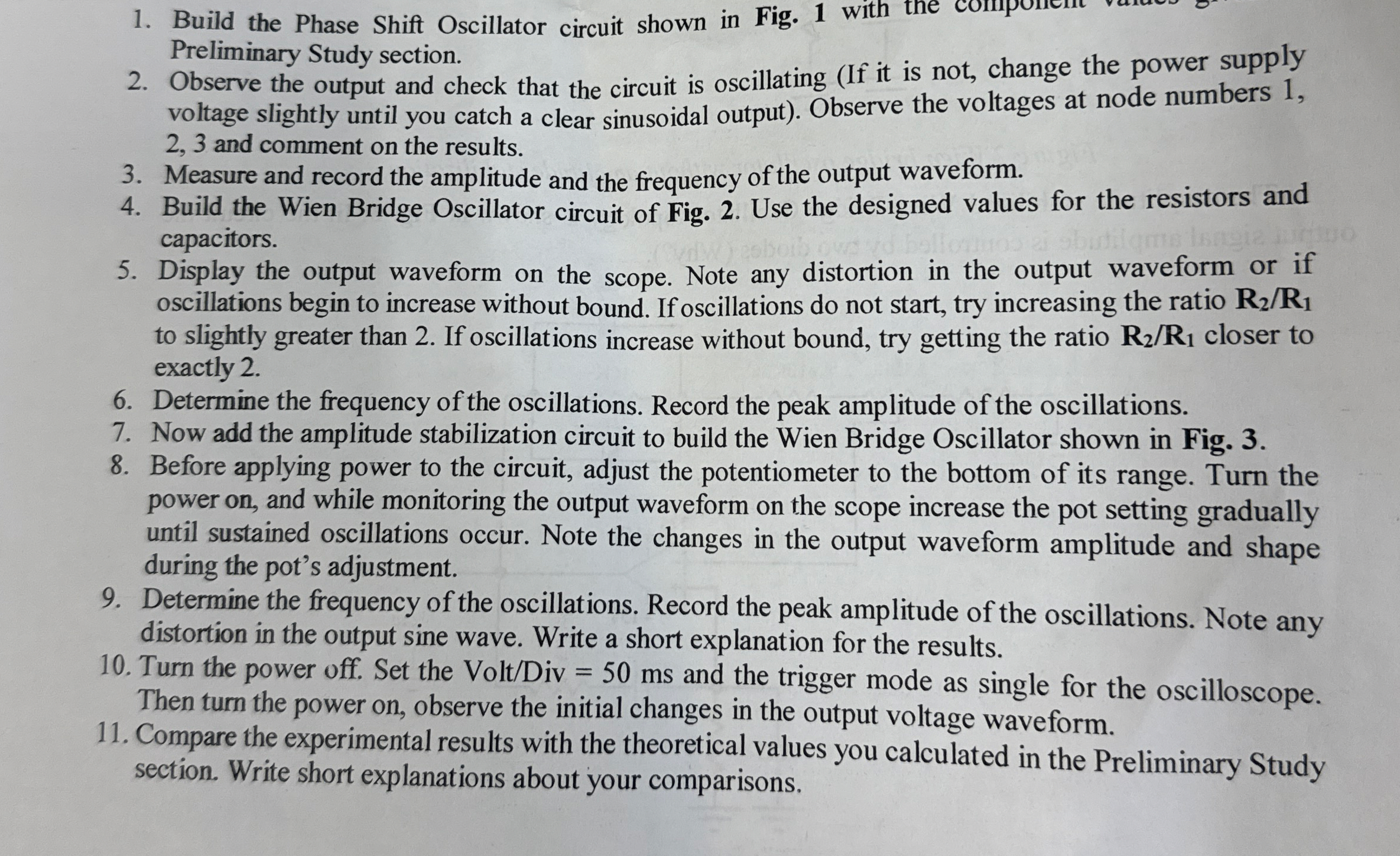
Question: Build the Phase Shift Oscillator circuit shown in Fig. 1 with Preliminary Study section. Observe the output and check that the circuit is oscillating (
Build the Phase Shift Oscillator circuit shown in Fig. with Preliminary Study section.
Observe the output and check that the circuit is oscillating If it is not, change the power supply voltage slightly until you catch a clear sinusoidal output Observe the voltages at node numbers and comment on the results.
Measure and record the amplitude and the frequency of the output waveform.
Build the Wien Bridge Oscillator circuit of Fig. Use the designed values for the resistors and capacitors.
Display the output waveform on the scope. Note any distortion in the output waveform or if oscillations begin to increase without bound. If oscillations do not start, try increasing the ratio to slightly greater than If oscillations increase without bound, try getting the ratio closer to exactly
Determine the frequency of the oscillations. Record the peak amplitude of the oscillations.
Now add the amplitude stabilization circuit to build the Wien Bridge Oscillator shown in Fig.
Before applying power to the circuit, adjust the potentiometer to the bottom of its range. Turn the power on and while monitoring the output waveform on the scope increase the pot setting gradually until sustained oscillations occur. Note the changes in the output waveform amplitude and shape during the pot's adjustment.
Determine the frequency of the oscillations. Record the peak amplitude of the oscillations. Note any distortion in the output sine wave. Write a short explanation for the results.
Turn the power off. Set the VoltDiv and the trigger mode as single for the oscilloscope. Then turn the power on observe the initial changes in the output voltage waveform.
Compare the experimental results with the theoretical values you calculated in the Preliminary Study section. Write short explanations about your comparisons.
Step by Step Solution
There are 3 Steps involved in it
1 Expert Approved Answer
Step: 1 Unlock

Question Has Been Solved by an Expert!
Get step-by-step solutions from verified subject matter experts
Step: 2 Unlock
Step: 3 Unlock
 Study Help