Question: BUS250: Business Organization & Management Individual Assignment (Case-Article) Chapter Coverage: Chapter 18: Controlling Activities and Operations NAME OF THE STUDENT SECTION UNIVERSITY ID NO. INSTRUCTIONS:
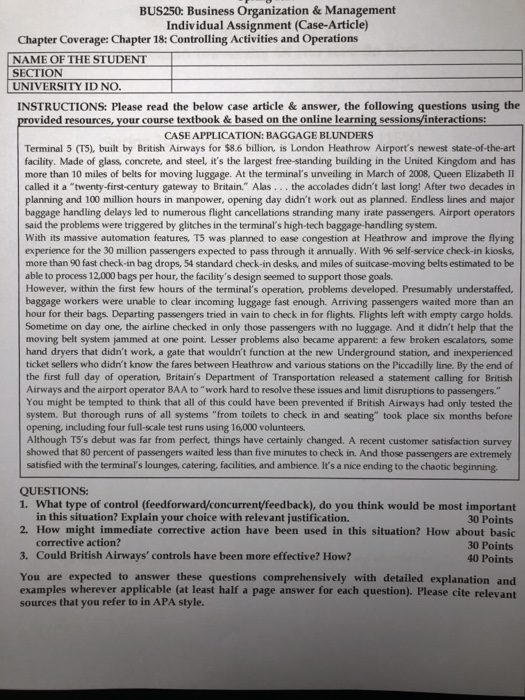
BUS250: Business Organization & Management Individual Assignment (Case-Article) Chapter Coverage: Chapter 18: Controlling Activities and Operations NAME OF THE STUDENT SECTION UNIVERSITY ID NO. INSTRUCTIONS: Please read the below case article & answer, the following questions using the provided resources, your course textbook & based on the online learning sessions/interactions: CASE APPLICATION: BAGGAGE BLUNDERS Terminal 5 (T5), built by British Airways for $8.6 billion, is London Heathrow Airport's newest state-of-the-art facility. Made of glass, concrete, and steel, it's the largest free-standing building in the United Kingdom and has more than 10 miles of belts for moving luggage. At the terminal's unveiling in March of 2008, Queen Elizabeth II called it a "twenty-first-century gateway to Britain." Alas ... the accolades didn't last long! After two decades in planning and 100 million hours in manpower, opening day didn't work out as planned. Endless lines and major baggage handling delays led to numerous flight cancellations stranding many irate passengers. Airport operators said the problems were triggered by glitches in the terminal's high-tech baggage-handling system. With its massive automation features, T5 was planned to ease congestion at Heathrow and improve the flying experience for the 30 million passengers expected to pass through it annually. With 96 self-service check-in kiosks, more than 90 fast check-in bag drops, 54 standard check-in desks, and miles of suitcase-moving belts estimated to be able to process 12,000 bags per hour, the facility's design seemed to support those goals. However, within the first few hours of the terminal's operation problems developed. Presumably understaffed, baggage workers were unable to clear incoming luggage fast enough. Arriving passengers waited more than an hour for their bags. Departing passengers tried in vain to check in for flights. Flights left with empty cargo holds. Sometime on day one, the airline checked in only those passengers with no luggage. And it didn't help that the moving belt system jammed at one point. Lesser problems also became apparent: a few broken escalators, some hand dryers that didn't work, a gate that wouldn't function at the new Underground station, and inexperienced ticket sellers who didn't know the fares between Heathrow and various stations on the Piccadilly line. By the end of the first full day of operation, Britain's Department of Transportation released a statement calling for British Airways and the airport operator BAA to work hard to resolve these issues and limit disruptions to passengers." You might be tempted to think that all of this could have been prevented if British Airways had only tested the system. But thorough runs of all systems "from toilets to check in and seating took place six months before opening including four full-scale test runs using 16,000 volunteers. Although Ty's debut was far from perfect, things have certainly changed. A recent customer satisfaction survey showed that 80 percent of passengers waited less than five minutes to check in. And those passengers are extremely satisfied with the terminal's lounges, catering, facilities, and ambience. It's a nice ending to the chaotic beginning. QUESTIONS: 1. What type of control (feedforward/concurrent feedback), do you think would be most important in this situation? Explain your choice with relevant justification. 30 Points 2. How might immediate corrective action have been used in this situation? How about basic corrective action? 30 Points 3. Could British Airways' controls have been more effective? How? 40 Points You are expected to answer these questions comprehensively with detailed explanation and examples wherever applicable (at least half a page answer for each question). Please cite relevant sources that you refer to in APA style. BUS250: Business Organization & Management Individual Assignment (Case-Article) Chapter Coverage: Chapter 18: Controlling Activities and Operations NAME OF THE STUDENT SECTION UNIVERSITY ID NO. INSTRUCTIONS: Please read the below case article & answer, the following questions using the provided resources, your course textbook & based on the online learning sessions/interactions: CASE APPLICATION: BAGGAGE BLUNDERS Terminal 5 (T5), built by British Airways for $8.6 billion, is London Heathrow Airport's newest state-of-the-art facility. Made of glass, concrete, and steel, it's the largest free-standing building in the United Kingdom and has more than 10 miles of belts for moving luggage. At the terminal's unveiling in March of 2008, Queen Elizabeth II called it a "twenty-first-century gateway to Britain." Alas ... the accolades didn't last long! After two decades in planning and 100 million hours in manpower, opening day didn't work out as planned. Endless lines and major baggage handling delays led to numerous flight cancellations stranding many irate passengers. Airport operators said the problems were triggered by glitches in the terminal's high-tech baggage-handling system. With its massive automation features, T5 was planned to ease congestion at Heathrow and improve the flying experience for the 30 million passengers expected to pass through it annually. With 96 self-service check-in kiosks, more than 90 fast check-in bag drops, 54 standard check-in desks, and miles of suitcase-moving belts estimated to be able to process 12,000 bags per hour, the facility's design seemed to support those goals. However, within the first few hours of the terminal's operation problems developed. Presumably understaffed, baggage workers were unable to clear incoming luggage fast enough. Arriving passengers waited more than an hour for their bags. Departing passengers tried in vain to check in for flights. Flights left with empty cargo holds. Sometime on day one, the airline checked in only those passengers with no luggage. And it didn't help that the moving belt system jammed at one point. Lesser problems also became apparent: a few broken escalators, some hand dryers that didn't work, a gate that wouldn't function at the new Underground station, and inexperienced ticket sellers who didn't know the fares between Heathrow and various stations on the Piccadilly line. By the end of the first full day of operation, Britain's Department of Transportation released a statement calling for British Airways and the airport operator BAA to work hard to resolve these issues and limit disruptions to passengers." You might be tempted to think that all of this could have been prevented if British Airways had only tested the system. But thorough runs of all systems "from toilets to check in and seating took place six months before opening including four full-scale test runs using 16,000 volunteers. Although Ty's debut was far from perfect, things have certainly changed. A recent customer satisfaction survey showed that 80 percent of passengers waited less than five minutes to check in. And those passengers are extremely satisfied with the terminal's lounges, catering, facilities, and ambience. It's a nice ending to the chaotic beginning. QUESTIONS: 1. What type of control (feedforward/concurrent feedback), do you think would be most important in this situation? Explain your choice with relevant justification. 30 Points 2. How might immediate corrective action have been used in this situation? How about basic corrective action? 30 Points 3. Could British Airways' controls have been more effective? How? 40 Points You are expected to answer these questions comprehensively with detailed explanation and examples wherever applicable (at least half a page answer for each question). Please cite relevant sources that you refer to in APA style









 Study Help