Question: Business Case Study 2 - Tools for Trade It has now been twelve months since you were hired to evaluate the business and recommend new
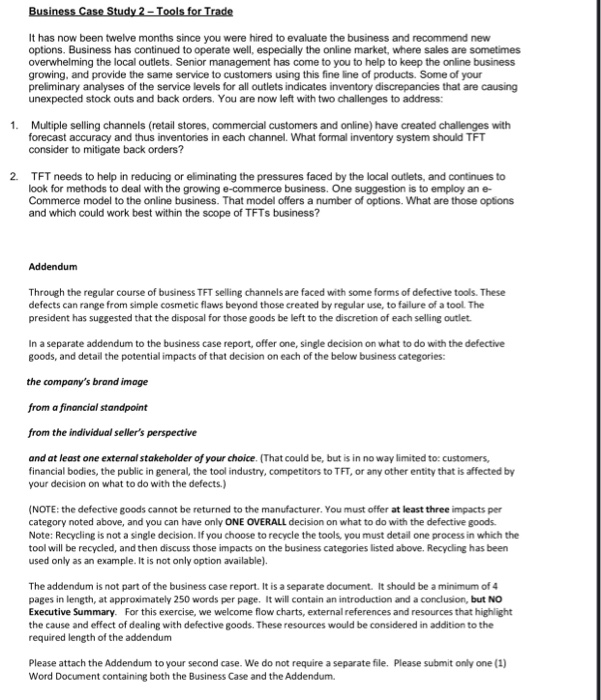
Business Case Study 2 - Tools for Trade It has now been twelve months since you were hired to evaluate the business and recommend new options. Business has continued to operate well, especially the online market, where sales are sometimes overwhelming the local outlets. Senior management has come to you to help to keep the online business growing, and provide the same service to customers using this fine line of products. Some of your preliminary analyses of the service levels for all outlets indicates inventory discrepancies that are causing unexpected stock outs and back orders. You are now left with two challenges to address: 1. Multiple selling channels (retail stores, commercial customers and online) have created challenges with forecast accuracy and thus inventories in each channel. What formal inventory system should TFT consider to mitigate back orders? 2. TFT needs to help in reducing or eliminating the pressures faced by the local outlets, and continues to look for methods to deal with the growing e-commerce business. One suggestion is to employ an e- Commerce model to the online business. That model offers a number of options. What are those options and which could work best within the scope of TFTs business? Addendum Through the regular course of business TFT selling channels are faced with some forms of defective tools. These defects can range from simple cosmetic flaws beyond those created by regular use, to failure of a tool. The president has suggested that the disposal for those goods be left to the discretion of each selling outlet In a separate addendum to the business case report, offer one, single decision on what to do with the defective goods, and detail the potential impacts of that decision on each of the below business categories: the company's brand image from a financial standpoint from the individual seller's perspective and at least one external stakeholder of your choice. (That could be, but is in no way limited to: customers, financial bodies, the public in general, the tool industry, competitors to TFT, or any other entity that is affected by your decision on what to do with the defects.) (NOTE: the defective goods cannot be returned to the manufacturer. You must offer at least three impacts per category noted above, and you can have only ONE OVERALL decision on what to do with the defective goods. Note: Recycling is not a single decision. If you choose to recycle the tools, you must detail one process in which the tool will be recycled, and then discuss those impacts on the business categories listed above. Recycling has been used only as an example. It is not only option available). The addendum is not part of the business case report. It is a separate document. It should be a minimum of 4 pages in length, at approximately 250 words per page. It will contain an introduction and a conclusion, but NO Executive Summary. For this exercise, we welcome flow charts, external references and resources that highlight the cause and effect of dealing with defective goods. These resources would be considered in addition to the required length of the addendum Please attach the Addendum to your second case. We do not require a separate file. Please submit only one (1) Word Document containing both the Business Case and the Addendum









 Study Help