business ethics now
thinking critically 10.3 unprofessional conduct
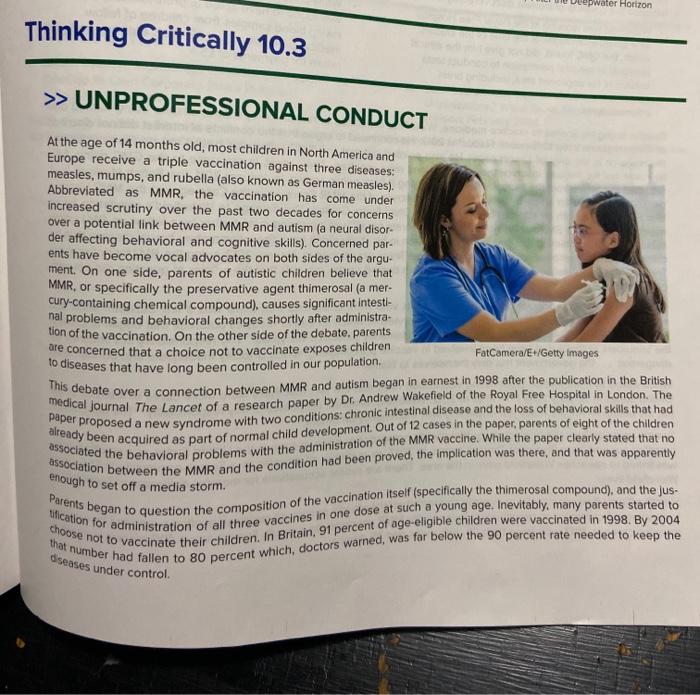
Thinking Critically 10.3 >> UNPROFESSIONAL CONDUCT paper proposed a new syndrome with two conditions: chronic intestinal disease and the loss of behavioral skills that had already been acquired as part of normal child development. Out of 12 cases in the paper parents of eight of the children associated the behavioral problems with the administration of the MMR vaccine. While the paper clearly stated that no association between the MMR and the condition had been proved, the implication was there, and that was apparently enough to set off a media storm. Parents began to question the composition of the vaccination itself (specifically the thimerosal compound), and the jus- ulication for administration of all three vaccines in one dose at such a young age. Inevitably, many parents started to choose not to vaccinate their children. In Britain, 91 percent of age-eligible children were vaccinated in 1998. By 2004 that number had fallen to 80 percent which, doctors warned, was far below the 90 percent rate needed to keep the cepwater Horizon At the age of 14 months old, most children in North America and Europe receive a triple vaccination against three diseases: measles, mumps, and rubella (also known as German measles). Abbreviated as MMR, the vaccination has come under increased scrutiny over the past two decades for concerns over a potential link between MMR and autism (a neural disor- der affecting behavioral and cognitive skills). Concerned par- ents have become vocal advocates on both sides of the argu- ment. On one side, parents of autistic children believe that MMR, or specifically the preservative agent thimerosal (a mer- cury-containing chemical compound), causes significant intesti- nal problems and behavioral changes shortly after administra- tion of the vaccination. On the other side of the debate, parents are concerned that a choice not to vaccinate exposes children FatCamera/E+/Getty Images to diseases that have long been controlled in our population. This debate over a connection between MMR and autism began in earnest in 1998 after the publication in the British medical journal The Lancet of a research paper by Dr. Andrew Wakefield of the Royal Free Hospital in London. The diseases under control CHAPTER 10: MAKING IT STICK: DOING WHAT'S RIGHT IN A COMPETITIVE MARKET Despite reassurances from the Medical Research Council in Britain and the U.S. Institute of Medicine that there was no evidence of a link between MMR and autism, emotions continued to escalate. Even study data from Finland (18 millon children over a 14-year period) and Denmark (537,303 children showing no evidence of a connection failed to have a calming effect, and Wakefield's reputation as a parent advocate continued to grow, even though his study had included only 12 cases. However, in 2004. a four-month investigation by Brian Deer, a journalist at England's Sunday Times newspaper, revealed Information that brought Wakefield's work into serious question: While actively warning parents to avoid MMR as . In addition, Wakefield's support for three separate the senior author on the Lancet paper, Wakefield vaccinations, rather than the triple MMR (which he failed to disclose that a follow-up study was funded believed could be overloading children's immune by a legal aid group helping parents who believed systems), included an experimental product under that their children had been harmed by the MMR development by a company in which he had a vaccines, Wakefield received $55.000 ($90,000) financial interest from the group but did not disclose the relationship with his coauthors of the paper or with editors at The Lancet This information prompted a partial retraction of the 1998 paper by The Lanceton grounds of a fatal conflict of interest In addition, persistent media scrutiny of Prime Minister Tony Blair's decision not to reveal whether or not his son Leo had received the MMR vaccination kept the story alive in the British press. In 2006 the death of a 13-year-old boy who had not received the MMR, the first person in Britain in 14 years to die from measles, prompted calls for a full investigation from the General Medical Council (GMC). After a two-and-a-half year investigation (the longest medical misconduct case in the GMC's 147-year history. at a cost of over 1 million ($1.6 million, the GMC removed Wakefield's license to practice medicine. Evidence for the decision Included the conflicts of interest discovered by the Sunday Times investigation and other concerns: Wakefield was working at the Royal Free Hospital While conducting his follow-up study, Wakefield as a gastroenterologist at the time of the studies, was found to have acted unprofessionally after which the GMC found, did not give him the ethical taking blood samples from children of fellow approval or medical permission to conduct tests medical professionals at his son's birthday party in outside of his approved area, including brain return for payments of 5 scans, spinal taps Pumbar punctures), and colonoscopies Despite losing his license to practice medicine, Wakefield continued to remain unrepentant, despite being named one of Time magazine's top 10 Science Frauds in 2012. He continued to argue that the conflicts of interest did not discredit the research in the original Lancet paper. He also pointed out that the GMC ruling was based not on the conclusions ne made but for the way in which those conclusions were reached. The Lancet, in response to the GMC ruling, fully retracted the paper from the journal effectively easing it from public record in January 2011, the British Medical Jour nal (BM) published an article by Brian Deet, titled "Secrets of the MMR Scare: How the case against the MMR Vaccine Was Fixed along with an editorial by BMJ Editor-in-Chief Fiona Godfee. The damage to Wakefields reputation by an assessment from the MJ that his work was an elaborate fraud" was increased even further by a follow-up BM article in November 2011 claiming that several of the children in this study didn't have the inflammatory bowel disease that he claimed Wakefield responded with a lawsuited in a Texas circuit court in January 2012, suing the BMJ for defamation The lawsuit and subsequent appeal motion were both denied on the grounds that the articles in question did not com cern Texas or any activities that occurred in Texas Wakefield remained a popular advocate with parents who were convinced that there was a link between MMR and autism, in a February 2015 Newsweek magazine Interview in which an earlier measles outbreak that began at Disney land in December 2014 was referenced, Wakefield adamantly defended his views.The responsables squarely on the shoulders of those that have been involved in vaccine policymaking, which is totally inadequate and bordering on dangerous the government has only themselves to blame When asked to comment on plummeting vaccination rates and the fact that there were more cases of measles in the United States in January 2015 than in all of 2012. Weeld remained dismissive of any responsibility: 'The people who put the same on me are really just displacing their inadequacy on others." Twenty years or on the original study, Wakefiel's notoriety has been rebom in the United States as a result of unan- Uicipated support from President Donald Trump in 2017 an outbreak of measles in a small-community in Minnesota was inked to speeches Wakefield gave in the area. There are similar accusations for mennes outrosks in Texas where Wakeholdes Health Officials have connued to express concern that Wakield persistent maging hen supported by celebrity anova continues to reduce confidence in the MMR vaccines. As a result, Europe saw a 400 percent increase measles coses in 2017, with more than 20.000 cases and 35 death CHAPTER 10: MAKING IT STICK: DOING WHAT'S RIGHT IN A COMPETITIVE MARKET 20 According to the U.S. Centers for Disease Control and Prevention (CDC), from January 1 to April 11, 2019,555 individual public health emergency for a measles outbreak in an ultra-orthodox Jewish community in Brooklyn. Unvaccinated indi viduals will face a fine of up to $1,000 if they do not get the measles vaccine and bring the community up to the required 95 percent level needed for effective Therd immunity protection from the disease. QUESTIONS 1. What were the perceived conflicts of interest in Wakefield's research activities? 3. Why did Wakefield lose his license to practice medicine? 2. If Wakefield had disclosed the source of the 4. Wakefield's messaging is continuing to cause funding of his study and his interest in the serious disruption and a resurgence of measles experimental vaccine, would that have added around the world. How should individual credibility to his campaign against MMR? Why or governments respond? why not? Sources: Brian Deer, "Revealed: MMR Research Scandal, The Times, February 22, 2004: "A Dose of Dissent." The Economist, Febru- ary 26, 2004; "Sow the Wind." The Economist, December 4, 2008, David Rose. "Fall of Andrew Wakefield, 'Dishonest Doctor Who Started MMR Scare." The Times, January 29, 2010: Andrew Jack. "Lancet Retracts MMR Link to Autism." Financial Times, February 2 2010: "A Nasty Rash." The Economist, May 27, 2010: Brian Deer, "Secrets of the MMR Scare: How the case against the MMR Vaccine Was Foed." British Medical Journal, January 6, 2011 Alice Park, "Great Science Frauds: Andrew Wakefield." Time: Health and Family, January 13, 2012, lan Sample, "Andrew Wakefield Sues BMJ for Claiming MMR Study Was Fraudulent." The Guardian, January 5, 2012: Stav Ziv, "Andrew Wakefield, Father of the Anti-Vaccine Movement, Responds to the Current Measles Outbreak for the First Time, Newsweek February 10, 2015: Andrew Buncombe, "Andrew Wakefield: How a Disgraced UK Doctor Has Re-Made Himself in Anti- vaxxer Trump's America. The Independent, May 4, 2018: Tyler Pager and Jeffrey C. Mays, "New York Declares Measles Emergency Requiring Vaccinations in Parts of Brooklyn The New York Times. April 9, 2019; and "Measles Cases in 2019." CDC, April 15, 2019