Question: business management PART 1: CASE ANALYSIS (Please answer both questions 40 points) South Korea's Samsung, under pressure from American activist investors looking for more returns,
business management
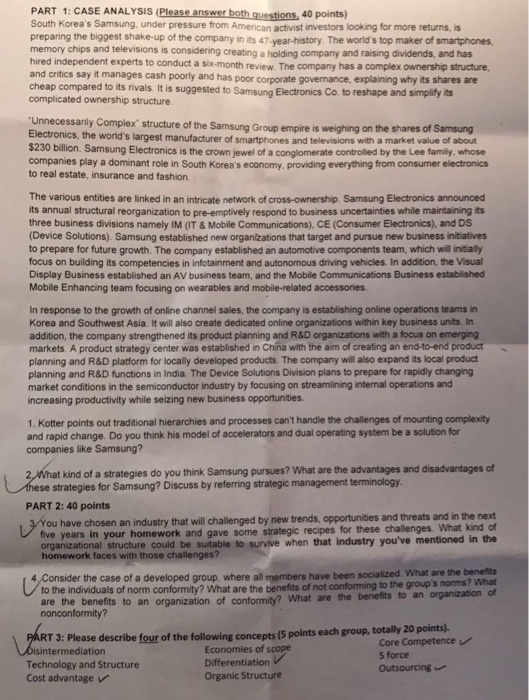
PART 1: CASE ANALYSIS (Please answer both questions 40 points) South Korea's Samsung, under pressure from American activist investors looking for more returns, is preparing the biggest shake-up of the company in its 47-year-history. The world's top maker of smartphones, memory chips and televisions is considering creating a holding company and raising dividends, and has hired independent experts to conduct a six-month review. The company has a complex ownership structure, and critics say it manages cash poorly and has poor corporate governance, explaining why its shares are cheap compared to its rivals. It is suggested to Samsung Electronics Co. to reshape and simplify its complicated ownership structure "Unnecessarily Complex structure of the Samsung Group empire is weighing on the shares of Samsung Electronics, the world's largest manufacturer of smartphones and televisions with a market value of about $230 billion. Samsung Electronics is the crown jewel of a conglomerate controlled by the Lee family, whose companies play a dominant role in South Korea's economy, providing everything from consumer electronics to real estate, insurance and fashion The various entities are linked in an intricate network of cross-ownership Samsung Electronics announced its annual structural reorganization to pre-emptively respond to business uncertainties while maintaining its three business divisions namely IM (IT & Mobile Communications). CE (Consumer Electronics), and DS (Device Solutions). Samsung established new organizations that target and pursue new business initiatives to prepare for future growth. The company established an automotive components team, which will initially focus on building its competencies in infotainment and autonomous driving vehicles. In addition, the Visual Display Business established an AV business team, and the Mobile Communications Business established Mobile Enhancing team focusing on wearables and mobile-related accessories In response to the growth of online channel sales, the company is establishing online operations teams in Korea and Southwest Asia. It will also create dedicated online organizations within key business units. In addition, the company strengthened its product planning and R&D organizations with a focus on emerging markets. A product strategy center was established in China with the aim of creating an end-to-end product planning and R&D platform for locally developed products. The company will also expand its local product planning and R&D functions in India. The Device Solutions Division plans to prepare for rapidly changing market conditions in the semiconductor industry by focusing on streamlining internal operations and increasing productivity while seizing new business opportunities. 1. Kotter points out traditional hierarchies and processes can't handle the challenges of mounting complexity and rapid change. Do you think his model of accelerators and dual operating system be a solution for companies like Samsung? 2. What kind of a strategies do you think Samsung pursues? What are the advantages and disadvantages of these strategies for Samsung? Discuss by referring strategic management terminology PART 2: 40 points 3/You have chosen an industry that will challenged by new trends, opportunities and threats and in the next five years in your homework and gave some strategic recipes for these challenges. What kind of organizational structure could be suitable to survive when that industry you've mentioned in the homework faces with those challenges? 14. Consider the case of a developed group, where all members have been socialized What are the benefits to the individuals of norm conformity? What are the benefits of not conforming to the group's norms? What are the benefits to an organization of conformity? What are the benefits to an organization of nonconformity? VART 3: Please describe four of the followine concepts (5 points each group, totally 20 points) Core Competence Disintermediation Economies of scope 5 force Technology and Structure Differentiation Outsourcing Cost advantage Organic Structure PART 2: 40 points 3/ You have chosen an industry that will challenged by new trends, opportunities and threats and in the next five years in your homework and gave some strategic recipes for these challenges. What kind of organizational structure could be suitable to survive when that industry you've mentioned in the homework faces with those challenges? 4. Consider the case of a developed group, where all members have been socialized. What are the benents to the individuals of norm conformity? What are the benefits of not conforming to the group's norms what are the benefits to an organization of conformity? What are the benefits to an organization of nonconformity? ART 3: Please describe four of the following concepts (5 points each group, totally 20 points). VDisintermediation Economies of scope Core Competence 5 force Technology and Structure Differentiation Outsourcing Cost advantage Organic Structure









 Study Help