







Question: Buyers and Consumer Behaviour Mark 1008 please answer the objective questions . 1. Which of the following 'Schools of Inquiry' (or 'Schools of Thought') focuses
Buyers and Consumer Behaviour Mark 1008 please answer the objective questions .
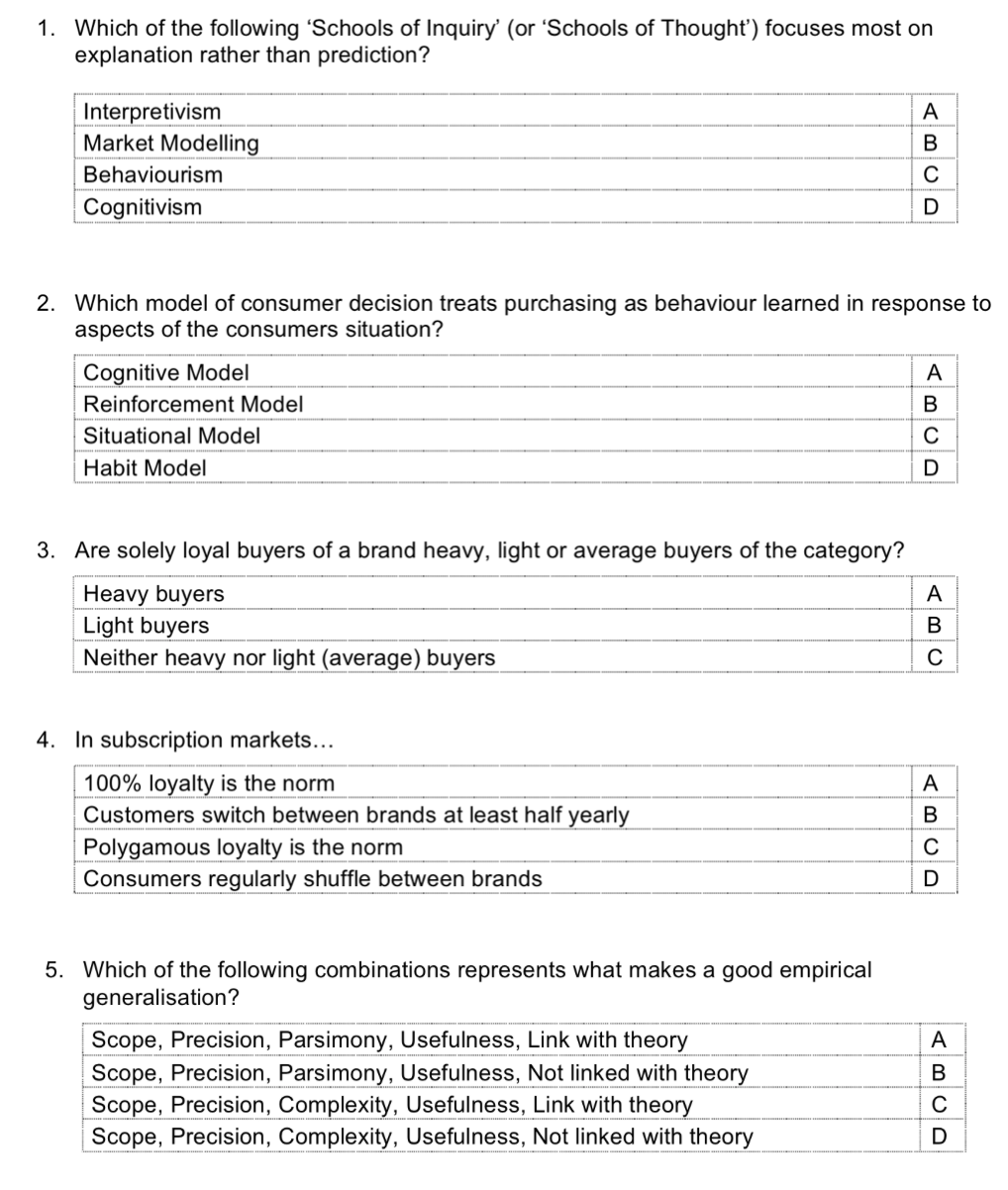
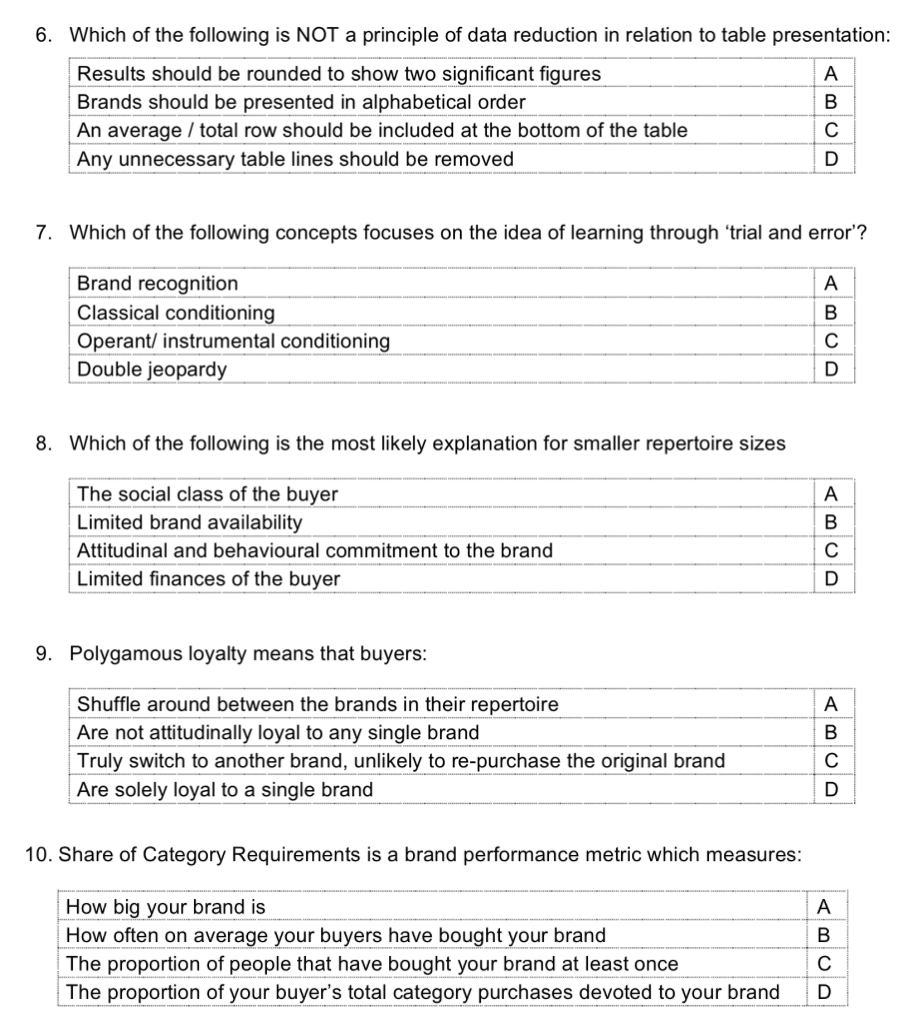
1. Which of the following 'Schools of Inquiry' (or 'Schools of Thought') focuses most on explanation rather than prediction? Interpretivism A Market Modelling B Behaviourism C Cognitivism D 2. Which model of consumer decision treats purchasing as behaviour learned in response to aspects of the consumers situation? Cognitive Model A Reinforcement Model B Situational Model C Habit Model D 3. Are solely loyal buyers of a brand heavy, light or average buyers of the category? Heavy buyers A Light buyers B Neither heavy nor light (average) buyers C 4. In subscription markets... 100% loyalty is the norm A Customers switch between brands at least half yearly B Polygamous loyalty is the norm C Consumers regularly shuffle between brands D 5. Which of the following combinations represents what makes a good empirical generalisation? Scope, Precision, Parsimony, Usefulness, Link with theory A Scope, Precision, Parsimony, Usefulness, Not linked with theory B Scope, Precision, Complexity, Usefulness, Link with theory C Scope, Precision, Complexity, Usefulness, Not linked with theory D6. Which of the following is NOT a principle of data reduction in relation to table presentation: Results should be rounded to show two significant figures A Brands should be presented in alphabetical order B An average / total row should be included at the bottom of the table C Any unnecessary table lines should be removed D 7. Which of the following concepts focuses on the idea of learning through 'trial and error'? Brand recognition A Classical conditioning B Operant/ instrumental conditioning C Double jeopardy D 8. Which of the following is the most likely explanation for smaller repertoire sizes The social class of the buyer A Limited brand availability B Attitudinal and behavioural commitment to the brand C Limited finances of the buyer D 9. Polygamous loyalty means that buyers: Shuffle around between the brands in their repertoire A Are not attitudinally loyal to any single brand B Truly switch to another brand, unlikely to re-purchase the original brand C Are solely loyal to a single brand D 10. Share of Category Requirements is a brand performance metric which measures: How big your brand is A How often on average your buyers have bought your brand B The proportion of people that have bought your brand at least once C The proportion of your buyer's total category purchases devoted to your brand D
Step by Step Solution
There are 3 Steps involved in it

Get step-by-step solutions from verified subject matter experts
 Study Help