







Question: C 7 - 1 As described in the chapter, the abnormal earnings approach for estimating common share Valuing abnormal earn - ngs ( LO 7
C
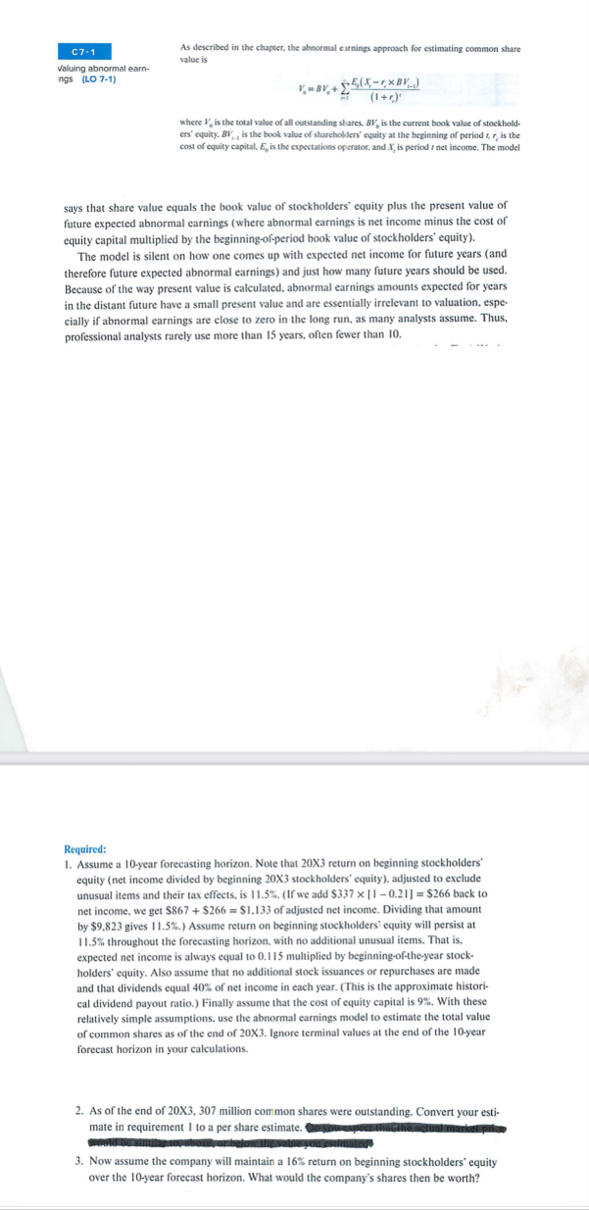
As described in the chapter, the abnormal earnings approach for estimating common share
Valuing abnormal earn
ngs LO
where is the total valoe of all outstanding shares. is the current book valoe of stockholders' equity. is the book valoe of shareholkers' equity at the beginning of period is the cost of equity capital. is the expectations operator, and is period net income. The model
says that share value equals the book value of stockholders' equity plus the present value of future expected abnormal earnings where abnormal earnings is net income minus the cost of equity capital multiplied by the beginningofperiod book value of stockholders' equity
The model is silent on how one comes up with expected net income for future years and therefore future expected abnormal earnings and just how many future years should be used. Because of the way present value is calculated, abnormal earnings amounts expected for years in the distant future have a small present value and are essentially irrelevant to valuation, especially if abnormal carnings are close to zero in the long run, as many analysts assume. Thus, professional analysts rarely use more than years, often fewer than
Required:
Assume a year forecasting horizon. Note that X return on beginning stockholders' equity net income divided by beginning stockholders' equity adjusted to exelude unusual items and their tax effects, is If we add $$ back to net income, we get $ $$ of adjusted net income. Dividing that amount by $ gives Assume return on beginning stockholders' equity will persist at throughout the forecasting horizon, with no additional unusual items. That is expected net income is always equal to multiplied by beginningoftheyear stockholders' equity. Also assume that no additional stock issuances or repurchases are made and that dividends equal of net income in each year. This is the approximate historical dividend payout ratio. Finally assume that the cost of equity capital is With these relatively simple assumptions, use the abnormal carnings model to estimate the total value of common shares as of the end of X Ignore terminal values at the end of the year forecast horizon in your calculations.
As of the end of million common shares were outstanding. Convert your estimate in requirement I to a per share estimate.
Now assume the company will maintain a return on beginning stockholders' equity over the year forecast horizon. What would the company's shares then be worth?Comparative income statements and statements of shareholders' equity for Tool Works Corporation for XX follow.
Tool Works Corporation Consolidated Statement of Income
table$in millionstimes
Step by Step Solution
There are 3 Steps involved in it
1 Expert Approved Answer
Step: 1 Unlock

Question Has Been Solved by an Expert!
Get step-by-step solutions from verified subject matter experts
Step: 2 Unlock
Step: 3 Unlock
 Study Help