







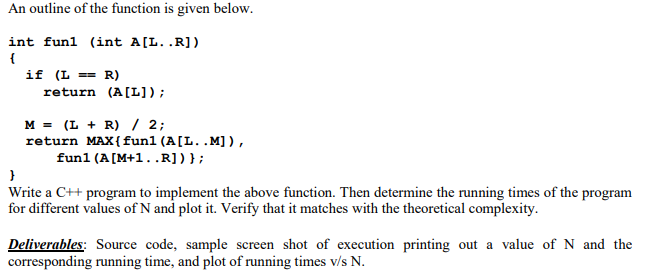
Question: C++ code An outline of the function is given below. int funl (int A[L..R]) { if (L == R) return (A[L]); M = (L +
C++ code
An outline of the function is given below. int funl (int A[L..R]) { if (L == R) return (A[L]); M = (L + R) / 2; return MAX{ fun1 (A[L..M]), fun1 (A[M+1..R]) }; } Write a C++ program to implement the above function. Then determine the running times of the program for different values of N and plot it. Verify that it matches with the theoretical complexity. Deliverables: Source code, sample screen shot of execution printing out a value of N and the corresponding running time, and plot of running times v/s N
Step by Step Solution
There are 3 Steps involved in it
1 Expert Approved Answer
Step: 1 Unlock

Question Has Been Solved by an Expert!
Get step-by-step solutions from verified subject matter experts
Step: 2 Unlock
Step: 3 Unlock
 Study Help