







Question: C++ Creating Classes (Invoice Class): Create a class called Invoice that a hardware store might use to represent an invoice for an item sold at
C++ Creating Classes (Invoice Class): Create a class called Invoice that a hardware store might use to represent an invoice for an item sold at the store. An Invoice should include four data membersa part number (type string), a part description (type string), a quantity of the item being purchased (type int) and a price per item (type int). Your class should have a constructor that initializes the four data members. Provide a set and a get function for each data member. In addition, provide a member function named getInvoiceAmount that calculates the invoice amount (i.e., multiplies the quantity by the price per item), then returns the amount as an int value. If the quantity is not positive, it should be set to 0. If the price per item is not positive, it should be set to 0. Write a test program that demonstrates class Invoices capabilities. Use classes, functions, objects, and exceptions to create an invoicing system.
Demonstrate understanding of three things: 1) Classes and functions 2) Objects 3) Exceptions.
Please make sure to demonstrate your understanding of exceptions from within this program. You may implement the use of exceptions in your own way, but please be sure to implement the use of exceptions. Comment how you used/implemented exceptions in the code through comments or just a quick summarry.
The following is a sample of what your output may look like:
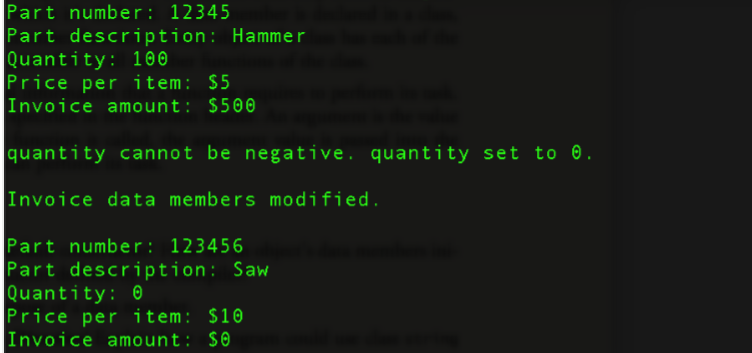
Part number 12345 Part description: Hammer Quantity: 100 Price per item: S5 invoice amount: $50 quantity cannot be negative, quantity set to . Invoice data members modified Part number: 123456 Part descriptionSaw Quantity: Price per item: $ invoice amount: $
Step by Step Solution
There are 3 Steps involved in it

Get step-by-step solutions from verified subject matter experts
 Study Help