



Question: c ) Find out the reduced Navier Stokes equation ( i . e . Prandlt boundary layer equation ) indicating the approximation that you can
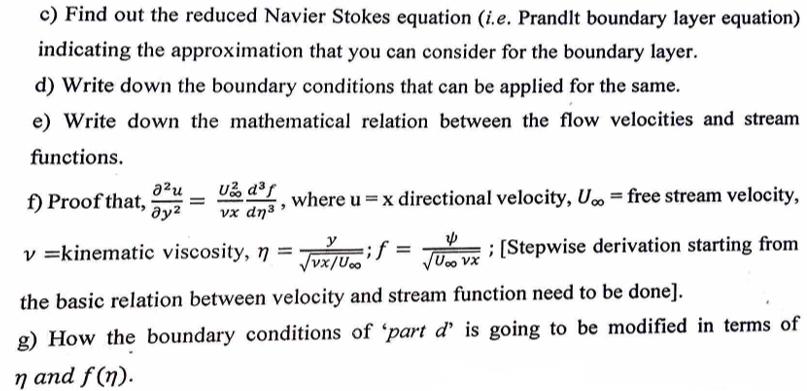
c Find out the reduced Navier Stokes equation ie Prandlt boundary layer equation indicating the approximation that you can consider for the boundary layer.
d Write down the boundary conditions that can be applied for the same.
e Write down the mathematical relation between the flow velocities and stream functions.
f Proof that, where directional velocity, free stream velocity, kinematic viscosity, ;; Stepwise derivation starting from the basic relation between velocity and stream function need to be done
g How the boundary conditions of 'part is going to be modified in terms of and
Step by Step Solution
There are 3 Steps involved in it
1 Expert Approved Answer
Step: 1 Unlock

Question Has Been Solved by an Expert!
Get step-by-step solutions from verified subject matter experts
Step: 2 Unlock
Step: 3 Unlock