







Question: C++ language C++ language PROGRAMMIING ENGINEERING PROBLEMS Problem 1: Wind Tunnels. A wind tunnel is a test chamber built to generate different wind speeds or
C++ language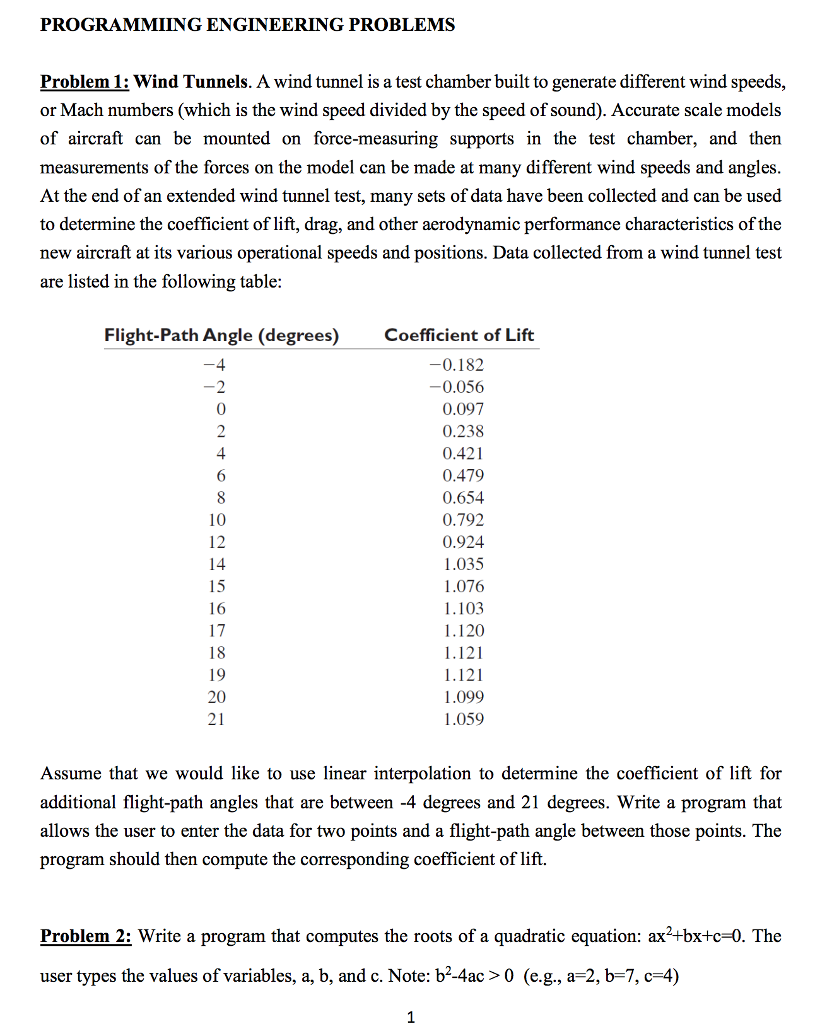
 C++ language
PROGRAMMIING ENGINEERING PROBLEMS Problem 1: Wind Tunnels. A wind tunnel is a test chamber built to generate different wind speeds or Mach numbers (which is the wind speed divided by the speed of sound). Accurate scale models of aircraft can be mounted on force-measuring supports in the test chamber, and then measurements of the forces on the model can be made at many different wind speeds and angles At the end of an extended wind tunnel test, many sets of data have been collected and can be used to determine the coefficient of lift, drag, and other aerodynamic performance characteristics of the new aircraft at its various operational speeds and positions. Data collected from a wind tunnel test are listed in the following table: Flight-Path Angle (degrees) Coefficient of Lift 0.182 0.056 0.097 0.238 0.421 0.479 0.654 0.792 0.924 1.035 1.076 1.103 1.120 1.121 1.121 1.099 1.059 0 10 12 15 16 17 18 19 20 21 Assume that we would like to use linear interpolation to determine the coefficient of lift for additional flight-path angles that are between -4 degrees and 21 degrees. Write a program that allows the user to enter the data for two points and a flight-path angle between those points. The program should then compute the corresponding coefficient of lift. Problem 2: Write a program that computes the roots of a quadratic equation: ax2+bxtc-0. The user types the values of variables, a, b, and c. Note: b2-4ac >0 (e.g., a-2, b-7, c-4) PROGRAMMIING ENGINEERING PROBLEMS Problem 1: Wind Tunnels. A wind tunnel is a test chamber built to generate different wind speeds or Mach numbers (which is the wind speed divided by the speed of sound). Accurate scale models of aircraft can be mounted on force-measuring supports in the test chamber, and then measurements of the forces on the model can be made at many different wind speeds and angles At the end of an extended wind tunnel test, many sets of data have been collected and can be used to determine the coefficient of lift, drag, and other aerodynamic performance characteristics of the new aircraft at its various operational speeds and positions. Data collected from a wind tunnel test are listed in the following table: Flight-Path Angle (degrees) Coefficient of Lift 0.182 0.056 0.097 0.238 0.421 0.479 0.654 0.792 0.924 1.035 1.076 1.103 1.120 1.121 1.121 1.099 1.059 0 10 12 15 16 17 18 19 20 21 Assume that we would like to use linear interpolation to determine the coefficient of lift for additional flight-path angles that are between -4 degrees and 21 degrees. Write a program that allows the user to enter the data for two points and a flight-path angle between those points. The program should then compute the corresponding coefficient of lift. Problem 2: Write a program that computes the roots of a quadratic equation: ax2+bxtc-0. The user types the values of variables, a, b, and c. Note: b2-4ac >0 (e.g., a-2, b-7, c-4)
Step by Step Solution
There are 3 Steps involved in it

Get step-by-step solutions from verified subject matter experts
 Study Help