







Question: (c) Now consider a general covariance matrix 2 E Rd! that is not necessarily equal to the identity Id. Reduce the problem to the identity
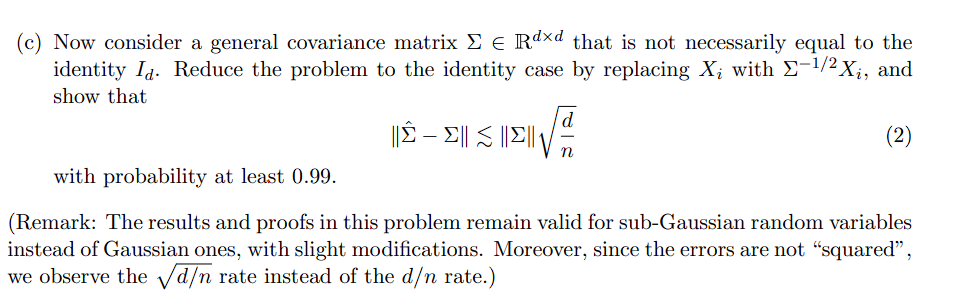
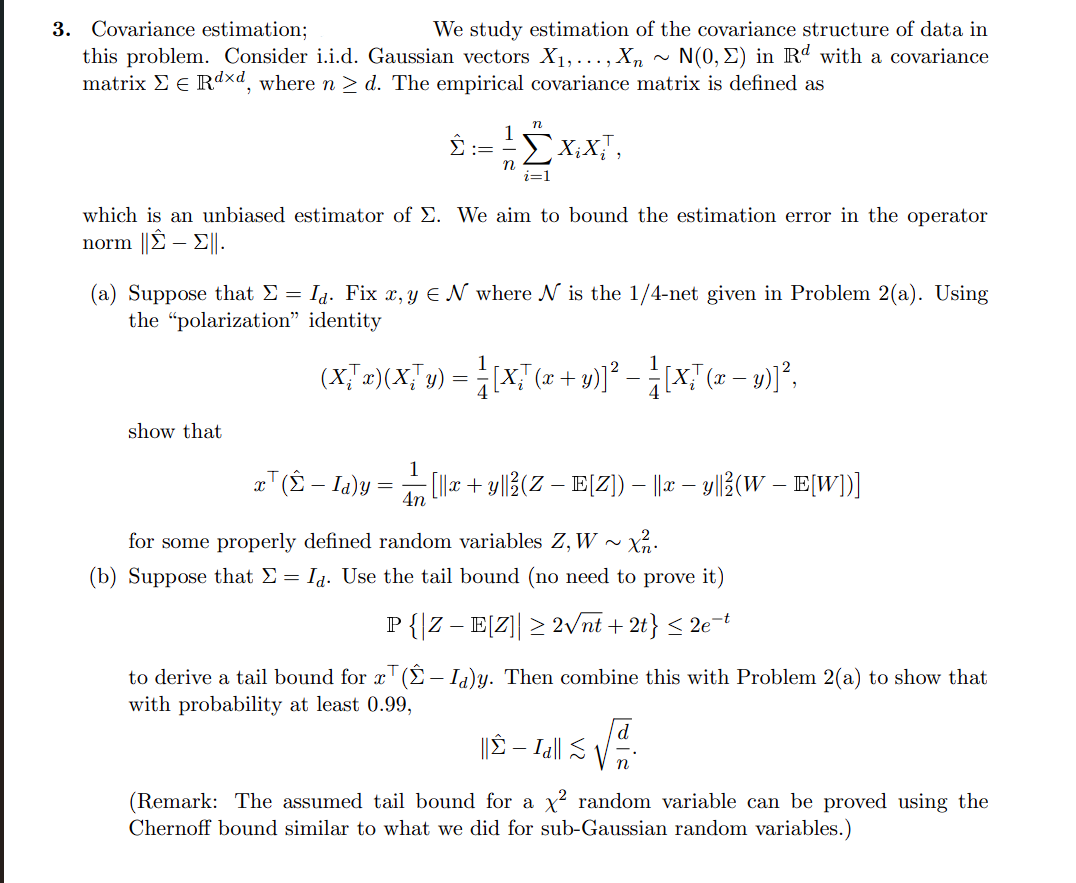
(c) Now consider a general covariance matrix 2 E Rd\"! that is not necessarily equal to the identity Id. Reduce the problem to the identity case by replacing X;- with 2-1/2Xi, and show that A d HE - 2II S HEM/g (2) (Remark: The results and proofs in this problem remain valid for sub-Gaussian random variables instead of Gaussian onesJ with slight modications. MoreoverJ since the errors are not \"squared\3. Covariance estimation; We study estimation of the covariance structure of data in this problem. Consider i.i.d. Gaussian vectors X1, ..., Xn ~ N(0, E) in R with a covariance matrix E E Rdxd, where n 2 d. The empirical covariance matrix is defined as E := CXXI, i=1 which is an unbiased estimator of E. We aim to bound the estimation error in the operator norm ||E - EI. (a) Suppose that E = Ia. Fix x, y EN where N is the 1/4-net given in Problem 2(a). Using the "polarization" identity ( x x ) ( X,y) =[x. (x+3)12 - 4[x.(x-3)12, show that (E - Ia)y = [lla+ yl13(Z -E[Z]) - 1/x - yl13(W -E[W])] for some properly defined random variables Z, W ~ Xn. (b) Suppose that E = Ia. Use the tail bound (no need to prove it) P { | Z - E[Z] | 2 2 Vnt + 2t)
Step by Step Solution
There are 3 Steps involved in it

Get step-by-step solutions from verified subject matter experts
 Study Help