







Question: c++ :( num1, num2, num3 )(max* ) : ! Is the prototype for function max.a O Is the header for function max.bo Is a declaration
c++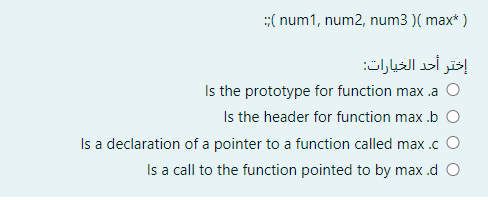
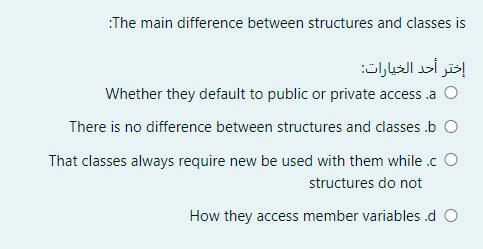
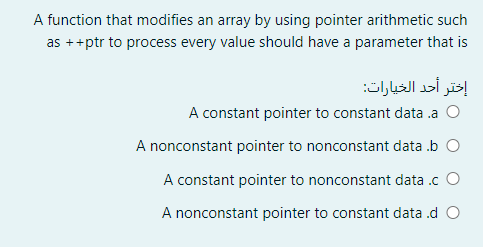
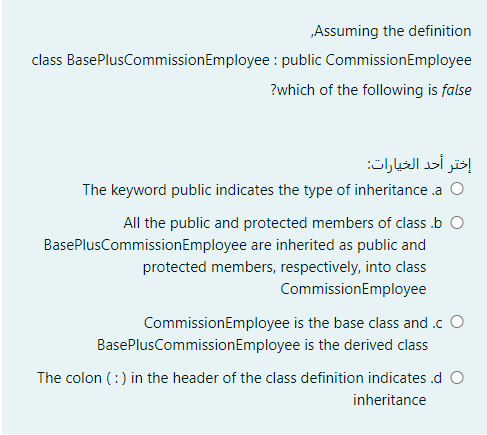
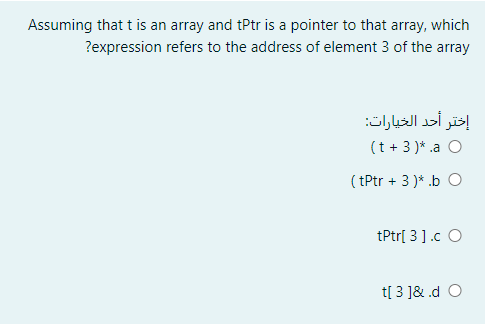
:( num1, num2, num3 )(max* ) : ! Is the prototype for function max.a O Is the header for function max.bo Is a declaration of a pointer to a function called max.co Is a call to the function pointed to by max.d O :The main difference between structures and classes is ! Whether they default to public or private access. O There is no difference between structures and classes .b O That classes always require new be used with them while.co structures do not How they access member variables.do A function that modifies an array by using pointer arithmetic such as ++ptr to process every value should have a parameter that is : :! A constant pointer to constant data .a O A nonconstant pointer to nonconstant data.b O A constant pointer to nonconstant data.co A nonconstant pointer to constant data.do Assuming the definition class BasePlusCommissionEmployee : public CommissionEmployee ?which of the following is false : :! The keyword public indicates the type of inheritance .a O All the public and protected members of class. O BasePlusCommission Employee are inherited as public and protected members, respectively, into class CommissionEmployee Commission Employee is the base class and.co BasePlusCommission Employee is the derived class The colon (:) in the header of the class definition indicates.d O inheritance Assuming that t is an array and tPtr is a pointer to that array, which ?expression refers to the address of element 3 of the array : (t + 3)*.a o (tPtr + 3 )*.b tPtr[3].co t[ 3 ]&.do
Step by Step Solution
There are 3 Steps involved in it

Get step-by-step solutions from verified subject matter experts
 Study Help