







Question: C++ only. Comments would be appriciated. I am really lost with this and would greatly appricate some help. proj06_functions.h has the descroptions of the functions
C++ only. Comments would be appriciated. I am really lost with this and would greatly appricate some help.
proj06_functions.h has the descroptions of the functions being used so please use the functions off of this link:
http://www.cse.msu.edu/~cse232/Weekly/week07/project/proj06_functions.h
**So this file has the layout of what the functions are (name and values in the parantheses). The goal is to create a .cpp file with the extact same functions, but in the .cpp you will write their definitions and what they do. Hope this helps. If not let me know.**
The goal is to create a proj06_funtions.cpp to complie with this and submit both together so that they run. If there are any questions let me know. It is described well in the pictures beloe so pleae just read that and it should be clear.
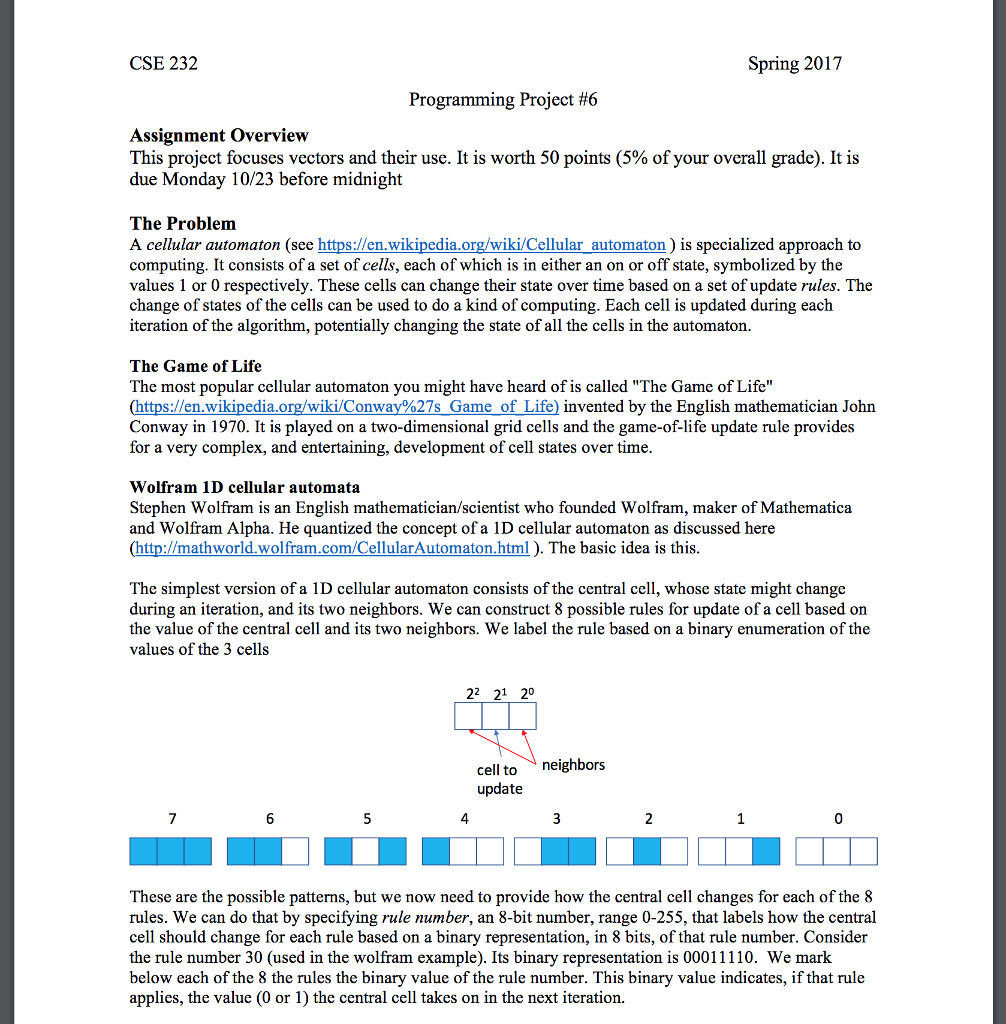
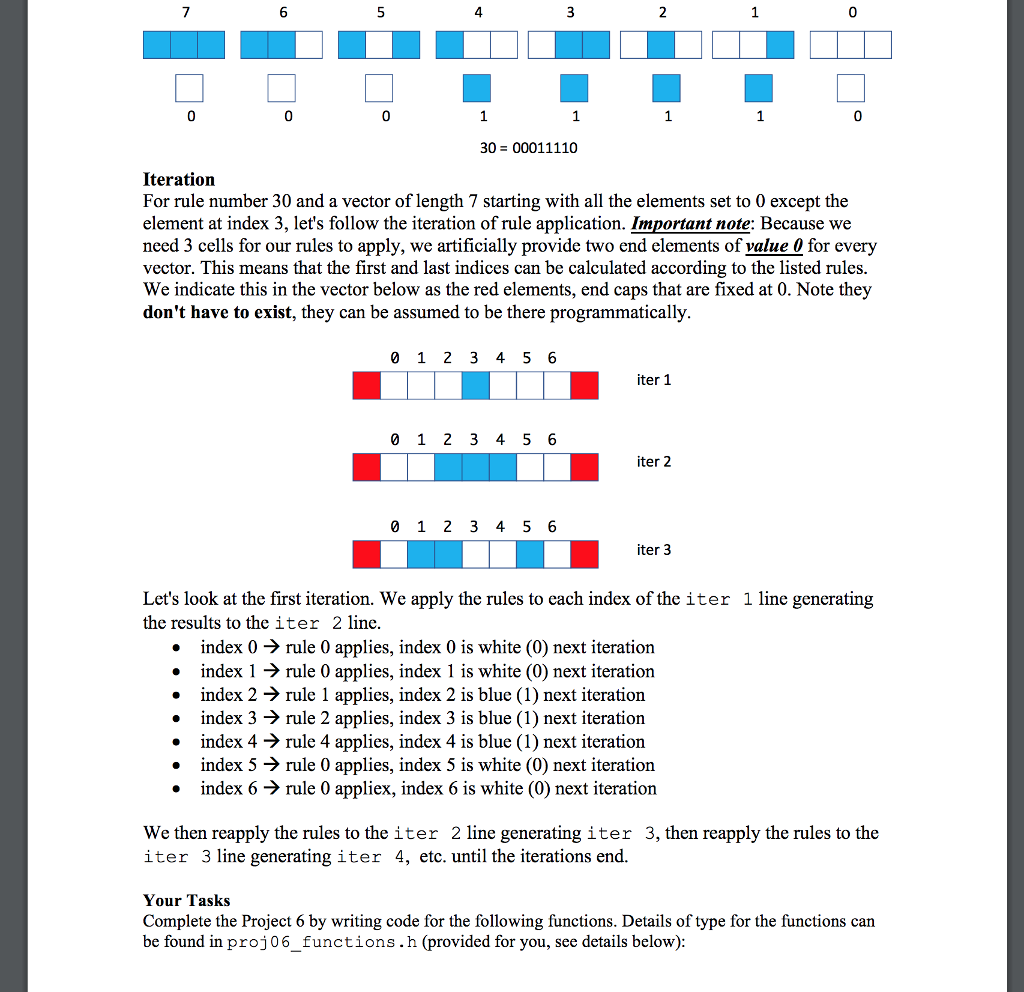
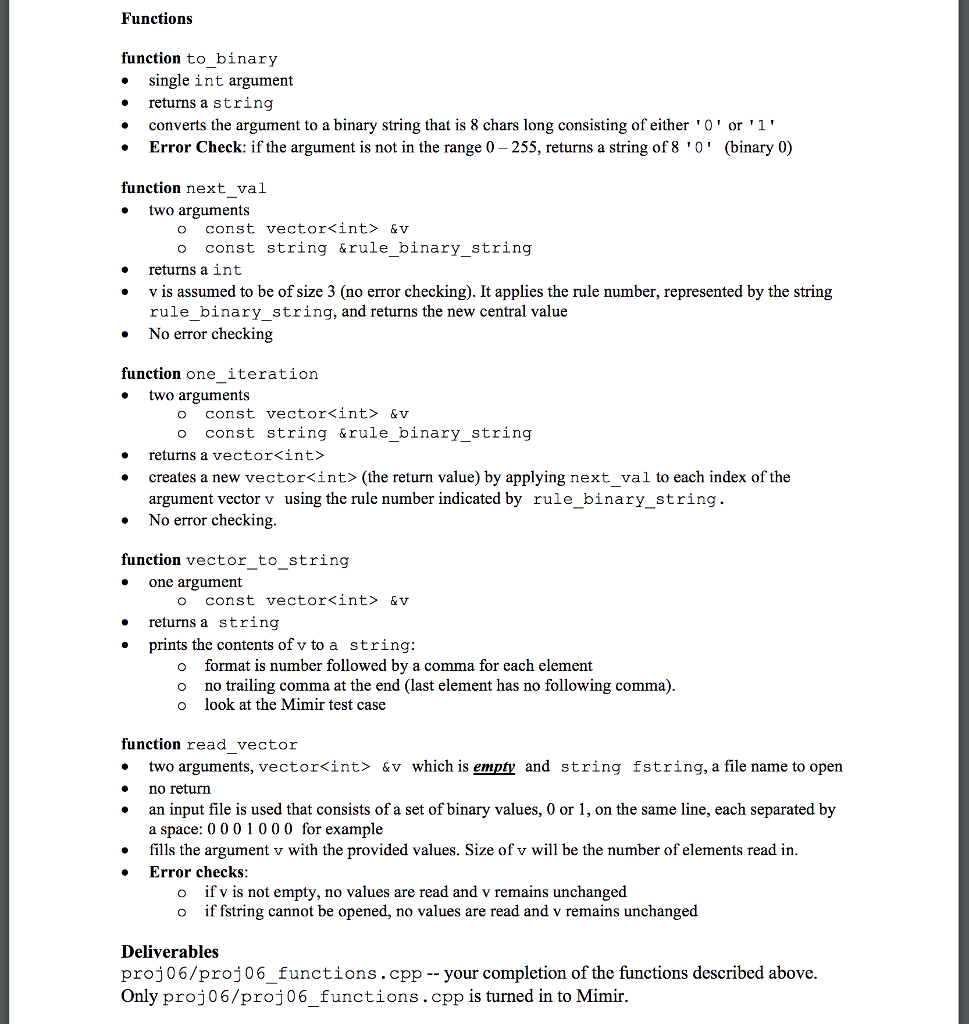
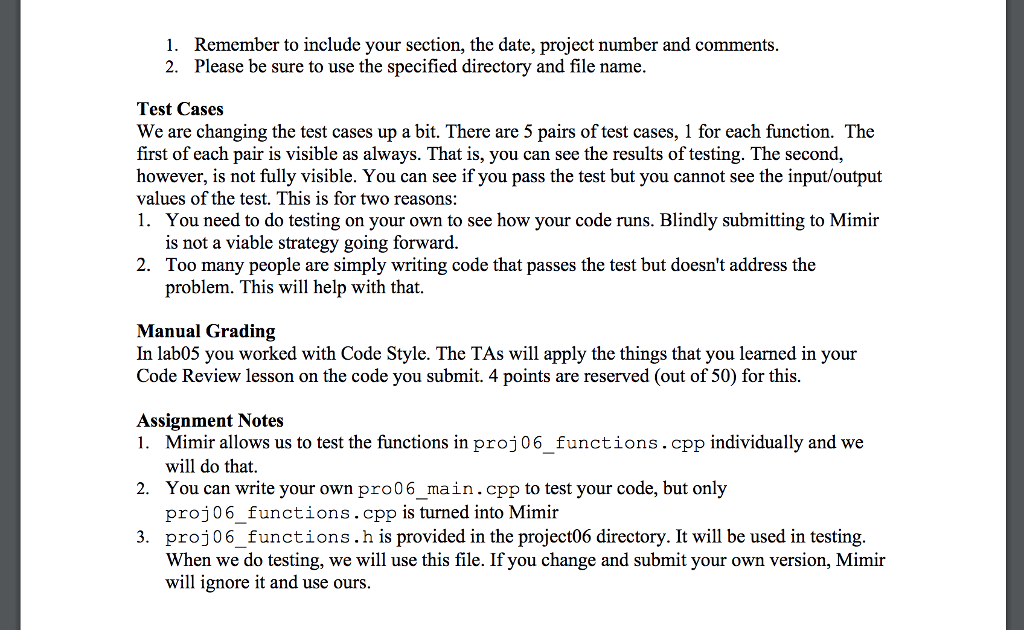
CSE 232 Spring 2017 Programming Project #6 Assignment Overview This project focuses vectors and their use. It is worth 50 points (5% of your overall grade). It is due Monday 10/23 before midnight The Problem A cellular automaton (see https://en.wikipedia.org/wiki/Cellular automaton) is specialized approach to computing. It consists of a set of cells, each of which is in either an on or off state, symbolized by the values 1 or 0 respectively. These cells can change their state over time based on a set of update rules. The change of states of the cells can be used to do a kind of computing. Each cell is updated during each iteration of the algorithm, potentially changing the state of all the cells in the automaton The Game of Life The most popular cellular automaton you might have heard of is called "The Game of Life" (https://en.wikipedia.org/wiki/Conway%27s Game of Life) invented by the English mathematician John Conway in 1970. It is played on a two-dimensional grid cells and the game-of-life update rule provides for a very complex, and entertaining, development of cell states over time Wolfram 1D cellular automata Stephen Wolfram is an English mathematician/scientist who founded Wolfram, maker of Mathematica and Wolfram Alpha. He quantized the concept of a 1D cellular automaton as discussed here (http://mathworld.wolfram.com/CellularAutomaton.html). The basic idea is this The simplest version of a 1D cellular automaton consists of the central cell, whose state might change during an iteration, and its two neighbors. We can construct 8 possible rules for update of a cell based on the value of the central cell and its two neighbors. We label the rule based on a binary enumeration of the values of the 3 cells 22 21 2 cell to neighbors update 0 These are the possible patterns, but we now need to provide how the central cell changes for each of the 8 rules. We can do that by specifying rule number, an 8-bit number, range 0-255, that labels how the central cell should change for each rule based on a binary representation, in 8 bits, of that rule number. Consider the rule number 30 (used in the wolfram example). Its binary representation is 00011110. We mark below each of the 8 the rules the binary value of the rule number. This binary value indicates, if that rule applies, the value (0 or 1) the central cell takes on in the next iteration. CSE 232 Spring 2017 Programming Project #6 Assignment Overview This project focuses vectors and their use. It is worth 50 points (5% of your overall grade). It is due Monday 10/23 before midnight The Problem A cellular automaton (see https://en.wikipedia.org/wiki/Cellular automaton) is specialized approach to computing. It consists of a set of cells, each of which is in either an on or off state, symbolized by the values 1 or 0 respectively. These cells can change their state over time based on a set of update rules. The change of states of the cells can be used to do a kind of computing. Each cell is updated during each iteration of the algorithm, potentially changing the state of all the cells in the automaton The Game of Life The most popular cellular automaton you might have heard of is called "The Game of Life" (https://en.wikipedia.org/wiki/Conway%27s Game of Life) invented by the English mathematician John Conway in 1970. It is played on a two-dimensional grid cells and the game-of-life update rule provides for a very complex, and entertaining, development of cell states over time Wolfram 1D cellular automata Stephen Wolfram is an English mathematician/scientist who founded Wolfram, maker of Mathematica and Wolfram Alpha. He quantized the concept of a 1D cellular automaton as discussed here (http://mathworld.wolfram.com/CellularAutomaton.html). The basic idea is this The simplest version of a 1D cellular automaton consists of the central cell, whose state might change during an iteration, and its two neighbors. We can construct 8 possible rules for update of a cell based on the value of the central cell and its two neighbors. We label the rule based on a binary enumeration of the values of the 3 cells 22 21 2 cell to neighbors update 0 These are the possible patterns, but we now need to provide how the central cell changes for each of the 8 rules. We can do that by specifying rule number, an 8-bit number, range 0-255, that labels how the central cell should change for each rule based on a binary representation, in 8 bits, of that rule number. Consider the rule number 30 (used in the wolfram example). Its binary representation is 00011110. We mark below each of the 8 the rules the binary value of the rule number. This binary value indicates, if that rule applies, the value (0 or 1) the central cell takes on in the next iteration
Step by Step Solution
There are 3 Steps involved in it

Get step-by-step solutions from verified subject matter experts
 Study Help