







Question: C++. Please use functions with concise, but descriptive function names. Not function or variable names like a, b, c, etc. Thank you. 1. No global
C++. Please use functions with concise, but descriptive function names. Not function or variable names like a, b, c, etc. Thank you.
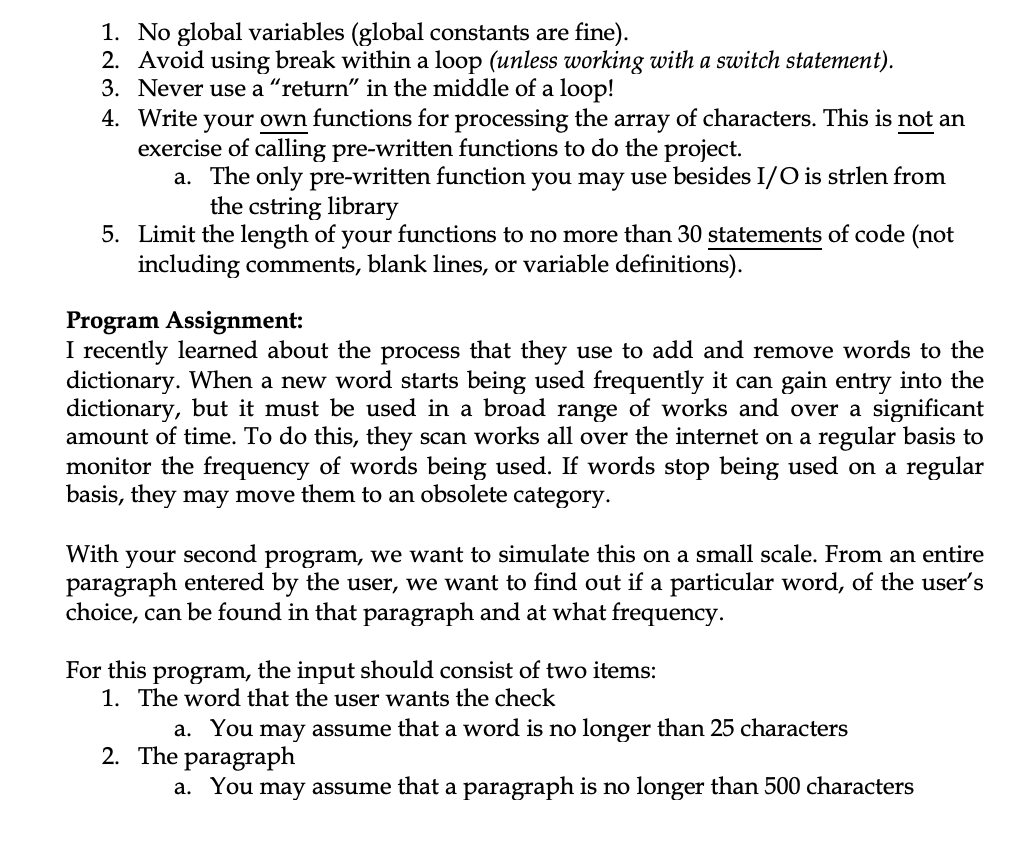
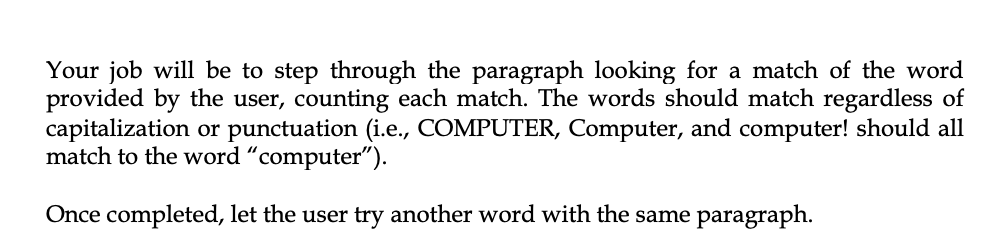
1. No global variables (global constants are fine). 2. Avoid using break within a loop (unless working with a switch statement). 3. Never use a "return" in the middle of a loop! 4. Write your own functions for processing the array of characters. This is not an exercise of calling pre-written functions to do the project. a. The only pre-written function you may use besides I/O is strlen from the cstring library 5. Limit the length of your functions to no more than 30 statements of code (not including comments, blank lines, or variable definitions). Program Assignment: I recently learned about the process that they use to add and remove words to the dictionary. When a new word starts being used frequently it can gain entry into the dictionary, but it must be used in a broad range of works and over a significant amount of time. To do this, they scan works all over the internet on a regular basis to monitor the frequency of words being used. If words stop being used on a regular basis, they may move them to an obsolete category. With your second program, we want to simulate this on a small scale. From an entire paragraph entered by the user, we want to find out if a particular word, of the user's choice, can be found in that paragraph and at what frequency. For this program, the input should consist of two items: 1. The word that the user wants the check a. You may assume that a word is no longer than 25 characters 2. The paragraph a. You may assume that a paragraph is no longer than 500 characters Your job will be to step through the paragraph looking for a match of the word provided by the user, counting each match. The words should match regardless of capitalization or punctuation (i.e., COMPUTER, Computer, and computer! should all match to the word "computer). Once completed, let the user try another word with the same paragraph. 1. No global variables (global constants are fine). 2. Avoid using break within a loop (unless working with a switch statement). 3. Never use a "return" in the middle of a loop! 4. Write your own functions for processing the array of characters. This is not an exercise of calling pre-written functions to do the project. a. The only pre-written function you may use besides I/O is strlen from the cstring library 5. Limit the length of your functions to no more than 30 statements of code (not including comments, blank lines, or variable definitions). Program Assignment: I recently learned about the process that they use to add and remove words to the dictionary. When a new word starts being used frequently it can gain entry into the dictionary, but it must be used in a broad range of works and over a significant amount of time. To do this, they scan works all over the internet on a regular basis to monitor the frequency of words being used. If words stop being used on a regular basis, they may move them to an obsolete category. With your second program, we want to simulate this on a small scale. From an entire paragraph entered by the user, we want to find out if a particular word, of the user's choice, can be found in that paragraph and at what frequency. For this program, the input should consist of two items: 1. The word that the user wants the check a. You may assume that a word is no longer than 25 characters 2. The paragraph a. You may assume that a paragraph is no longer than 500 characters Your job will be to step through the paragraph looking for a match of the word provided by the user, counting each match. The words should match regardless of capitalization or punctuation (i.e., COMPUTER, Computer, and computer! should all match to the word "computer). Once completed, let the user try another word with the same paragraph
Step by Step Solution
There are 3 Steps involved in it

Get step-by-step solutions from verified subject matter experts
 Study Help