







Question: C Programming: #include #include strlib.h void check_compare (char* a, char* b) { if (!my_strcmp (a, b)) { printf (Strings match! ); } else { printf
C Programming:
#include
void check_compare (char* a, char* b) { if (!my_strcmp (a, b)) { printf ("Strings match! "); } else { printf ("Strings DONT match! "); } }
int main (int argc, char** argv) { char foo[] = "Foo"; char empty[] = ""; char str1[] = "ECE Programmers are the best!"; char str2[] = "ECE Programmers are the best!";
printf (" length of foo: %i ", my_strlen(foo)); printf ("length of empty: %i ", my_strlen(empty)); printf (" length of str1: %i ", my_strlen(str1)); printf (" length of str2: %i ", my_strlen(str2));
printf ("----------------------- "); printf ("Comparing foo to empty: "); check_compare (foo, empty); printf ("Comparing str1 to str2: "); check_compare (str1, str2);
return 0; }
Need 3 files:
strlib.h
strlib.c
test.c
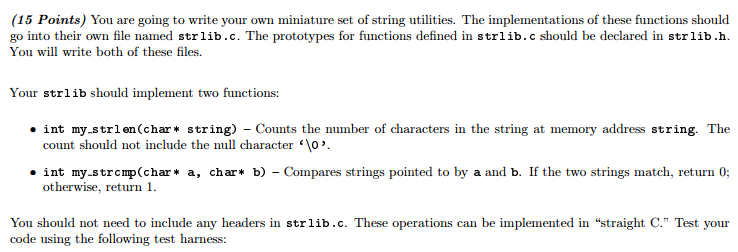
(15 Points You are going to write your own miniature set of string utilities. The implementations of these functions should go into their own file named strlib.c. The prototypes for functions defined in strlib.c should be declared in strlib.h. You will write both of these files. our str ib should implement two functions int my-strlen char string) Counts the number of characters in the string at memory address string. The count should not include the null character "Vo int my-strcmp(char a, char b) Compares strings pointed to by a and b. If the two strings match, return 0 otherwise, return 1. You should not need to include any headers in strlib.c. ese operations can be implemented in "straight C." Test your code using the following test harness
Step by Step Solution
There are 3 Steps involved in it

Get step-by-step solutions from verified subject matter experts
 Study Help